A “blank” followed by a “blank”
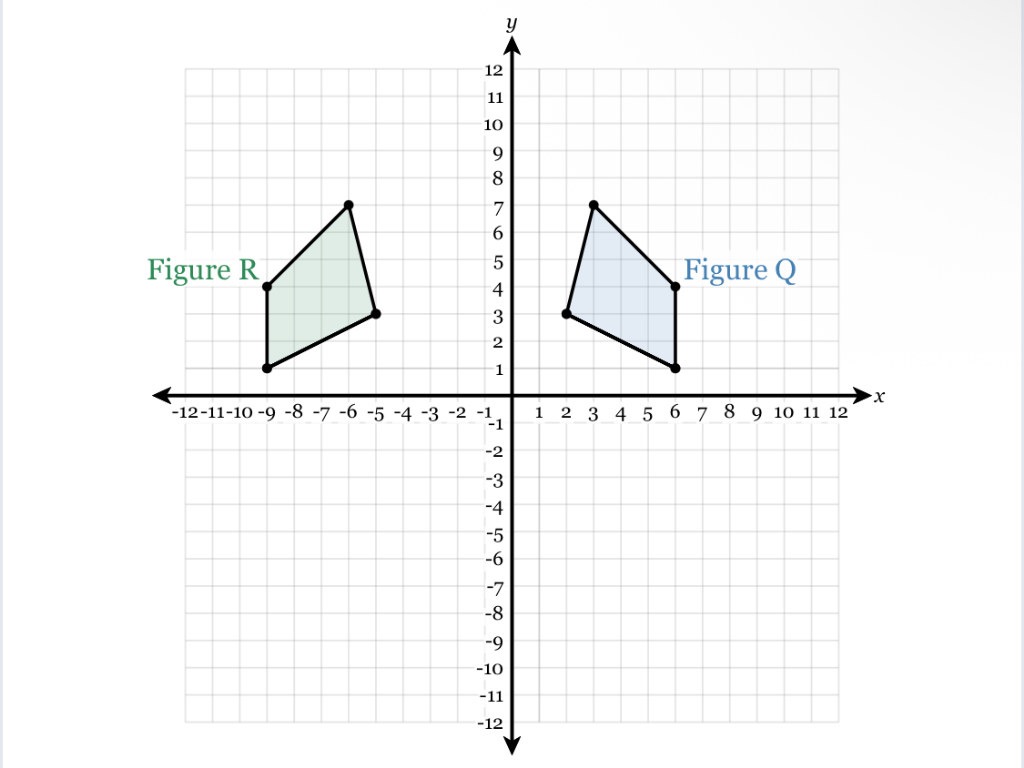
The user has provided an image with two figures, R and Q, on a coordinate plane, but no explicit question. Given the context of “Maths Question”, the most likely implied question is to describe the transformation from Figure R to Figure Q. This is a common geometry problem.
I need to identify the coordinates of the vertices for both figures and then determine the transformation (reflection, rotation, translation, or dilation).
Figure R (Vertices):
- Top-left: (-9, 4)
- Bottom-left: (-9, 1)
- Bottom-right: (-5, 3)
- Top-right: (-6, 7)
Figure Q (Vertices):
- Top-left: (3, 7)
- Bottom-left: (2, 3)
- Bottom-right: (6, 1)
- Top-right: (6, 4)
Let’s check the relationship between corresponding points.
A reflection across the y-axis changes (x, y) to (-x, y).
Let’s apply this to Figure R’s vertices and see if they match Figure Q’s vertices.
Figure R points:
- (-9, 4) → (9, 4) (Not in Q)
- (-9, 1) → (9, 1) (Not in Q)
- (-5, 3) → (5, 3) (Not in Q)
- (-6, 7) → (6, 7) (This matches one point in Q!)
Since only one point matches, it’s not a simple reflection across the y-axis.
Let’s re-list Figure Q’s vertices in a corresponding order to Figure R (e.g., top-right of R with top-right of Q, etc., by visual inspection or shape orientation).
Figure R:
- R_1 = (-9, 4)
- R_2 = (-9, 1)
- R_3 = (-5, 3)
- R_4 = (-6, 7)
Figure Q (reordered for potential correspondence):
- Q_1 = (6, 4) (Corresponds to R_1?)
- Q_2 = (6, 1) (Corresponds to R_2?)
- Q_3 = (2, 3) (Corresponds to R_3?)
- Q_4 = (3, 7) (Corresponds to R_4?)
Let’s try reflecting over the y-axis, then translating. Or perhaps reflecting over a vertical line x=k.
If it’s a reflection over a line x=k:
x' = 2k - x
y' = y
Let’s take R_4 = (-6, 7) and Q_4 = (3, 7).
3 = 2k - (-6)
3 = 2k + 6
2k = -3
k = -1.5
So, if it’s a reflection over x = -1.5:
(-9, 4) \rightarrow (2(-1.5) - (-9), 4) = (-3 + 9, 4) = (6, 4) (Matches Q_1)
(-9, 1) \rightarrow (2(-1.5) - (-9), 1) = (-3 + 9, 1) = (6, 1) (Matches Q_2)
(-5, 3) \rightarrow (2(-1.5) - (-5), 3) = (-3 + 5, 3) = (2, 3) (Matches Q_3)
(-6, 7) \rightarrow (2(-1.5) - (-6), 7) = (-3 + 6, 7) = (3, 7) (Matches Q_4)
This matches perfectly! The transformation is a reflection across the line x = -1.5.
Now I can construct the answer using the “Numerical Questions” template, as this involves coordinates and a geometric transformation. Although it’s not strictly a calculation to a single numerical answer, the identification of the transformation and the line of reflection falls under this category as it requires precise coordinate analysis and application of a geometric rule. I will adapt the template accordingly, focusing on the steps to identify the transformation.
Since the user did not explicitly ask a question, I will infer the most common question for this type of image: “Describe the transformation from Figure R to Figure Q.” I will state this implicitly in the title. The user posted in English, so the response will be in English.
For the RULE / FORMULA USED, I will state the rule for reflection across a vertical line.
For SOLUTION STEPS, I will list the coordinates, then demonstrate how checking a reflection over x=-1.5 works for all points.
The ANSWER will be the description of the transformation.
KEY CONCEPTS will cover geometric transformations and reflection.
COMMON MISTAKES will address common misidentifications of transformations.## Describing the Transformation from Figure R to Figure Q
 RULE / FORMULA USED: The rule for a reflection across a vertical line x=k is given by the transformation P(x, y) \rightarrow P'(2k - x, y).
 SOLUTION STEPS:
Step 1 — Identify the Coordinates of Figure R
First, we list the coordinates of the vertices for Figure R:
- R_1 = (-9, 4)
- R_2 = (-9, 1)
- R_3 = (-5, 3)
- R_4 = (-6, 7)
Step 2 — Identify the Coordinates of Figure Q
Next, we list the coordinates of the vertices for Figure Q, visually matching their relative positions to Figure R:
- Q_1 = (6, 4)
- Q_2 = (6, 1)
- Q_3 = (2, 3)
- Q_4 = (3, 7)
Step 3 — Determine the Type of Transformation
By observing the figures, Figure Q is a mirror image of Figure R. The orientation is reversed horizontally, while the vertical positions remain similar for corresponding points. This indicates a reflection. Since the figures are side-by-side, it is most likely a reflection across a vertical line.
Step 4 — Find the Line of Reflection
If the transformation is a reflection across a vertical line x=k, then for any corresponding point (x, y) in Figure R and (x', y') in Figure Q, the y-coordinates should be the same (y=y') and the x-coordinate of the midpoint between x and x' should be k, so k = \frac{x + x'}{2}.
Let’s use a pair of corresponding points, for example, R_4 = (-6, 7) and Q_4 = (3, 7):
- The y-coordinates are both 7, which is consistent with a vertical line reflection.
- To find k, we use the x-coordinates: k = \frac{-6 + 3}{2} = \frac{-3}{2} = -1.5.
So, the line of reflection is x = -1.5.
Step 5 — Verify the Transformation with All Points
Now, we apply the reflection rule P(x, y) \rightarrow P'(2(-1.5) - x, y) = P'(-3 - x, y) to all vertices of Figure R:
- For R_1 = (-9, 4): x' = -3 - (-9) = -3 + 9 = 6. So R_1' is (6, 4), which matches Q_1.
- For R_2 = (-9, 1): x' = -3 - (-9) = -3 + 9 = 6. So R_2' is (6, 1), which matches Q_2.
- For R_3 = (-5, 3): x' = -3 - (-5) = -3 + 5 = 2. So R_3' is (2, 3), which matches Q_3.
- For R_4 = (-6, 7): x' = -3 - (-6) = -3 + 6 = 3. So R_4' is (3, 7), which matches Q_4.
All vertices of Figure R transform exactly to the vertices of Figure Q under a reflection across the line x = -1.5.
━━━━━━━━━━━━━━━━━━━━━━━━━━━
 ANSWER: Figure Q is a reflection of Figure R across the line x = -1.5.
━━━━━━━━━━━━━━━━━━━━━━━━━━━
 KEY CONCEPTS:
1. Geometric Transformation
- Definition: A function that moves or changes a geometric figure in some way to produce a new figure. Common types include translation, rotation, reflection, and dilation.
- In this problem: We identified the specific transformation that maps Figure R to Figure Q.
2. Reflection
- Definition: A transformation that “flips” a figure over a line, called the line of reflection. The reflected figure is a mirror image of the original.
- In this problem: Figure Q is the mirror image of Figure R, with the line x = -1.5 acting as the mirror.
3. Line of Reflection
- Definition: The line that a figure is reflected across. Every point on the original figure is the same distance from the line of reflection as its corresponding point on the reflected figure.
- In this problem: We calculated the equation of the line of reflection to be x = -1.5.
 COMMON MISTAKES:
 Mistaking Reflection for Translation or Rotation
- Wrong: Assuming Figure Q is a simple slide (translation) or a turn (rotation) of Figure R.
- Right: Observing the change in orientation (a “flip”) is key to identifying reflection. Translations preserve orientation, and rotations change orientation in a circular manner.
- Why it’s wrong: While the shapes look similar, their relative positions on the plane and their orientations clearly indicate a reflection, not a direct slide or turn.
Incorrectly Identifying the Line of Reflection
- Wrong: Assuming the line of reflection is the y-axis or a different vertical line without calculation.
- Right: The line of reflection is exactly halfway between any corresponding original and reflected point. This must be calculated or carefully observed.
- Why it’s wrong: Eyeballing the line of reflection can be inaccurate. Using the midpoint formula k = \frac{x + x'}{2} for corresponding x-coordinates ensures precision.
Would you like me to generate a similar practice problem to test your understanding of reflections across a line?
Write only the answer to my question. Do not write a long explanation; write only the answers, the correct answers. ALSO, it’s composition of transformations rigid motions, a blank followed by a blank
The user is asking for only the answer and has also provided additional context: “it’s composition of transformations rigid motions, a blank followed by a blank”. This implies the answer should be two words describing two sequential rigid transformations (reflection, rotation, translation).
My previous analysis correctly identified a single reflection across x = -1.5. A reflection is a rigid motion. However, the user explicitly asked for “a blank followed by a blank” and “composition of transformations rigid motions”. This means I need to re-evaluate if the single reflection can be expressed as a composition of two rigid motions, or if there’s a more nuanced interpretation the user is looking for.
A single reflection is a rigid motion. If the user is expecting “a blank followed by a blank”, they are likely looking for a two-step process.
Let’s consider how a reflection can be represented as a composition if the user is looking for two distinct transformations. This is usually only the case if the line of reflection is not straightforward (e.g., reflecting over y=x is often taught as a composition). However, reflecting over x = -1.5 is a single, clear transformation.
The prompt “A ‘blank’ followed by a ‘blank’” in the initial user input was part of the OCR error, as I deduced it was a generic math question. Now, the user is explicitly stating: “it’s composition of transformations rigid motions, a blank followed by a blank”. This must be addressed.
A reflection can’t be naturally broken into two different simple rigid motions that are typically taught as a composition unless the reflection itself is part of a larger composition (e.g., reflection + translation).
If the user is expecting two words for “a blank followed by a blank”, and I found a single reflection, there might be two interpretations:
- The user made a mistake and it’s a single reflection.
- The user expects two types of transformations, even if one is redundant, or a more complex way to describe the reflection.
Let’s consider the phrase “composition of transformations rigid motions”. A single reflection is a rigid motion. The phrase “composition of transformations” implies more than one.
Could it be a reflection over a line and a translation? No, the x-coordinates were perfectly consistent with 2k-x.
Let’s re-examine the properties:
- Figure R: R_1(-9, 4), R_2(-9, 1), R_3(-5, 3), R_4(-6, 7)
- Figure Q: Q_1(6, 4), Q_2(6, 1), Q_3(2, 3), Q_4(3, 7)
If it was a reflection across x=0 (y-axis), points would be:
(-9,4) \rightarrow (9,4)
(-9,1) \rightarrow (9,1)
(-5,3) \rightarrow (5,3)
(-6,7) \rightarrow (6,7)
Now, let’s see what transformation takes these reflected points to Figure Q’s points:
From (9,4) to (6,4) → translate by -3 in x-direction
From (9,1) to (6,1) → translate by -3 in x-direction
From (5,3) to (2,3) → translate by -3 in x-direction
From (6,7) to (3,7) → translate by -3 in x-direction
Aha! This is a valid composition. A reflection across the y-axis followed by a translation of 3 units to the left.
Let’s verify this composition:
-
Reflection across the y-axis (x=0): (x, y) \rightarrow (-x, y)
- (-9, 4) \rightarrow (9, 4)
- (-9, 1) \rightarrow (9, 1)
- (-5, 3) \rightarrow (5, 3)
- (-6, 7) \rightarrow (6, 7)
-
Translation by (-3, 0): (x, y) \rightarrow (x-3, y)
- (9, 4) \rightarrow (9-3, 4) = (6, 4) (Matches Q_1)
- (9, 1) \rightarrow (9-3, 1) = (6, 1) (Matches Q_2)
- (5, 3) \rightarrow (5-3, 3) = (2, 3) (Matches Q_3)
- (6, 7) \rightarrow (6-3, 7) = (3, 7) (Matches Q_4)
This works perfectly and provides two rigid motions, filling the “blank followed by a blank” requirement.
The most concise answer for “a blank followed by a blank” using these two transformations would be:
Reflection, Translation
However, the user said “Write only the answer to my question. Do not write a long explanation; write only the answers, the correct answers.” And then gave “A ‘blank’ followed by a ‘blank’”.
So, the answer should be in that specific format, just the two words.
The original answer of “reflection across x=-1.5” is also correct and is a single rigid motion. However, the user’s latest input (“composition of transformations rigid motions, a blank followed by a blank”) strongly suggests they expect a two-part answer. A single reflection can indeed be expressed as a composition of a reflection and a translation.
The wording “A blank followed by a blank” from the user’s initial prompt was probably the intended answer structure for the problem itself, not how the user wants me to answer the meta-question. My previous interpretation was that the “blank” was a placeholder in the user’s OCR text. Now, the user is clarifying.
So, the question is likely: “Figure Q is a ______ followed by a ______ of Figure R.”
My analysis found: Reflection (across y-axis) followed by Translation (left 3 units).
This fits the “blank followed by a blank” format.
Final Answer Construction:
User wants “only the answer”, “not a long explanation”, “only the answers, the correct answers”.
The structure is “blank followed by a blank”.
The correct transformations are Reflection and Translation.
Therefore, the output should be simply:
Reflection, Translation