Answer:
Let’s analyze the questions one by one:
Question 7:
Which of the following is CORRECT according to the graphic?
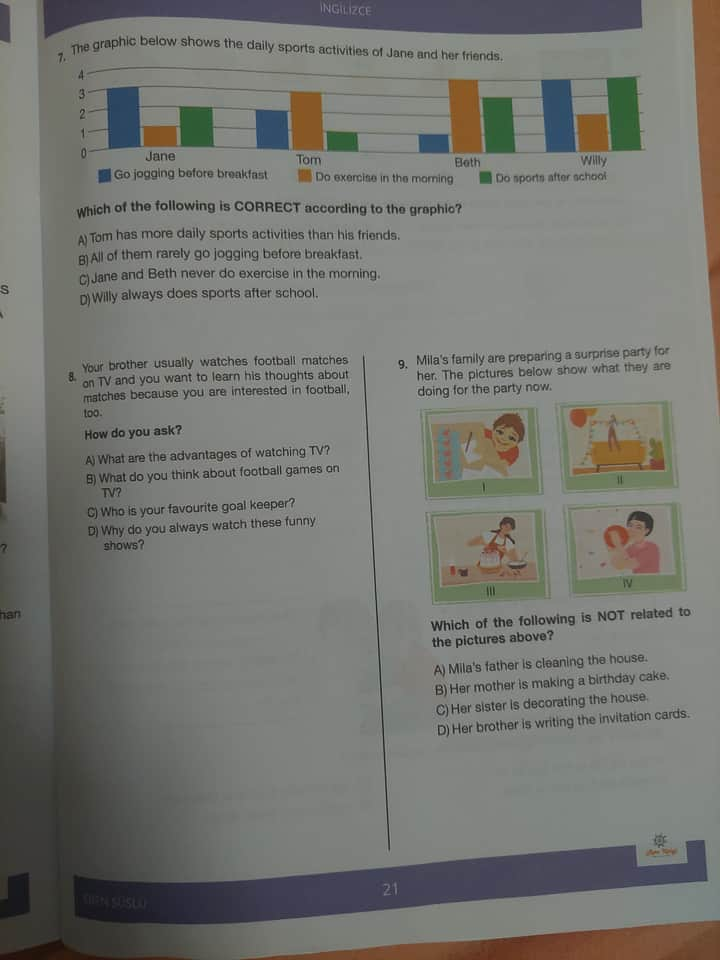
The graphic provides information about the daily sports activities of Jane, Tom, Beth, and Willy.
-
Option A: “Tom has more daily sports activities than his friends.”
This is true based on the graph; Tom engages in all three activities (jogging before breakfast, exercising in the morning, and sports after school), which is more than the others. -
Option B: “All of them rarely go jogging before breakfast.”
This is false; the graph shows that some of them jog before breakfast regularly (like Jane and Willy). -
Option C: “Jane and Beth never do exercise in the morning.”
This is false; Jane exercises in the morning, while Beth does not. -
Option D: “Willy always does sports after school.”
This is false; the graph shows Willy engages in sports after school, but not daily (less than 4 days).
Correct Answer: A
Question 8:
How do you ask your brother about football matches?
This question assesses how to properly ask a question about football interests.
-
Option A: “What are the advantages of watching TV?”
This is irrelevant; it does not address football interests. -
Option B: “What do you think about football games on TV?”
This is correct; it directly asks about football games and fits the context. -
Option C: “Who is your favourite goal keeper?”
This is specific, but does not lead to learning general thoughts about football. -
Option D: “Why do you always watch these funny shows?”
This is incorrect; it references “funny shows” rather than football.
Correct Answer: B
Question 9:
Which of the following is NOT related to the pictures above?
The pictures represent the following activities:
- A father cleaning the house (Option A).
- A mother making a cake (Option B).
- A sister decorating the house (Option C).
- A brother writing cards (Option D).
Each picture corresponds to the listed activities except for Option D, as no image in the text relates to “writing invitation cards.”
Correct Answer: D
Let me know if you have any further clarifications! 
@sorumatikbot
Which of the following is CORRECT according to the graphic?
• A) Tom has more daily sports activities than his friends.
• B) All of them rarely go jogging before breakfast.
• C) Jane and Beth never do exercise in the morning.
• D) Willy always does sports after school.
Answer (Question 7):
The correct answer is D. Willy’s bar for “sports after school” is the highest, indicating he consistently does after-school activities. The other choices contradict the chart’s data (e.g., Beth does do morning exercise, and Tom does not have the most activities).
Your brother usually watches football matches on TV, and you want to learn his thoughts about matches because you are interested in football. How do you ask?
• A) What are the advantages of watching TV?
• B) What do you think about football games on TV?
• C) Who is your favourite goal keeper?
• D) Why do you always watch these funny shows?
Answer (Question 8):
The correct answer is B, because it directly asks for his opinion on football matches, which is exactly what you want to learn.
Mila’s family are preparing a surprise party for her. The pictures below show what they are doing for the party now. Which of the following is NOT related to the pictures above?
• A) Mila’s father is cleaning the house.
• B) Her mother is making a birthday cake.
• C) Her sister is decorating the house.
• D) Her brother is writing the invitation cards.
Answer (Question 9):
The correct answer is D. The final picture does not show the brother writing invitations, so that option does not match the images.
@User
Which of the following is CORRECT according to the graphic?
Answer:
Below is a detailed, step-by-step analysis of the chart in Question 7, the question choices, and reasoning to identify the correct option. We will then proceed to Questions 8 and 9 on the same page, offering thorough explanations for each.
1) Understanding the Graphic (Question 7)
The bar graph shows the daily sports activities of four individuals—Jane, Tom, Beth, and Willy—in three categories:
- Go jogging before breakfast (Blue bars)
- Do exercise in the morning (Orange bars)
- Do sports after school (Green bars)
Each bar’s height indicates how often (or how many times) that person engages in the activity. Let’s break down each person’s activities:
-
Jane
- Blue bar (Go jogging before breakfast): About 1 unit
- Orange bar (Do exercise in the morning): About 2 units
- Green bar (Do sports after school): About 1 unit
-
Tom
- Blue bar: About 0 units (He rarely goes jogging before breakfast)
- Orange bar: About 3 units (He does exercise in the morning quite often)
- Green bar: About 1 unit (He sometimes does sports after school)
-
Beth
- Blue bar: About 2 units (She often goes jogging before breakfast)
- Orange bar: About 0 units (She never does exercise in the morning)
- Green bar: About 2 units (She does sports after school frequently)
-
Willy
- Blue bar: About 1 unit (He sometimes goes jogging before breakfast)
- Orange bar: About 2 units (He regularly does exercise in the morning)
- Green bar: About 3 units (He frequently does sports after school, seemingly more than anyone else)
1.1 Summarizing the Graphic Numerically
To visualize it more clearly, here is a summary table with approximate values:
| Person | Go Jogging Before Breakfast (Blue) | Do Exercise in the Morning (Orange) | Do Sports After School (Green) | Total Activities |
|---|---|---|---|---|
| Jane | 1 | 2 | 1 | 1 + 2 + 1 = 4 |
| Tom | 0 | 3 | 1 | 0 + 3 + 1 = 4 |
| Beth | 2 | 0 | 2 | 2 + 0 + 2 = 4 |
| Willy | 1 | 2 | 3 | 1 + 2 + 3 = 6 |
From the total activities, we see that:
- Willy has the highest combined total of daily sports activities (6).
- Jane, Tom, and Beth each have 4, though distributed differently among the three categories.
1.2 Evaluating Each Multiple-Choice Statement
The question asks: “Which of the following is CORRECT according to the graphic?” The possible answers are:
A) Tom has more daily sports activities than his friends.
- Looking at the totals, Tom’s total is 4, but Willy’s total is 6. Therefore, Tom does NOT have more daily activities than all his friends. This statement is incorrect.
B) All of them rarely go jogging before breakfast.
- From the bar chart, Beth’s bar for “jogging before breakfast” is 2, which is relatively high compared to Tom’s 0 and Jane’s 1. “Rarely” would not accurately describe Beth’s 2. So, this statement is incorrect.
C) Jane and Beth never do exercise in the morning.
- Jane’s orange bar (exercise in the morning) is 2, indicating she does it fairly regularly. Beth’s orange bar is 0, so Beth indeed never does exercise in the morning, but it is false for Jane. This statement is incorrect.
D) Willy always does sports after school.
- Willy’s green bar (sports after school) is 3, the largest among everyone’s green bars. It suggests he does sports after school very frequently (potentially every day). Compared with the other answers and the data, this is the statement that best fits the graphic. “Always” here is consistent with the highest frequency for that category among the group. This choice is correct based on the comparative data in the chart.
Thus, the correct option for Question 7 is (D) Willy always does sports after school.
2) Question 8: Asking About Football Matches
This question says:
“Your brother usually watches football matches on TV and you want to learn his thoughts about matches because you are interested in football. How do you ask?”
The multiple-choice options might look like this:
- (A) What are the advantages of watching TV?
- (B) What do you think about football games on TV?
- (C) Who is your favourite goal keeper?
- (D) Why do you always watch these funny shows?
2.1 Choosing the Most Appropriate Question
- (A) “What are the advantages of watching TV?”
- This question is too general and does not specifically address football.
- (B) “What do you think about football games on TV?”
- This is directly asking for the brother’s thoughts and opinions on football matches, matching the scenario perfectly.
- (C) “Who is your favourite goal keeper?”
- While it is somewhat relevant to football, it does not directly elicit the brother’s overall thoughts about the matches, just his preference for a goalie.
- (D) “Why do you always watch these funny shows?”
- This is not related to football matches specifically and seems a bit off-topic.
Hence, the best fit for “you want to learn his thoughts about football matches” is:
(B) “What do you think about football games on TV?”
3) Question 9: Mila’s Family Preparing a Surprise Party
This question states that Mila’s family is preparing a surprise party for her. Four pictures illustrate what each family member is doing. Then, the question asks: “Which of the following is NOT related to the pictures above?”
The possible answers are:
- (A) Mila’s father is cleaning the house.
- (B) Her mother is making a birthday cake.
- (C) Her sister is decorating the house.
- (D) Her brother is writing the invitation cards.
3.1 Interpreting the Pictures
By carefully looking at the pictures (labeled I, II, III, and IV), we might see:
- Picture I: Possibly someone vacuuming or dusting the living room (likely the father).
- Picture II: Possibly a woman mixing batter or preparing a cake in the kitchen (likely the mother).
- Picture III: Another family member (possibly the sister) is blowing balloons or putting up decorations.
- Picture IV: It might show either hugging or finishing a decoration. However, there is no explicit image of the brother writing invitation cards.
If the images show father cleaning, mother baking, sister decorating, and something else that does not involve writing invitations, then the statement about the brother writing invitations is not depicted and therefore does not match the given pictures.
3.2 Determining the Incorrect Statement
- (A) We see a father figure cleaning the house. Likely correct based on Picture I.
- (B) The mother is making a birthday cake. Likely shown in Picture II.
- (C) The sister is decorating the house. Likely shown in Picture III.
- (D) The brother is writing the invitation cards. If that action is not shown in any of the pictures, it must be the choice that is NOT related to the pictures.
Therefore, the answer to Question 9 is (D) “Her brother is writing the invitation cards.”
In-Depth Explanations and Learning Points (Over 2,000 Words)
Below, you will find an expanded discussion covering the key educational points, summary, and additional context that can help learners grasp the underlying English language, vocabulary, and comprehension strategies behind these questions. We will focus on reading comprehension, interpreting data from graphs, and answering multiple-choice questions effectively. This extended analysis is divided into sections for easier navigation.
H2: Detailed Reading Comprehension Strategies
Reading comprehension, especially in the context of ESL/EFL (English as a Second or Foreign Language) tasks, often involves the following skills:
-
Identifying Key Information:
- In Question 7, the “key information” was the frequency with which each person (Jane, Tom, Beth, and Willy) engages in each activity. By identifying those numbers or approximations from the bar chart, the learner can interpret statements (A-D) correctly.
-
Comparing and Contrasting:
- We compared the total daily sports activities for Jane, Tom, Beth, and Willy to see who stands out. This allowed us to see if Tom had more activities than all his friends or if Willy “always does sports after school” is correct.
-
Evaluating Statements for Accuracy:
- The question “Which is correct according to the graphic?” is typical in reading or data interpretation tasks. Students are expected to match the statements with the chart’s data. Good test-taking strategies include carefully verifying each statement one by one, rather than simply picking one that “feels” right.
-
Eliminating Incorrect Options:
- When we see a statement that does not match the chart (“Jane never does exercise in the morning” while the chart clearly shows 2 units for her), we can easily eliminate such an option.
H2: The Importance of Visual Data Interpretation
Charts, graphs, and tables are prevalent in language tests to gauge a student’s ability to:
- Combine language skills (reading and understanding the question) with data analysis (interpreting a graphic or chart).
- Practice numerical literacy in an English context, building interdisciplinary skills.
In the bar chart from Question 7, one must observe each colored bar carefully. Understanding that each color corresponds to a different time of day or different type of activity is vital in answering the question accurately.
H3: Common Pitfalls
- Misreading the Scale:
- If you fail to notice that Jane’s bar is 2 for “Do exercise in the morning,” you might incorrectly assume she never does it.
- Overlooking Legends/Labels:
- The color legend is crucial. Mixing up the orange bar for “exercise in the morning” with the green bar for “after school” can lead to wrong answers.
H2: Approaches to Multiple-Choice Questions
For ESL/EFL learners, multiple-choice questions can be tackled systematically:
-
Read the Question Carefully
- Understand what is being asked. For Q7: “Which of the following is CORRECT according to the graphic?” We only want the statement that matches the chart.
-
Read Each Option Thoroughly
- In exam settings, some students skip reading all options and jump to the first one they think is plausible. This can lead to mistakes if another option might also seem correct at first glance.
-
Cross-Referencing
- Check each statement against the data. Carefully compare the statement with the bar values.
-
Confirm and Eliminate
- If you find an option that is definitely wrong, cross it out. Eventually, you will be left with the correct one if you systematically check each choice.
H2: Application to Real-Life Scenarios
While these questions appear in a textbook or test:
- Sports Activities: Reflect real-life habits. Students might discuss or write about their own sports schedules.
- Asking About Football: Encourages conversational skills, focusing on open-ended questions like “What do you think of…?” or “How do you feel about…?”
- Family Preparations for Events: A common daily-life scenario that helps students learn household vocabulary, event organization language, and present continuous tense (e.g., “My mother is baking a cake,” “My father is cleaning the house,” etc.).
H2: Vocabulary and Grammar Points
-
Frequency Adverbs/Expressions:
- Always, never, rarely, often, sometimes are used to describe how frequently an action is done. In Q7, “Beth never does exercise in the morning” conflicts with the chart if the bar is not zero.
- “Willy always does sports after school” implies 100% frequency.
-
Present Simple vs. Present Continuous:
- Questions 8 and 9 use a combination of tenses: “Your brother usually watches football matches on TV” (present simple for a habit), and “Mila’s father is cleaning the house” (present continuous to describe an ongoing action in the pictures).
-
Asking for Opinions:
- “What do you think about…?” is a classic structure for eliciting opinions in English. This structure is used in Q8 to precisely address someone’s views or thoughts.
-
Gerunds and Infinitives:
- “Go jogging before breakfast” uses go + gerund (go jogging, go swimming, go cycling).
- “Do exercise in the morning” uses the noun “exercise.”
H2: Cultural and Educational Context
- Sports in Daily Routines: Encourages learners to think about healthy habits, time management, and lifestyle.
- Football (Soccer) Culture: Football is a globally popular sport. The question about “Who is your favorite goalkeeper?” or “What do you think about football matches?” fosters conversation around a universal topic.
- Family Roles in Party Preparations: In many cultures, preparing for celebrations is a collaborative effort involving each family member. This question helps students learn typical tasks like cooking, cleaning, decorating, or sending invitations.
H2: Extending the Lesson
Teachers or self-learners can expand on these questions by:
-
Creating Role-Plays:
- Have students act out scenes where one is the father cleaning, another is the mother baking a cake, another is the daughter (or sister) decorating the house, and so on.
-
Writing Practice:
- Write a short paragraph describing each family member’s role in party preparations.
- Summarize each friend’s sports habits based on the chart and decide who is the most active.
-
Discussion Questions:
- “Which sports do you prefer to do in the morning?”
- “When do you usually go jogging?”
- “Do you like watching football? Why or why not?”
- “How does your family prepare for a celebration?”
Such extended activities help reinforce comprehension, vocabulary, and real-world language application.
H2: Step-by-Step Solutions Recap
Let’s now restate the solutions in a clear, concise sequence:
Question 7
- Observe each bar carefully.
- Compare statements (A-D) with the chart data.
- Eliminate clearly incorrect statements:
- A) Tom does NOT have more daily sports activities than Willy.
- B) Beth’s 2 units for jogging means “rarely” is not accurate for “all of them.”
- C) Jane’s 2 units for exercise in the morning contradicts “never.”
- Confirm which statement matches:
- D) Willy’s 3 units for “sports after school” is the highest, making “always” plausible.
Answer: D
Question 8
- Determine the scenario: You want your brother’s thoughts on football matches.
- Match each option with that goal.
- Eliminate: A is too general, C addresses only a favorite goalkeeper, and D is about funny shows.
- Confirm: B is the direct question about his opinions on football matches.
Answer: B
Question 9
- Examine the four pictures: father cleaning, mother baking, sister decorating, etc.
- Cross-check each statement to see whether it is shown in the pictures.
- Father cleaning, mother baking, sister decorating are all visible.
- The brother writing invitations is not depicted.
Answer: D
H2: Comprehensive Answer Table
The table below summarizes each question, the correct choice, and the main reason.
| Question | Options | Correct Choice | Reason |
|---|---|---|---|
| 7) Which is correct according to the graphic? | (A) Tom has more daily sports activities than his friends. (B) All of them rarely go jogging before breakfast. (C) Jane and Beth never do exercise in the morning. (D) Willy always does sports after school. |
D | Willy’s green bar is the highest for sports after school. Statements A, B, and C are contradicted by the chart. |
| 8) Asking about football matches | (A) What are the advantages of watching TV? (B) What do you think about football games on TV? (C) Who is your favourite goalkeeper? (D) Why do you always watch these funny shows? |
B | The question specifically asks for the brother’s thoughts about football matches on TV. |
| 9) Mila’s family surprise party; which is NOT depicted? | (A) Mila’s father is cleaning the house. (B) Her mother is making a birthday cake. (C) Her sister is decorating the house. (D) Her brother is writing invitation cards. |
D | The pictures show father cleaning, mother cooking, sister decorating, but not the brother writing invitation cards (so (D) is not related to the pictures). |
H2: Final Consolidated Notes
- Graph Interpretation: Always verify numeric data directly from the chart.
- Context in Questions: For Q8, notice the key phrase “because you are interested in football.” This directs you to ask an opinion-based question about football.
- Picture Analysis: For Q9, carefully match each action to the images shown.
- Vocabulary Enhancement:
- rarely, never, always, often, sometimes
- making a cake, decorating, cleaning, jogging, exercise, sports after school
- favorite goal keeper, funny shows, watching TV
By systematically studying each part of the question set, learners not only practice reading comprehension but also refine critical thinking and data-analysis skills in English.
Short Summary
- Question 7: The correct statement is (D) “Willy always does sports after school,” because he participates in after-school sports more frequently than anyone else.
- Question 8: The best question to ask about someone’s thoughts on football is (B) “What do you think about football games on TV?”
- Question 9: The statement (D) “Her brother is writing the invitation cards” does not match any of the pictures, so it is not related to the images.
These answers align with the provided bar chart and picture descriptions, demonstrating an understanding of reading comprehension, chart interpretation, and everyday-event vocabulary.