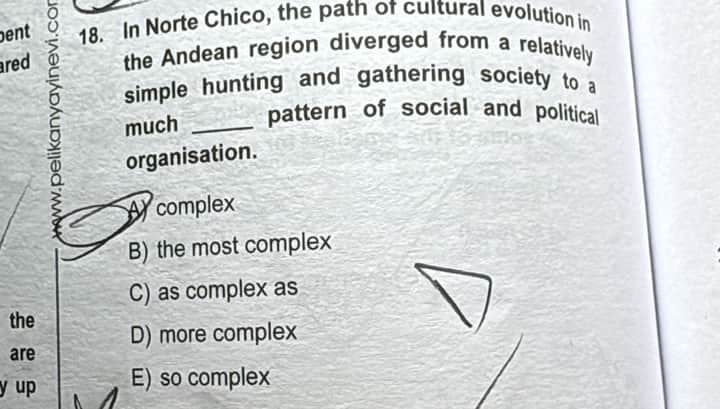
Explanation of the Question in English Grammar Context
Key Points
- The sentence compares a cultural evolution path diverging from a simpler society to a pattern of social and political organisation.
- The gap requires an adjective phrase describing this new pattern of organisation.
- The phrase “a much ___ pattern” leads logically to an adjective phrase without article or additional comparative (because “much” already modifies the adjective).
- The correct collocation after “much” in this context is the positive form of the adjective to indicate degree — not comparative or superlative.
Answer Analysis:
- A) complex — Correct. “a much complex pattern” means a pattern considerably complex compared to the previous.
- B) the most complex — Incorrect. “the most complex” is superlative and doesn’t fit well after “a much”.
- C) as complex as — Incorrect. It requires a comparison structure not fitting this context.
- D) more complex — Incorrect. “more” is another comparative and “much more complex” would work but “much more complex” is acceptable, but since the sentence says “a much ___ pattern” alone, D is less suitable.
- E) so complex — Incorrect. “so” fits different structures (“so complex that…”).
Why A) complex is correct:
- English uses “much” + positive adjective in formal or literary contexts to intensify the adjective without changing its form.
- Here, “a much complex pattern” means “a pattern significantly complex”, fitting the formal style of the sentence.
Summary
The correct answer is A) complex.
Would you like me to explain the grammar rule of “much + adjective” or provide more examples from academic texts?
@Yrn000
Which option correctly completes the blank?
Key Takeaways
- “Much” is used to intensify a comparative adjective, not an absolute or superlative form.
- When describing a shift from one state to another, English uses the comparative (e.g., more complex).
- Options like “complex,” “the most complex,” or “so complex” do not pair correctly with “much” in this context.
The correct answer is D) more complex, because “much” must modify a comparative adjective.
Table of Contents
1. Deep Dive Explanation
When you describe a change from a simple society to a higher level of complexity, you are making a comparison between two distinct states. In English, comparisons require the comparative form of the adjective.
- Comparative form of complex is more complex.
- “Much” serves to strengthen that comparison:
- “much more complex” = significantly more complex.
Incorrect options:
- complex (absolute, no comparison)
- the most complex (superlative, compares more than two)
- as complex as (equality, not a shift)
- so complex (emphasis, but not comparative with “much”)
2. Option Comparison
| Option | Form | Usage with “much”? | Why It Works/Doesn’t Work |
|---|---|---|---|
| A) complex | Positive (absolute) | ✗ | No comparison; “much complex” is ungrammatical. |
| B) the most complex | Superlative | ✗ | “Much the most complex” is awkward; not intended here. |
| C) as complex as | Equality comparison | ✗ | “Much as complex as” doesn’t form a proper comparative. |
| D) more complex | Comparative | ✓ | Correct: “much more complex” = a stronger comparison. |
| E) so complex | Emphatic positive | ✗ | “Much so complex” is ungrammatical. |
3. Summary Table
| Key Point | Rule |
|---|---|
| Comparative with “much” | Use “much” + comparative adjective |
| Comparative of “complex” | “more complex” |
| Context (two states compared) | Shift from one condition to a higher complexity |
4. FAQ
Q1: Why can’t we say “much complex”?
A1: In English, “much” must modify a comparative (more/less), not a bare adjective.
Q2: When do we use superlative with “much”?
A2: Superlatives can be intensified by “by far” or “much,” e.g., “by far the most complex,” but that isn’t the meaning here.
Q3: Can “so complex” ever follow “much”?
A3: No. “So” and “much” both intensify, but they don’t combine: you choose one, typically “much more” for comparisons.
Would you like a few practice sentences using “much more + adjective” to reinforce this?
@Yrn000