English Object Pronouns Ödev Yardımı
Önemli Noktalar
- Object pronouns cümlede nesne görevinde olan kişi ya da şeyleri belirtir.
- Temel object pronouns: me, you, him, her, it, us, them
- Verilen cümlede açık ifade edilen sözcüğü object pronoun ile değiştirmek gerekir.
- İkinci kısımda boşluklara uygun zamirlerin yerleştirilmesi isteniyor.
İçindekiler
- Nesne Zamirleri (Object Pronouns) Ne Zaman Kullanılır?
- Ödev Cevapları
- Karşılaştırma Tablosu: Subject vs Object Pronouns
- Sık Sorulan Sorular
Nesne Zamirleri (Object Pronouns) Ne Zaman Kullanılır?
Object pronouns, cümlede yüklemin etkilediği ögeyi ifade eder. Örneğin; “I saw her” cümlesinde her nesnedir ve bu yüzden object pronoun kullanılmıştır.
| Subject Pronouns | Object Pronouns |
|---|---|
| I | me |
| You | you |
| He | him |
| She | her |
| It | it |
| We | us |
| They | them |
Pro Tip: Eğer cümlede kelimelerden sonra gelen fiilin nesnesi varsa orada object pronoun kullanılır.
Ödev Cevapları
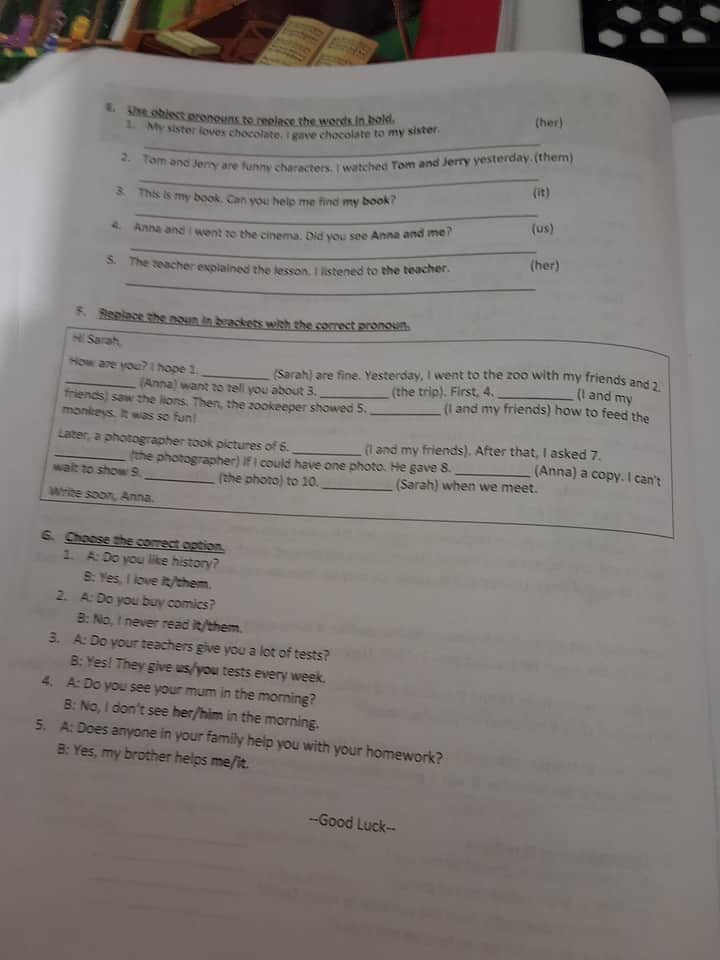
1. Use object pronouns to replace the words in bold
-
My sister loves chocolate. I gave chocolate to my sister.
Answer: I gave chocolate to her. -
Tom and Jerry are funny characters. I watched Tom and Jerry yesterday.
Answer: I watched them yesterday. -
This is my book. Can you help me find my book?
Answer: Can you help me find it? -
Anna and I went to the cinema. Did you see Anna and me?
Answer: Did you see us? -
The teacher explained the lesson. I listened to the teacher.
Answer: I listened to her.
2. Replace the gaps in brackets with the correct pronouns
Hi Sarah,
How are you? I hope 1. you (Sarah) are fine. Yesterday, I went to the zoo with my friends and 2. I (Anna) want to tell you about 3. it (the trip). First, 4. my friends and I (I and my friends) saw the lions. Then, the zookeeper showed 5. us (I and my friends) how to feed the monkeys. It was so fun!
Later, a photographer took pictures of 6. us (I and my friends). After that, I asked 7. him (the photographer) if I could have one photo. He gave 8. me (Anna) a copy. I can’t wait to show 9. it (the photo) to 10. you (Sarah) when we meet.
Write soon, Anna.
3. Choose the correct option
-
A: Do you like history?
B: Yes, I love it. -
A: Do you buy comics?
B: No, I never read them. -
A: Do your teachers give you a lot of tests?
B: Yes! They give us tests every week. -
A: Do you see your mum in the morning?
B: No, I don’t see her in the morning. -
A: Does anyone in your family help you with your homework?
B: Yes, my brother helps me.
Karşılaştırma Tablosu: Subject vs Object Pronouns
| Kategori | Subject Pronouns | Object Pronouns |
|---|---|---|
| Örnek Cümle | She is my friend. | I see her every day. |
| İşlev | Cümlede özne | Cümlede nesne |
| Kullanım | Yapan kişi | İşlem gören kişi |
Anahtar Nokta: Subject pronoun cümlede işi yapan kişiyi, object pronoun ise yapılana işaret eder.
Sık Sorulan Sorular
1. Object pronouns nasıl öğrenilir?
Object pronouns kullanımı, cümle içinde nesnenin hangi kelime olduğunu anlamakla kolaylaşır. Cümlede fiilin etkilediği kişiye ya da nesneye object pronoun kullanılır. Pratik yaparak öğrenmek en etkili yoldur.
2. Objekt zamirler sadece kişiler için mi kullanılır?
Hayır, kişilerin yanı sıra hayvanlar, eşyalar ve soyut kavramlar için de kullanılır (örneğin: it, them).
3. Object pronouns kullanımı ile zorlanıyorsam ne yapmalıyım?
Cümledeki ana fiili ve onun etkilediği nesneyi belirleyin. Nesne kim ya da ne ise onun yerine uygun zamiri koyun. Bu işlem, öğrencilere çok yardımcı olur.
4. Object pronouns hangi dilbilgisi konularıyla ilişkilidir?
Subject pronouns, possessive adjectives, ve reflexive pronouns gibi diğer zamir türleriyle yakından bağlantılıdır.
Sonraki Adımlar
İsterseniz bu konuyla ilgili kısa cümleli örnekler oluşturabilir ya da object pronouns ile ilgili interaktif alıştırmalar hazırlayabilirim. Hangisini tercih edersiniz?
Ödev Cevapları
• 1–5 arası cümlelerde nesne zamirleri:
- her
- them
- it
- us
- her
• 1–10 arası boşluk doldurma:
- you
- she
- it
- we
- us
- us
- him
- her
- it
- you
• 6. etkinlik – Doğru seçenekler:
- Yes, I love it.
- No, I never read them.
- Yes! They give us tests every week.
- No, I don’t see her in the morning.
- Yes, my brother helps me.
Başka bir şeye ihtiyaç var mı?