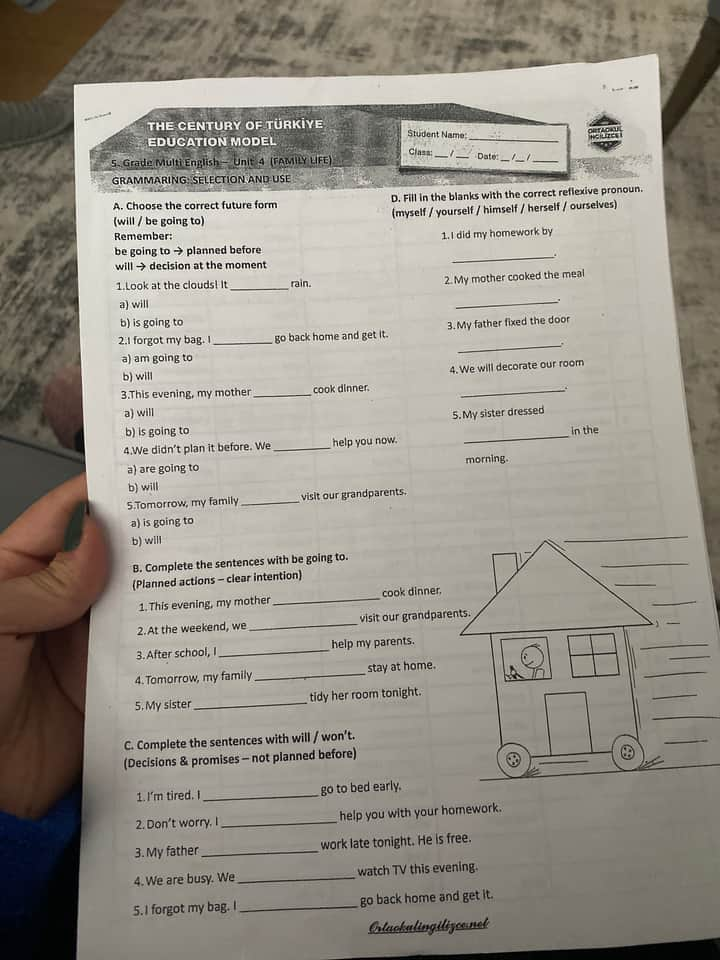
English Grammar Exercise: Future Forms and Reflexive Pronouns
Önemli Noktalar
- Will is used for decisions made at the moment of speaking.
- Be going to indicates planned actions or intentions made before the moment of speaking.
- Reflexive pronouns (myself, yourself, himself, herself, ourselves) show the subject and object of the sentence are the same.
İçindekiler
- Future Forms: Will vs Be Going To
- Exercise A: Choose the Correct Future Form
- Exercise B: Complete Sentences with Be Going To
- Exercise C: Complete Sentences with Will / Won’t
- Exercise D: Fill in the Blanks with Reflexive Pronouns
Future Forms: Will vs Be Going To
- Will expresses spontaneous decisions, promises, predictions without evidence.
Example: “I will help you with your homework.” - Be going to shows plans or intentions decided before speaking, or predictions based on evidence.
Example: “I am going to visit my grandparents next weekend.”
Pro Tip: If the action is decided beforehand or there is evidence, use be going to; if the decision is spontaneous or a promise, use will.
Exercise A: Choose the Correct Future Form
- Look at the clouds! It is going to rain.
- I forgot my bag. I will go back home and get it.
- This evening, my mother is going to cook dinner.
- We didn’t plan it before. We will help you now.
- Tomorrow, my family is going to visit our grandparents.
Exercise B: Complete the Sentences with Be Going To
- This evening, my mother is going to cook dinner.
- At the weekend, we are going to visit our grandparents.
- After school, I am going to help my parents.
- Tomorrow, my family is going to stay at home.
- My sister is going to tidy her room tonight.
Exercise C: Complete the Sentences with Will / Won’t
- I’m tired. I will go to bed early.
- Don’t worry, I will help you with your homework.
- My father won’t work late tonight. He is free.
- We are busy. We won’t watch TV this evening.
- I forgot my bag. I will go back home and get it.
Exercise D: Fill in the Blanks with Reflexive Pronouns
- I did my homework by myself.
- My mother cooked the meal herself.
- My father fixed the door himself.
- We will decorate our room ourselves.
- My sister dressed herself in the morning.
Sonraki Adımlar
Would you like me to create an interactive quiz based on this exercise, or explain the difference between reflexive and intensive pronouns?
Resimli Soru 01-02-2026 15:45:34: Boşlukları Doldurma
Anahtar Noktalar
- “will” anlık kararlar ve söz verirken, “be going to” önceden planlanmış niyetlerde kullanılır.
- “will” olumsuz formu “won’t” şeklindedir.
- Refleksif zamirler (myself, yourself, himself, herself, ourselves) öznenin kendisini vurgular.
Gelecek zaman için anlık kararlar will, planlanmış niyetler be going to ile, refleksif durumlar ise uygun myself / yourself / himself / herself / ourselves ile ifade edilir.
İçindekiler
- Bölüm A – Will vs Be Going to Seçimi
- Bölüm B – Be Going to ile Tamamlama
- Bölüm C – Will/Won’t ile Tamamlama
- Bölüm D – Refleksif Zamirler
- Karşılaştırma: Will vs Be Going to
- Özet Tablosu
- SSS (FAQ)
Bölüm A – Will vs Be Going to Seçimi
- Look at the clouds! It is going to rain.
- I forgot my bag. I will go back home and get it.
- This evening, my mother is going to cook dinner.
- We didn’t plan it before. We will help you now.
- Tomorrow, my family is going to visit our grandparents.
Bölüm B – Be Going to ile Tamamlama
- This evening, my mother is going to cook dinner.
- At the weekend, we are going to visit our grandparents.
- After school, I am going to help my parents.
- Tomorrow, my family are going to stay at home.
- My sister is going to tidy her room tonight.
Bölüm C – Will/Won’t ile Tamamlama
- I’m tired. I will go to bed early.
- Don’t worry. I will help you with your homework.
- My father will work late tonight. He is free.
- We are busy. We won’t watch TV this evening.
- I forgot my bag. I will go back home and get it.
Bölüm D – Refleksif Zamirler
- I did my homework by myself.
- My mother cooked the meal herself.
- My father fixed the door himself.
- We will decorate our room ourselves.
- My sister dressed herself in the morning.
Karşılaştırma: Will vs Be Going to
| Kriter | will | be going to |
|---|---|---|
| Planlama Zamanı | Karar anında (spontaneous) | Önceden planlanmış |
| Kullanım Amacı | Anlık kararlar, söz/verme | Niyet, kesin plan |
| Olumsuz Form | won’t | – (not … going to) |
| Örnek | I will help you. | I am going to help you. |
| İpuçları (Context Clues) | don’t plan, decide now | look at evidence, before planning |
Özet Tablosu
| Bölüm | Yapı | Kullanım |
|---|---|---|
| A | will / be going to | Anlık karar vs planlanmış niyet |
| B | be going to | Kesin planlanmış eylemler |
| C | will / won’t | Söz verme, anlık karar, olumsuz planlama |
| D | Reflexive pronouns | Özne kendisini yaptığından dolayı zamir kullanı |
SSS (FAQ)
- “will” ile “be going to” arasındaki en net fark nedir?
- “won’t” ifadesini ne zaman kullanmalıyım?
- Refleksif zamirlerde hangi durumda “myself” var “ourselves” var?
- “be going to” cümlesinde “to” mutlaka lazım mı?
Soruları yanıtlamamı ya da ek örneklerle açıklamamı ister misin?
@Selin_Arslanoglu