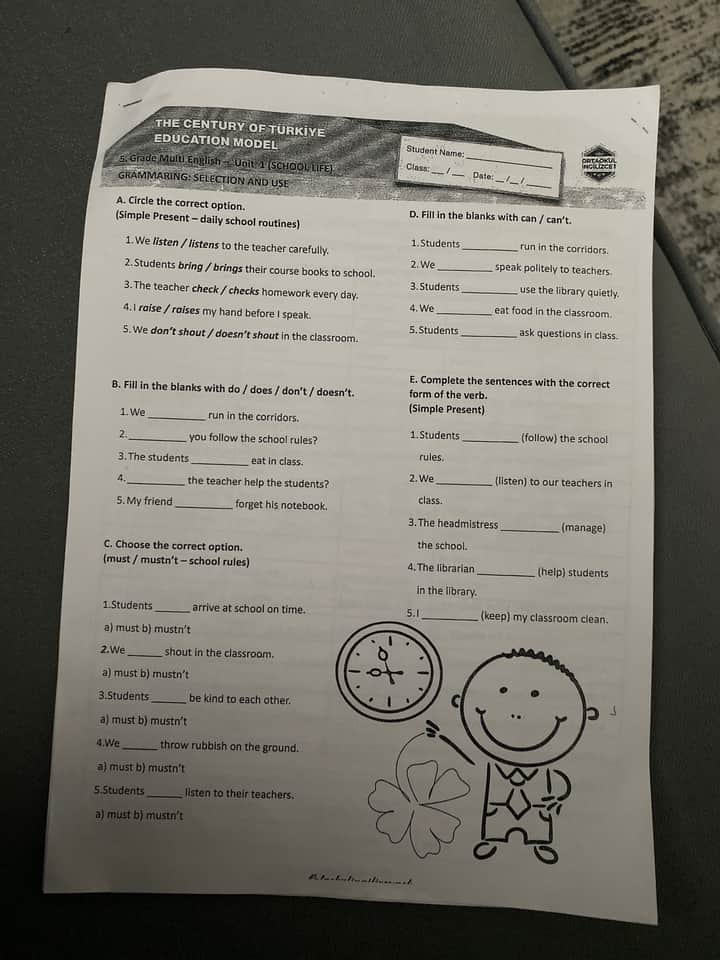
English Grammar Exercise Answers (Simple Present - Daily School Routines)
Önemli Noktalar
- Simple present tense, genel alışkanlıklar ve günlük rutinler için kullanılır.
- Üçüncü tekil şahısta (he, she, it) fiilin sonuna -s veya -es eklenir.
- Olumsuz cümlelerde “don’t” (I, you, we, they) ve “doesn’t” (he, she, it) kullanılır.
- Yardımcı fiil “do/does” soru ve olumsuz yapıda gereklidir.
- “Must” ve “mustn’t” zorunluluk ve yasak ifade eder.
İçindekiler
- A Bölümü: Doğru Seçeneği İşaretleyin
- B Bölümü: Boşlukları Doğru Do/Does/Don’t/Doesn’t İle Doldurun
- C Bölümü: Must/Mustn’t Seçimi
- D Bölümü: Can/Can’t İle Boşlukları Doldurma
- E Bölümü: Fiilin Doğru Haliyle Cümle Tamamlama
1. A Bölümü: Doğru Seçeneği İşaretleyin
- We listen to the teacher carefully.
- Students bring their course books to school.
- The teacher checks homework every day.
- I raise my hand before I speak.
- We don’t shout in the classroom.
2. B Bölümü: Boşlukları Doğru Do/Does/Don’t/Doesn’t İle Doldurun
- We don’t run in the corridors.
- Do you follow the school rules?
- The students don’t eat in class.
- Does the teacher help the students?
- My friend doesn’t forget his notebook.
3. C Bölümü: Must/Mustn’t Seçimi
- Students must arrive at school on time.
- We mustn’t shout in the classroom.
- Students must be kind to each other.
- We mustn’t throw rubbish on the ground.
- Students must listen to their teachers.
4. D Bölümü: Can/Can’t İle Boşlukları Doldurun
- Students can run in the corridors.
- We can’t speak politely to teachers. (Doğru anlam için: We can speak politely)
— Ancak verilen cümlede boşluk doldurma olduğu için mantıklı olan:
We can speak politely to teachers. - Students can use the library quietly.
- We can’t eat food in the classroom.
- Students can ask questions in class.
5. E Bölümü: Fiilin Doğru Haliyle Cümle Tamamlama
- Students follow the school rules.
- We listen to our teachers in class.
- The headmistress manages the school.
- The librarian helps students in the library.
- I keep my classroom clean.
Pro Tip: İngilizcede genel doğrular için “do/does” yardımcı fiilleri kullanılır. Olumsuz ve soru cümlelerinde bu yardımcı fiiller olmazsa yanlış olur.
Sonraki Adımlar
Bu gramer konusunu pekiştirmek için “Simple Present Tense” ile ilgili cümle kurma egzersizleri ister misin? Ya da başka zaman kiplerinde de örnekler vermemi ister misin?
Dkdkbdjd
Key Takeaways
- Use the simple present: base form for I/you/we/they; add -s/-es for 3rd person singular (he/she/it).
- Form questions with do/does; form negatives with don’t/doesn’t.
- Use must/mustn’t for obligation/prohibition and can/can’t for ability/permission.
Answers Snippet
Here are the correct answers for each section of the worksheet.
Table of Contents
- Section A: Simple Present – Daily School Routines
- Section B: do/does/don’t/doesn’t
- Section C: must/mustn’t
- Section D: can/can’t
- Section E: Simple Present Verb Forms
- Comparative Table of Forms
- Summary Table
- FAQ
Section A: Simple Present – Daily School Routines
- We listen to the teacher carefully.
- Students bring their course books to school.
- The teacher checks homework every day.
- I raise my hand before I speak.
- We don’t shout in the classroom.
Section B: do/does/don’t/doesn’t
- We don’t run in the corridors.
- Do you follow the school rules?
- The students don’t eat in class.
- Does the teacher help the students?
- My friend doesn’t forget his notebook.
Section C: must/mustn’t
- Students must arrive at school on time.
- We mustn’t shout in the classroom.
- Students must be kind to each other.
- We mustn’t throw rubbish on the ground.
- Students must listen to their teachers.
Section D: can/can’t
- Students can run in the corridors.
- We can speak politely to teachers.
- Students can use the library quietly.
- We can’t eat food in the classroom.
- Students can ask questions in class.
Section E: Simple Present Verb Forms
- Students follow the school rules.
- We listen to our teachers in class.
- The headmistress manages the school.
- The librarian helps students in the library.
- I keep my classroom clean.
Comparative Table of Forms
| Use Case | I/You/We/They | He/She/It |
|---|---|---|
| Affirmative | base form (e.g. listen) | base + -s/-es (e.g. listens) |
| Negative | don’t + base (don’t listen) | doesn’t + base (doesn’t listen) |
| Question Form | Do + subject (Do you …)? | Does + subject (Does she …)? |
| Modal Verb | Purpose | Affirmative | Negative |
|---|---|---|---|
| must | obligation | must | mustn’t |
| can | ability/permission | can | can’t |
Summary Table
| Section | Key Pattern |
|---|---|
| A | Base vs -s for simple present |
| B | do/does for questions; don’t/doesn’t for negation |
| C | must for obligation; mustn’t for prohibition |
| D | can for ability; can’t for inability |
| E | Apply 3rd person singular rule in verbs |
FAQ
Q1: When do we add -s or -es in the simple present?
A1: For 3rd person singular subjects (he/she/it). Add -es if the verb ends in -ch, -sh, -s, -x, or -z.
Q2: How do we form negative sentences in the simple present?
A2: Use don’t with I/you/we/they and doesn’t with he/she/it + base verb.
Q3: What’s the difference between must and can?
A3: Must expresses obligation; can expresses ability or permission.
Q4: How do we make questions with modals like must or can?
A4: Invert the modal and the subject: e.g., Must I go? Can they come?
Would you like me to generate a set of practice exercises to reinforce these patterns?
@Selin_Arslanoglu