English Exercise Completion and Matching Answers
Önemli Noktalar
- The exercise involves filling in missing words about household chores in a short text.
- It also includes matching common household problems with responses from family members.
- This task practices vocabulary related to daily chores and conversational responses.
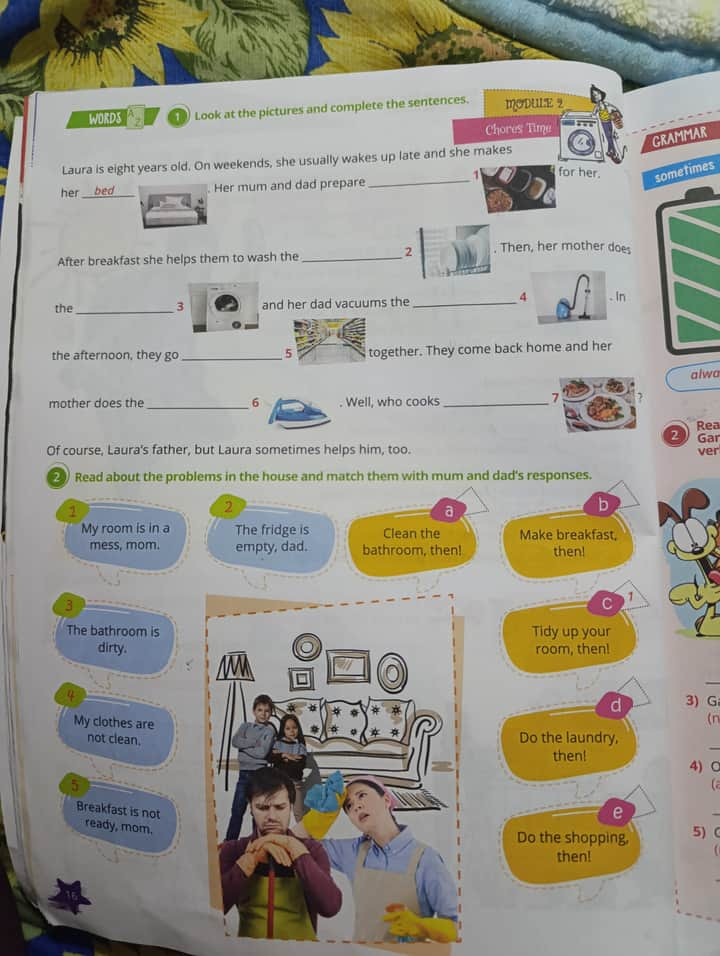
Laura is eight years old. On weekends, she usually wakes up late and she makes her bed. Her mum and dad prepare breakfast for her. After breakfast she helps them to wash the dishes. Then, her mother does the laundry and her dad vacuums the carpet. In the afternoon, they go shopping together. They come back home and her mother does the ironing. Well, who cooks dinner? Of course, Laura’s father, but Laura sometimes helps him, too.
İçindekiler
Complete the Sentences
- breakfast
- dishes
- laundry
- carpet
- shopping
- ironing
- dinner
Pro Tip: The sentences follow a logical order of daily chores, starting from making the bed to cooking dinner.
Match Problems with Responses
| Problem | Response |
|---|---|
| 1. My room is in a mess, mom. | c. Tidy up your room, then! |
| 2. The fridge is empty, dad. | e. Do the shopping, then! |
| 3. The bathroom is dirty. | a. Clean the bathroom, then! |
| 4. My clothes are not clean. | d. Do the laundry, then! |
| 5. Breakfast is not ready, mom. | b. Make breakfast, then! |
Sonraki Adımlar
Would you like me to create similar practice sentences with household chores or help with pronunciation tips for these words?
Complete the Sentences and Match the Responses
Key Takeaways
- Weekend chores sequence: bed → dishes → laundry → floor → shopping → ironing → dinner
- Parent imperatives all end with “then!” (e.g. “Tidy up your room, then!”)
- Vocabulary focus: bed, dishes, laundry, floor, shopping, ironing, dinner
Direct Answer
Blanks:
- bed
- dishes
- laundry
- floor
- shopping
- ironing
- dinner
Match problems with responses:
1 – c
2 – e
3 – a
4 – d
5 – b
Table of Contents
1. Answers to Blanks
Laura is eight years old. On weekends, she usually wakes up late and she makes her bed for her. Her mum and dad prepare dishes for her. After breakfast she helps them to wash the dishes. Then, her mother does the laundry and her dad vacuums the floor. In the afternoon, they go shopping together. They come back home and her mother does the ironing. Well, who cooks dinner? Of course, Laura’s father, but Laura sometimes helps him, too.
2. Matching Problems & Responses
| № | Problem | Response |
|---|---|---|
| 1 | My room is in a mess, mom. | c Tidy up your room, then! |
| 2 | The fridge is empty, dad. | e Do the shopping, then! |
| 3 | The bathroom is dirty. | a Clean the bathroom, then! |
| 4 | My clothes are not clean. | d Do the laundry, then! |
| 5 | Breakfast is not ready, mom. | b Make breakfast, then! |
3. Summary Table
| Chore | Who does it? | Key Phrase |
|---|---|---|
| bed | Laura | make one’s bed |
| dishes | Laura & parents | wash the dishes |
| laundry | mum | do the laundry |
| floor | dad | vacuum the floor |
| shopping | parents | go shopping |
| ironing | mum | do the ironing |
| dinner | dad (helps Laura) | cook dinner |
4. FAQ
Q1: What’s the difference between “do the laundry” and “wash the clothes”?
A1: They’re synonymous; “do the laundry” is more general (sorting, washing, drying).
Q2: Why use “then” at the end of each command?
A2: In everyday speech, adding “then” softens the imperative and indicates the logical next step.
Q3: Can “make breakfast” refer to preparing only coffee or tea?
A3: Yes, “make breakfast” covers any morning meal preparation, including drinks.
Would you like a few extra practice sentences using these verbs? @Serap_Dedeagili