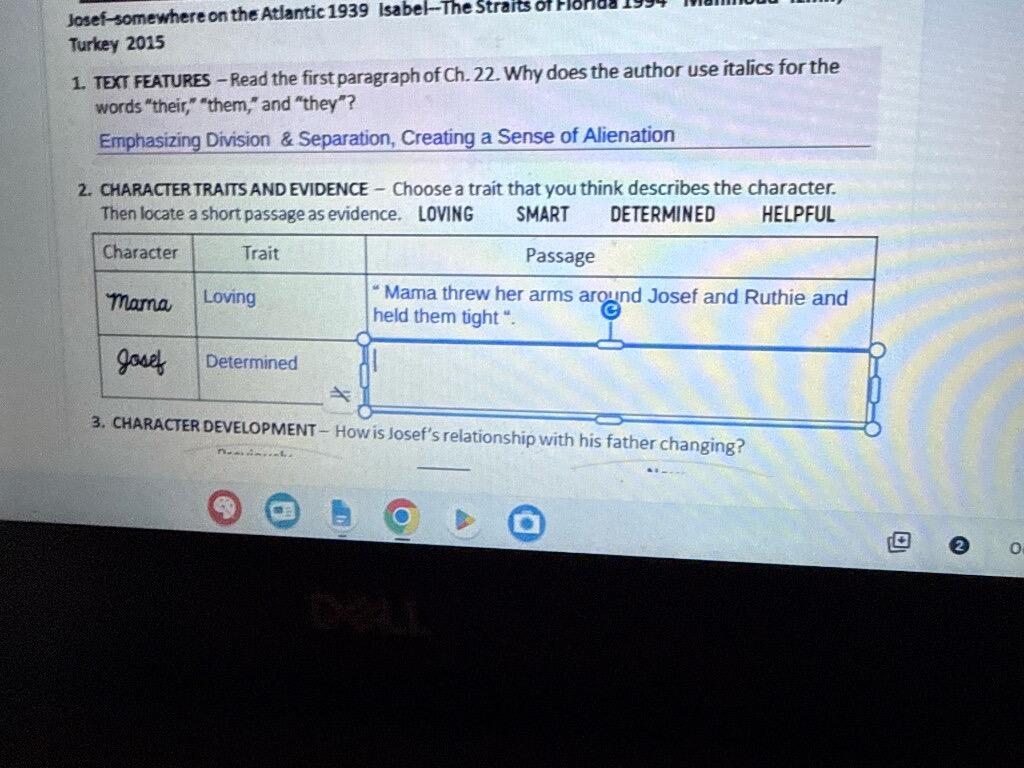
- TEXT FEATURES - Read the first paragraph of Ch. 22. Why does the author use italics for the words “their,” “them,” and “they”?
Emphasizing Division & Separation, Creating a Sense of Alienation - CHARACTER TRAITS AND EVIDENCE - Choose a trait that you think describes the character. Then locate a short passage as evidence. LOVING SMART DETERMINED HELPFUL
| Character | Trait | Passage |
|—|—|—|
| Mama | Loving | “Mama threw her arms around Josef and Ruthie and held them tight.” |
| Josef | Determined | | - CHARACTER DEVELOPMENT - How is Josef’s relationship with his father changing?
Character Traits & Development: Refugee (Chapter 22 — Josef)
2. Character Traits and Evidence
| Character | Trait | Passage |
|---|---|---|
| Josef | Determined | “He had to be strong. He had to be the man of the family now.” (Alternative Ch. 22 quote): “Josef was not going to let them send them back to Germany. He had to make sure they got to Cuba.” |
Why this evidence fits:
- Context & Meaning: Throughout Chapter 22, as terrifying rumors spread that Cuba might reject their visas and send them back to Nazi Germany, Josef does not give in to despair. Instead of acting like a helpless child, he displays resolute determination to protect his mother and Ruthie, refusing to let fear stop him from keeping his family safe.
3. Character Development: How Josef’s Relationship with His Father is Changing
In Chapter 22 and throughout this part of the novel, Josef’s relationship with his father (Aaron Landau) undergoes a profound role reversal:
- From Protector to Dependent: Before his imprisonment at Dachau, Josef’s father was an authoritative, respectable lawyer and the head of the household whom Josef looked up to. After Dachau, he is severely traumatized, paranoid, and mentally broken. Josef must now act as the parent and caregiver to his own father.
- Forced Adulthood: Because his father hides in their cabin, terrified that the crew and Nazis are out to get him, Josef is forced to step up and become the “man of the family.” Josef must make decisions, shield his younger sister Ruthie, and keep up family morale.
- Complex Emotions (Sympathy vs. Frustration): Josef still loves his father, but he also struggles with embarrassment, sadness, and anxiety. He realizes that his father’s erratic, panicked behavior poses a direct threat to the family’s safety—especially if the Cuban inspectors see that Aaron is mentally unstable.
Summary Statement for Your Sheet:
Josef’s relationship with his father reverses roles: rather than relying on his father for protection and guidance, Josef must step up as the mature “man of the family.” Because his father is crippled by trauma and paranoia from Dachau, Josef has to take charge, protect his family, and manage his father’s fragile state.
Would you like to examine how Josef’s character development here compares to Isabel’s or Mahmoud’s leadership in their chapters?