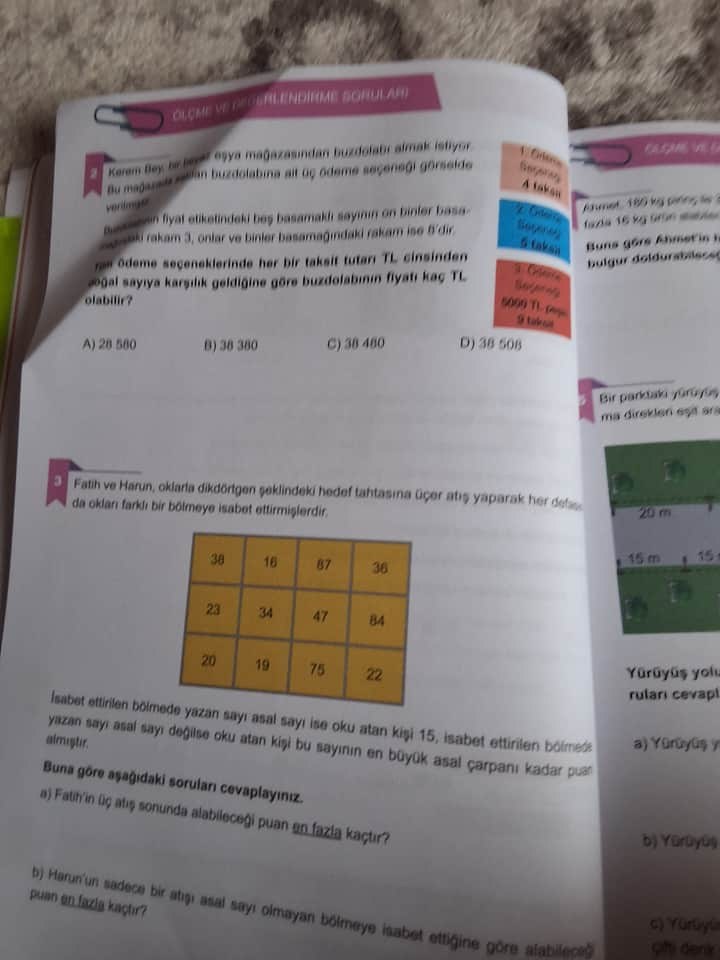
Here is a step-by-step solution to the arrow-board problem (the lower question in your screenshot):
Problem restatement
Fatih and Harun each shoot three arrows into distinct cells of the rectangular board below. Each cell contains a number.
-
If the number is prime, the shooter scores 15 points for that hit.
-
If the number is composite, the shooter scores the largest prime factor of that number.
38 16 87 36
23 34 47 84
20 19 75 22
a) What is the maximum total score Fatih can get in three hits?
b) If Harun hits exactly one composite cell and two prime cells, what is the maximum total score he can get?
Solution steps
-
List each cell’s “score value”
• If prime ⇒ 15
• If composite ⇒ largest prime factor (LPF)• 38 = 2·19 ⇒ LPF = 19
• 16 = 2⁴ ⇒ LPF = 2
• 87 = 3·29 ⇒ LPF = 29
• 36 = 2²·3² ⇒ LPF = 3
• 23 is prime ⇒ 15
• 34 = 2·17 ⇒ LPF = 17
• 47 is prime ⇒ 15
• 84 = 2²·3·7 ⇒ LPF = 7
• 20 = 2²·5 ⇒ LPF = 5
• 19 is prime ⇒ 15
• 75 = 3·5² ⇒ LPF = 5
• 22 = 2·11 ⇒ LPF = 11 -
Sort possible single-hit scores
Composite LPFs in descending order: 29 (from 87), 19 (38), 17 (34), 11 (22), 7, 5, 3, 2
Prime hits all yield 15 -
Part (a): Fatih may choose any three distinct cells to maximize sum
• The three highest scores are 29, 19, and 17
• Total = 29 + 19 + 17 = 65 -
Part (b): Harun must hit exactly one composite cell and two primes
• Best composite choice = 29 (cell 87)
• Two primes each give 15 points ⇒ 2×15 = 30
• Total = 29 + 30 = 59
Answers
a) 65 points
b) 59 points