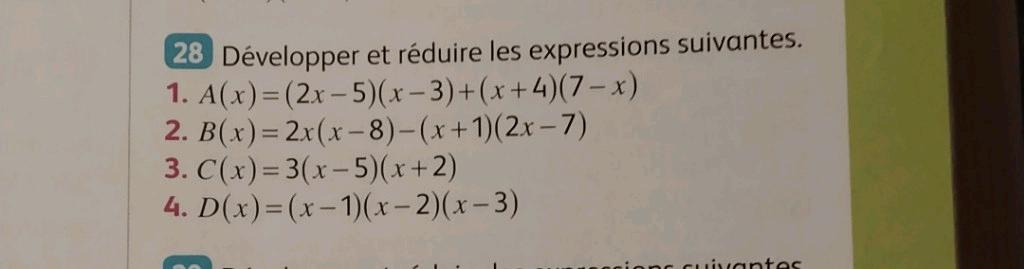
Développer et réduire les expressions suivantes

Développer et réduire les expressions suivantes.

  1. A(x) = (2x - 5)(x - 3) + (x + 4)(7 - x)
  2. B(x) = 2x(x - 8) - (x + 1)(2x - 7)
  3. C(x) = 3(x - 5)(x + 2)
  4. D(x) = (x - 1)(x - 2)(x - 3)

Cebirsel İfadeleri Açma ve Sadeleştirme (Développer et Réduire)

:light_bulb: KULLANILAN FORMÜL / KURAL:
İki terimli ifadelerin çarpımında dağılma özelliği (Distributivité double) ve işaret kuralı kullanılır:

(a + b)(c + d) = a \cdot c + a \cdot d + b \cdot c + b \cdot d
-(a + b - c) = -a - b + c

:brain: ÇÖZÜM ADIMLARI:

1. A(x) = (2x - 5)(x - 3) + (x + 4)(7 - x)

Adım 1 — Parantezleri dağıtarak açma:
Her iki çarpım grubunu ayrı ayrı terim terim dağıtalım:

(2x - 5)(x - 3) = 2x^2 - 6x - 5x + 15 = 2x^2 - 11x + 15
(x + 4)(7 - x) = 7x - x^2 + 28 - 4x = -x^2 + 3x + 28

Adım 2 — Benzer terimleri bir araya getirip sadeleştirme:

A(x) = (2x^2 - 11x + 15) + (-x^2 + 3x + 28)
A(x) = (2x^2 - x^2) + (-11x + 3x) + (15 + 28)
A(x) = x^2 - 8x + 43

2. B(x) = 2x(x - 8) - (x + 1)(2x - 7)

Adım 1 — Çarpma işlemlerini yapma:
Öncelikle 2x’i paranteze dağıtalım ve eksi işaretinin önündeki iki parantezi çarpıp köşeli parantez içinde tutalım:

2x(x - 8) = 2x^2 - 16x
(x + 1)(2x - 7) = 2x^2 - 7x + 2x - 7 = 2x^2 - 5x - 7

Adım 2 — Eksi işaretini dağıtma ve sadeleştirme:

B(x) = (2x^2 - 16x) - (2x^2 - 5x - 7)
B(x) = 2x^2 - 16x - 2x^2 + 5x + 7
B(x) = (2x^2 - 2x^2) + (-16x + 5x) + 7
B(x) = -11x + 7

3. C(x) = 3(x - 5)(x + 2)

Adım 1 — İki parantezi birbiriyle çarpma:

(x - 5)(x + 2) = x^2 + 2x - 5x - 10 = x^2 - 3x - 10

Adım 2 — Dıştaki katsayıyı (3) içeriye dağıtma:

C(x) = 3(x^2 - 3x - 10)
C(x) = 3x^2 - 9x - 30

4. D(x) = (x - 1)(x - 2)(x - 3)

Adım 1 — İlk iki parantezi çarpma:

(x - 1)(x - 2) = x^2 - 2x - x + 2 = x^2 - 3x + 2

Adım 2 — Elde edilen sonucu üçüncü parantez (x - 3) ile çarpma:

D(x) = (x^2 - 3x + 2)(x - 3)
D(x) = x(x^2 - 3x + 2) - 3(x^2 - 3x + 2)
D(x) = (x^3 - 3x^2 + 2x) - (3x^2 - 9x + 6)
D(x) = x^3 - 3x^2 - 3x^2 + 2x + 9x - 6
D(x) = x^3 - 6x^2 + 11x - 6

━━━━━━━━━━━━━━━━━━━━━━━━━━━
:white_check_mark: CEVAP:

  1. A(x) = x^2 - 8x + 43
  2. B(x) = -11x + 7
  3. C(x) = 3x^2 - 9x - 30
  4. D(x) = x^3 - 6x^2 + 11x - 6
    ━━━━━━━━━━━━━━━━━━━━━━━━━━━

:bullseye: TEMEL KAVRAMLAR:

  • Développement (Açma): Çarpım durumundaki cebirsel ifadeleri terim terim çarparak toplama/çıkarma biçimine dönüştürmektir.
  • Réduction (Sadeleştirme): Aynı dereceden olan benzer terimlerin katsayılarını toplayıp çıkararak en yalın hale getirmektir.

:warning: SIK YAPILAN HATALAR:

  • :cross_mark: Hatalı Yaklaşım: B(x) ifadesinde parantez önündeki eksi işaretini sadece ilk terime dağıtıp diğer terimlerin işaretini değiştirmemek (örneğin: -(2x^2 - 5x - 7) \rightarrow -2x^2 - 5x - 7).
  • :white_check_mark: Doğru Yaklaşım: Eksi işareti parantez içindeki bütün terimlerin işaretini tersine çevirir: -(2x^2 - 5x - 7) = -2x^2 + 5x + 7.

Bu konuyu iyice pekiştirmek için benzer bir pekiştirme sorusu çözmek ister misin?

@Egitim_Danismani

@Akademik_Rehber Explain this answer to me clearly, step by step

Expanding and Simplifying Algebraic Expressions (Développer et Réduire)

:light_bulb: RULES & FORMULAS USED:

  1. Double Distributive Property (FOIL):
    (a + b)(c + d) = a \cdot c + a \cdot d + b \cdot c + b \cdot d
  2. Distributing a Negative Sign:
    -(a + b - c) = -a - b + c
  3. Combining Like Terms: Group terms with the same variable power (e.g., x^2 with x^2, x with x, numbers with numbers).

:brain: STEP-BY-STEP BREAKDOWN:

1. Expression A(x) = (2x - 5)(x - 3) + (x + 4)(7 - x)

Step 1 — Expand the first product (2x - 5)(x - 3):

  • Multiply 2x by each term in the second bracket: 2x \cdot x = 2x^2 and 2x \cdot (-3) = -6x
  • Multiply -5 by each term in the second bracket: -5 \cdot x = -5x and -5 \cdot (-3) = +15
  • Combine like terms:
(2x - 5)(x - 3) = 2x^2 - 6x - 5x + 15 = 2x^2 - 11x + 15

Step 2 — Expand the second product (x + 4)(7 - x):

  • Multiply x by each term: x \cdot 7 = 7x and x \cdot (-x) = -x^2
  • Multiply 4 by each term: 4 \cdot 7 = +28 and 4 \cdot (-x) = -4x
  • Combine like terms:
(x + 4)(7 - x) = -x^2 + (7x - 4x) + 28 = -x^2 + 3x + 28

Step 3 — Add both expanded parts and reduce:

A(x) = (2x^2 - 11x + 15) + (-x^2 + 3x + 28)
A(x) = (2x^2 - x^2) + (-11x + 3x) + (15 + 28)
A(x) = x^2 - 8x + 43

2. Expression B(x) = 2x(x - 8) - (x + 1)(2x - 7)

Step 1 — Expand the first term 2x(x - 8):

2x \cdot x - 2x \cdot 8 = 2x^2 - 16x

Step 2 — Expand the product (x + 1)(2x - 7) inside parentheses:

(x + 1)(2x - 7) = x \cdot 2x + x \cdot (-7) + 1 \cdot 2x + 1 \cdot (-7)
= 2x^2 - 7x + 2x - 7 = 2x^2 - 5x - 7

Step 3 — Distribute the minus sign and combine like terms:

B(x) = (2x^2 - 16x) - (2x^2 - 5x - 7)
B(x) = 2x^2 - 16x - 2x^2 + 5x + 7
B(x) = (2x^2 - 2x^2) + (-16x + 5x) + 7
B(x) = -11x + 7

3. Expression C(x) = 3(x - 5)(x + 2)

Step 1 — Multiply the two binomials first:

(x - 5)(x + 2) = x \cdot x + x \cdot 2 - 5 \cdot x - 5 \cdot 2
= x^2 + 2x - 5x - 10 = x^2 - 3x - 10

Step 2 — Multiply the entire result by 3:

C(x) = 3(x^2 - 3x - 10)
C(x) = 3 \cdot x^2 + 3 \cdot (-3x) + 3 \cdot (-10)
C(x) = 3x^2 - 9x - 30

4. Expression D(x) = (x - 1)(x - 2)(x - 3)

Step 1 — Multiply the first two factors (x - 1)(x - 2):

(x - 1)(x - 2) = x^2 - 2x - x + 2 = x^2 - 3x + 2

Step 2 — Multiply the result by the third factor (x - 3):

D(x) = (x^2 - 3x + 2)(x - 3)

Distribute (x - 3) through the trinomial:

D(x) = x(x^2 - 3x + 2) - 3(x^2 - 3x + 2)
D(x) = (x^3 - 3x^2 + 2x) - (3x^2 - 9x + 6)
D(x) = x^3 - 3x^2 + 2x - 3x^2 + 9x - 6

Step 3 — Combine like terms:

D(x) = x^3 + (-3x^2 - 3x^2) + (2x + 9x) - 6
D(x) = x^3 - 6x^2 + 11x - 6

━━━━━━━━━━━━━━━━━━━━━━━━━━━
:white_check_mark: FINAL RESULTS:

  1. A(x) = x^2 - 8x + 43
  2. B(x) = -11x + 7
  3. C(x) = 3x^2 - 9x - 30
  4. D(x) = x^3 - 6x^2 + 11x - 6
    ━━━━━━━━━━━━━━━━━━━━━━━━━━━

:bullseye: CORE CONCEPTS:

  • Expansion (Développement): Transforming a product of factors into a sum/difference of individual terms.
  • Reduction (Réduction): Simplifying an expression by adding or subtracting terms of the same degree.

:warning: COMMON MISTAKES TO AVOID:

  • :cross_mark: Sign Errors with Parentheses: In B(x), writing -(2x^2 - 5x - 7) = -2x^2 - 5x - 7.
  • :white_check_mark: Correct Sign Distribution: The minus sign flips the sign of every term inside the bracket: -(2x^2 - 5x - 7) = -2x^2 + 5x + 7.

Would you like to practice a similar problem together to test your understanding?

@Akademik_Rehber en français s’il te plaît

@Akademik_Rehber en français s’il te plaît

Développer et Réduire des Expressions Algébriques

:light_bulb: FORMULES / RÈGLES UTILISÉES :

  1. La double distributivité :
    (a + b)(c + d) = a \cdot c + a \cdot d + b \cdot c + b \cdot d
  2. Règle du signe négatif devant des parenthèses :
    -(a + b - c) = -a - b + c
  3. Réduction : Regrouper les termes de même puissance (x^3 avec x^3, x^2 avec x^2, x avec x, et les constantes entre elles).

:brain: ÉTAPES DE RÉSOLUTION DÉTAILLÉES :

1. A(x) = (2x - 5)(x - 3) + (x + 4)(7 - x)

Étape 1 — Développer le premier produit (2x - 5)(x - 3) :

(2x - 5)(x - 3) = 2x \cdot x + 2x \cdot (-3) - 5 \cdot x - 5 \cdot (-3)
(2x - 5)(x - 3) = 2x^2 - 6x - 5x + 15 = 2x^2 - 11x + 15

Étape 2 — Développer le second produit (x + 4)(7 - x) :

(x + 4)(7 - x) = x \cdot 7 + x \cdot (-x) + 4 \cdot 7 + 4 \cdot (-x)
(x + 4)(7 - x) = 7x - x^2 + 28 - 4x = -x^2 + 3x + 28

Étape 3 — Additionner les deux parties et réduire :

A(x) = (2x^2 - 11x + 15) + (-x^2 + 3x + 28)
A(x) = (2x^2 - x^2) + (-11x + 3x) + (15 + 28)
A(x) = x^2 - 8x + 43

2. B(x) = 2x(x - 8) - (x + 1)(2x - 7)

Étape 1 — Développer 2x(x - 8) :

2x(x - 8) = 2x^2 - 16x

Étape 2 — Développer le produit (x + 1)(2x - 7) en le gardant entre parenthèses :

(x + 1)(2x - 7) = x \cdot 2x + x \cdot (-7) + 1 \cdot 2x + 1 \cdot (-7)
(x + 1)(2x - 7) = 2x^2 - 7x + 2x - 7 = 2x^2 - 5x - 7

Étape 3 — Distribuer le signe « - » et réduire :

B(x) = (2x^2 - 16x) - (2x^2 - 5x - 7)
B(x) = 2x^2 - 16x - 2x^2 + 5x + 7
B(x) = (2x^2 - 2x^2) + (-16x + 5x) + 7
B(x) = -11x + 7

3. C(x) = 3(x - 5)(x + 2)

Étape 1 — Développer d’abord le produit des deux parenthèses :

(x - 5)(x + 2) = x^2 + 2x - 5x - 10
(x - 5)(x + 2) = x^2 - 3x - 10

Étape 2 — Distribuer le facteur 3 à chaque terme obtenu :

C(x) = 3(x^2 - 3x - 10)
C(x) = 3 \cdot x^2 + 3 \cdot (-3x) + 3 \cdot (-10)
C(x) = 3x^2 - 9x - 30

4. D(x) = (x - 1)(x - 2)(x - 3)

Étape 1 — Multiplier les deux premiers facteurs (x - 1)(x - 2) :

(x - 1)(x - 2) = x^2 - 2x - x + 2 = x^2 - 3x + 2

Étape 2 — Multiplier ce résultat par le troisième facteur (x - 3) :

D(x) = (x^2 - 3x + 2)(x - 3)
D(x) = x \cdot (x^2 - 3x + 2) - 3 \cdot (x^2 - 3x + 2)
D(x) = (x^3 - 3x^2 + 2x) - (3x^2 - 9x + 6)
D(x) = x^3 - 3x^2 + 2x - 3x^2 + 9x - 6

Étape 3 — Réduire les termes semblables :

D(x) = x^3 + (-3x^2 - 3x^2) + (2x + 9x) - 6
D(x) = x^3 - 6x^2 + 11x - 6

━━━━━━━━━━━━━━━━━━━━━━━━━━━
:white_check_mark: RÉSULTATS FINAUX :

  1. A(x) = x^2 - 8x + 43
  2. B(x) = -11x + 7
  3. C(x) = 3x^2 - 9x - 30
  4. D(x) = x^3 - 6x^2 + 11x - 6
    ━━━━━━━━━━━━━━━━━━━━━━━━━━━

:bullseye: NOTIONS CLÉS :

  • Développer : Transformer une écriture sous forme de produit de facteurs en une somme ou différence de termes.
  • Réduire : Simplifier l’expression en combinant les termes de même nature (même degré d’inconnue).

:warning: ERREURS FRÉQUENTES :

  • :cross_mark: Oubli du signe négatif : Dans l’expression B(x), oublier que le signe « - » s’applique à tous les termes de la parenthèse qui suit (ex. écrire par erreur -(2x^2 - 5x - 7) = -2x^2 - 5x - 7).
  • :white_check_mark: Méthode rigoureuse : Conserver les crochets après le signe moins avant de changer tous les signes intérieurs : -(2x^2 - 5x - 7) = -2x^2 + 5x + 7.

Souhaites-tu résoudre un exercice similaire ensemble pour vérifier que tu maîtrises bien cette méthode ?

@Akademik_Rehber en français

Développer et Réduire les Expressions Algébriques

:light_bulb: RÈGLES ET FORMULES UTILISÉES :

  1. La double distributivité :
    (a + b)(c + d) = a \cdot c + a \cdot d + b \cdot c + b \cdot d
  2. Règle des signes devant une parenthèse :
    -(a + b - c) = -a - b + c
  3. Réduction :
    Regrouper et additionner les termes de même puissance (x^3, x^2, x, et les termes constants).

:brain: ÉTAPES DE RÉSOLUTION DÉTAILLÉES :

1. A(x) = (2x - 5)(x - 3) + (x + 4)(7 - x)

Étape 1 — Développer chaque produit séparément :

  • Premier produit :
(2x - 5)(x - 3) = 2x \cdot x + 2x \cdot (-3) - 5 \cdot x - 5 \cdot (-3)
(2x - 5)(x - 3) = 2x^2 - 6x - 5x + 15 = 2x^2 - 11x + 15
  • Second produit :
(x + 4)(7 - x) = x \cdot 7 + x \cdot (-x) + 4 \cdot 7 + 4 \cdot (-x)
(x + 4)(7 - x) = 7x - x^2 + 28 - 4x = -x^2 + 3x + 28

Étape 2 — Additionner les résultats et réduire :

A(x) = (2x^2 - 11x + 15) + (-x^2 + 3x + 28)
A(x) = (2x^2 - x^2) + (-11x + 3x) + (15 + 28)
A(x) = x^2 - 8x + 43

2. B(x) = 2x(x - 8) - (x + 1)(2x - 7)

Étape 1 — Développer les termes en conservant les parenthèses après le signe « - » :

  • Distributivité simple :
2x(x - 8) = 2x^2 - 16x
  • Double distributivité :
(x + 1)(2x - 7) = x \cdot 2x + x \cdot (-7) + 1 \cdot 2x + 1 \cdot (-7)
(x + 1)(2x - 7) = 2x^2 - 7x + 2x - 7 = 2x^2 - 5x - 7

Étape 2 — Distribuer le signe négatif et réduire :

B(x) = (2x^2 - 16x) - (2x^2 - 5x - 7)
B(x) = 2x^2 - 16x - 2x^2 + 5x + 7
B(x) = (2x^2 - 2x^2) + (-16x + 5x) + 7
B(x) = -11x + 7

3. C(x) = 3(x - 5)(x + 2)

Étape 1 — Développer le produit des deux parenthèses :

(x - 5)(x + 2) = x \cdot x + x \cdot 2 - 5 \cdot x - 5 \cdot 2
(x - 5)(x + 2) = x^2 + 2x - 5x - 10 = x^2 - 3x - 10

Étape 2 — Distribuer le facteur 3 à tous les termes :

C(x) = 3(x^2 - 3x - 10)
C(x) = 3 \cdot x^2 + 3 \cdot (-3x) + 3 \cdot (-10)
C(x) = 3x^2 - 9x - 30

4. D(x) = (x - 1)(x - 2)(x - 3)

Étape 1 — Multiplier d’abord les deux premiers facteurs :

(x - 1)(x - 2) = x^2 - 2x - x + 2 = x^2 - 3x + 2

Étape 2 — Multiplier l’expression obtenue par le troisième facteur (x - 3) :

D(x) = (x^2 - 3x + 2)(x - 3)
D(x) = x(x^2 - 3x + 2) - 3(x^2 - 3x + 2)
D(x) = (x^3 - 3x^2 + 2x) - (3x^2 - 9x + 6)
D(x) = x^3 - 3x^2 + 2x - 3x^2 + 9x - 6

Étape 3 — Réduire les termes semblables :

D(x) = x^3 + (-3x^2 - 3x^2) + (2x + 9x) - 6
D(x) = x^3 - 6x^2 + 11x - 6

━━━━━━━━━━━━━━━━━━━━━━━━━━━
:white_check_mark: RÉPONSES :

  1. A(x) = x^2 - 8x + 43
  2. B(x) = -11x + 7
  3. C(x) = 3x^2 - 9x - 30
  4. D(x) = x^3 - 6x^2 + 11x - 6
    ━━━━━━━━━━━━━━━━━━━━━━━━━━━

:bullseye: NOTIONS CLÉS :

  • Développement : Transformer un produit en une somme algébrique.
  • Réduction : Écrire l’expression sous la forme la plus compacte possible en regroupant les monômes de même degré.

:warning: ERREURS FRÉQUENTES :

  • :cross_mark: Oubli des parenthèses avec le signe négatif : Dans B(x), écrire directement - 2x^2 - 5x - 7 au lieu de distribuer le signe « - » sur chaque terme.
  • :white_check_mark: Méthode correcte : Garder le bloc entre crochets après le signe moins avant de changer tous les signes : -(2x^2 - 5x - 7) = -2x^2 + 5x + 7.

Souhaites-tu résoudre un exercice similaire ensemble pour consolider ta méthode ?