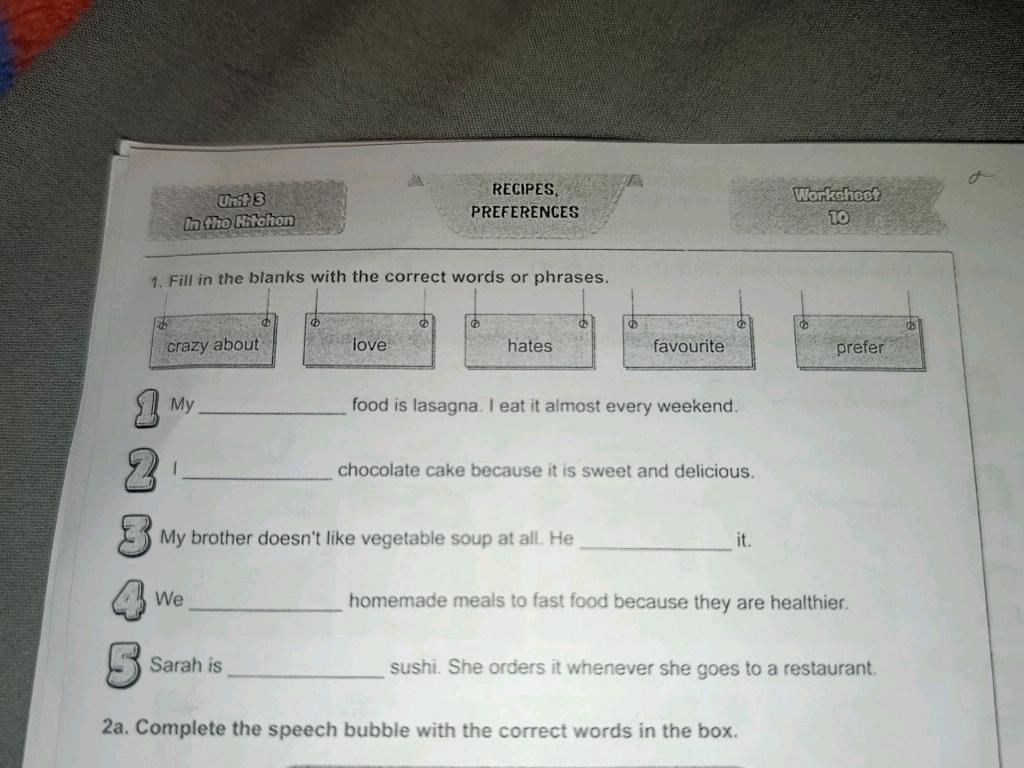
- Fill in the blanks with the correct words or phrases.
crazy about love hates favourite prefer
1 My _______________ food is lasagna. I eat it almost every weekend.
2 I _______________ chocolate cake because it is sweet and delicious.
3 My brother doesn’t like vegetable soup at all. He _______________ it.
4 We _______________ homemade meals to fast food because they are healthier.
5 Sarah is _______________ sushi. She orders it whenever she goes to a restaurant.
2a. Complete the speech bubble with the correct words in the box.
Expressing Likes, Dislikes, and Preferences in English
 KEY FORMULA / RULE: English uses specific verbs and adjectives to express personal taste: prefer … to … indicates choosing one item over another, the idiom be crazy about conveys extreme enthusiasm, favourite functions as an adjective before a noun, and verbs like hates require the third-person singular -s ending.
 SOLUTION STEPS
-
1. My
favouritefood is lasagna. I eat it almost every weekend.
Analysis: The blank comes before the noun “food.” The adjective favourite correctly describes the dish that someone likes the best. -
2. I
lovechocolate cake because it is sweet and delicious.
Analysis: The sentence describes a strong positive feeling toward chocolate cake with the first-person subject “I,” requiring the base verb love. -
3. My brother doesn’t like vegetable soup at all. He
hatesit.
Analysis: The clue “doesn’t like … at all” indicates strong dislike. Because the subject is third-person singular (“He”), the verb takes an -s ending: hates. -
4. We
preferhomemade meals to fast food because they are healthier.
Analysis: The presence of the preposition to completes the standard comparative structure: prefer [A] to [B]. -
5. Sarah is
crazy aboutsushi. She orders it whenever she goes to a restaurant.
Analysis: The linking verb is pairs with the idiomatic expression crazy about (+ noun) to express great passion for sushi.
 FINAL ANSWER:
- favourite
- love
- hates
- prefer
- crazy about
 EXAM INSIGHT / PITFALL: Always scan for preposition clues: the preposition to directly signals the verb prefer (prefer X to Y), whereas the auxiliary verb is signals the adjective phrase crazy about.