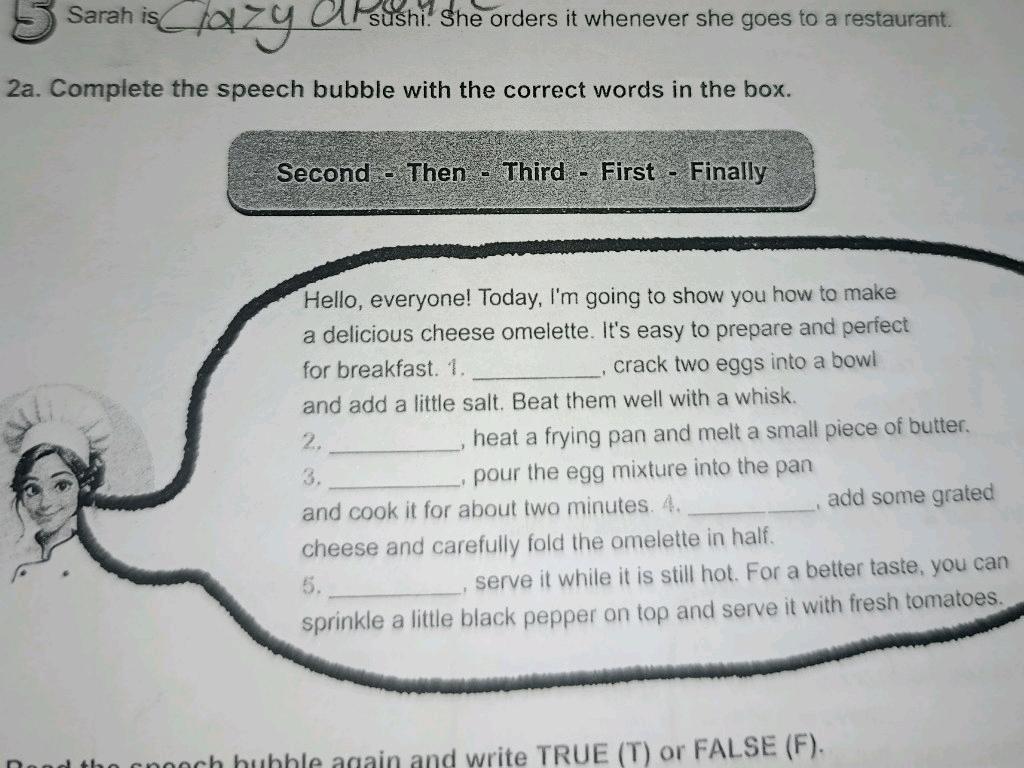
2a. Complete the speech bubble with the correct words in the box.
Second - Then - Third - First - Finally
Hello, everyone! Today, I’m going to show you how to make a delicious cheese omelette. It’s easy to prepare and perfect for breakfast. 1. ________, crack two eggs into a bowl and add a little salt. Beat them well with a whisk.
2. ________, heat a frying pan and melt a small piece of butter.
3. ________, pour the egg mixture into the pan and cook it for about two minutes. 4. ________, add some grated cheese and carefully fold the omelette in half.
5. ________, serve it while it is still hot. For a better taste, you can sprinkle a little black pepper on top and serve it with fresh tomatoes.
Sequencing Words in Process Descriptions: Recipe Steps
Sequencing words (transition words); are used to indicate the chronological order of actions or steps in a process, recipe, or instructional text. Standard English chronological ordering typically begins with First, advances through numerical or sequential connectors such as Second, Third, or Then, and concludes with Finally.
 Step-by-Step Analysis
- 1. First: Marks the initial action in the recipe (crack two eggs into a bowl and add a little salt).
- 2. Second: Introduces the subsequent stage (heat a frying pan and melt a small piece of butter).
- 3. Third: Represents the third chronological step (pour the egg mixture into the pan and cook it for about two minutes).
- 4. Then: Connects intermediate actions following the numbered steps (add some grated cheese and carefully fold the omelette in half).
- 5. Finally: Signals the final step and outcome of the entire procedure (serve it while it is still hot).
 FINAL ANSWER:
- First
- Second
- Third
- Then
- Finally
 EXAM INSIGHT: First and Finally are fixed anchor transitions for the very first and last steps of an instructional process, while Then, Next, and After that are flexible connectors used between intermediate stages.