S
R
HB
Vinter
enoe
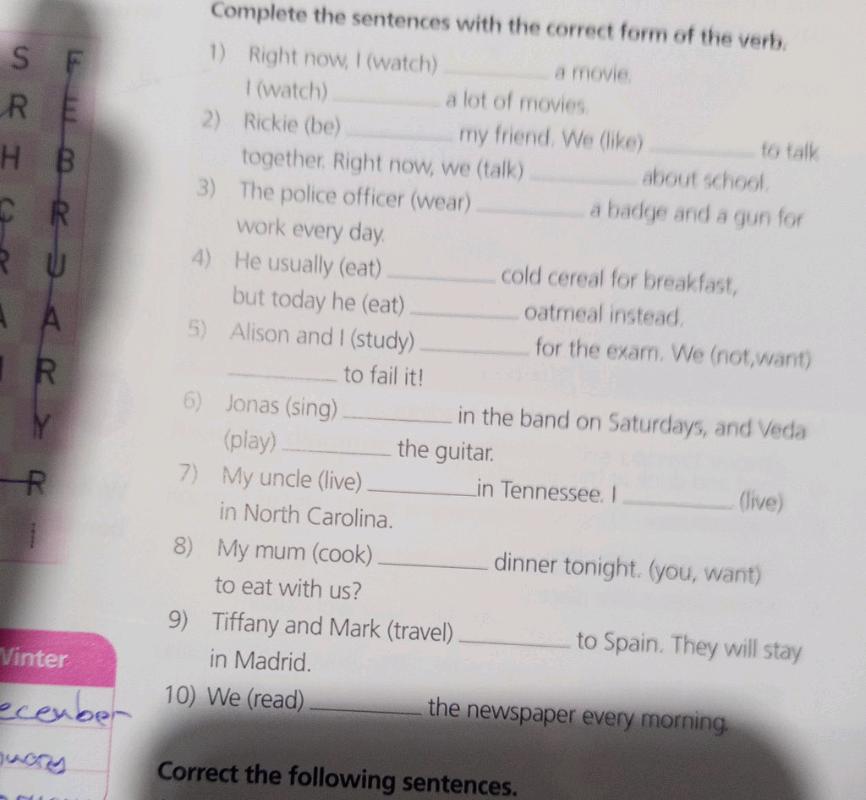
Complete the sentences wvith the correct form of the verb
- Right now i (watch)
I(watch)
- Rickie (be)
- He usualy (eat)
but today he (eat)
together Right now, we (talk)
- The police officer (wear)
work every day
- Alison and I (study)
- Jonas (sing)
(play)
to fail it!
- My uncle (live)
in North Carolina.
- My mum (cook)
to eat with us?
- We (read)
a lot of movies
- Tiffany and Mark (travel)
in Madrid.
my friend We (ike)
a fmovie
the guitar.
cold cereal for breakfast,
oatrmeal instead
about schiool
a badge and a gun for
fo talk
in the band on Saturdays, and Veda
Lin Tennessee.
Correct the following sentences.
for the exarm. We (not,want)
dinner tonight. (you, want)
the newspaper every morning
(ive)
to Spain. They will stay
Present Simple vs. Present Continuous Verb Forms
 FORMULAS & RULES USED:
- Present Simple (Habits, routines, permanent facts, stative verbs):
\text{Subject} + \text{Verb}_{(s/es)}
\text{Negative/Question: } \text{do/does} + (\text{not}) + \text{base verb}
- Present Continuous (Actions happening right now, temporary situations, current plans):
\text{Subject} + \text{am/is/are} + \text{Verb-ing}
 STEP-BY-STEP SOLUTION:
Step 1 — Sentence 1
- “Right now” indicates an action happening at this exact moment: am watching.
- “a lot of movies” expresses a regular habit or general fact: watch.
\text{Right now, I \textbf{am watching} a movie. I \textbf{watch} a lot of movies.}
Step 2 — Sentence 2
- “be” states a permanent fact: is.
- “like” is a stative verb expressing preference (not used in continuous form here): like.
- “Right now” indicates an activity in progress: are talking.
\text{Rickie \textbf{is} my friend. We \textbf{like} to talk together. Right now, we \textbf{are talking} about school.}
Step 3 — Sentence 3
- “every day” shows a daily routine, and “The police officer” is singular third-person (he/she): wears.
\text{The police officer \textbf{wears} a badge and a gun for work every day.}
Step 4 — Sentence 4
- “usually” signals a routine habit: eats.
- “but today” signals a temporary contrast or current exception to the routine: is eating.
\text{He usually \textbf{eats} cold cereal for breakfast, but today he \textbf{is eating} oatmeal instead.}
Step 5 — Sentence 5
- “Alison and I” (we) are currently engaged in a temporary preparation period: are studying.
- “want” is a stative verb of desire, requiring the auxiliary “do not”: do not want (or don’t want).
\text{Alison and I \textbf{are studying} for the exam. We \textbf{do not want} to fail it!}
Step 6 — Sentence 6
- “on Saturdays” expresses a repeating scheduled activity (routine): sings and plays.
\text{Jonas \textbf{sings} in the band on Saturdays, and Veda \textbf{plays} the guitar.}
Step 7 — Sentence 7
- Residence is treated as a permanent state or general truth: lives (for singular third-person) and live (for first-person I).
\text{My uncle \textbf{lives} in Tennessee. I \textbf{live} in North Carolina.}
Step 8 — Sentence 8
- “tonight” refers to an arrangement or action set for the evening: is cooking.
- “want” is a stative verb in a question form: Do you want.
\text{My mum \textbf{is cooking} dinner tonight. \textbf{Do you want} to eat with us?}
Step 9 — Sentence 9
- Tiffany and Mark are planning or currently embarking on a trip: are traveling (or are travelling).
\text{Tiffany and Mark \textbf{are traveling} to Spain. They will stay in Madrid.}
Step 10 — Sentence 10
- “every morning” expresses a daily routine: read.
\text{We \textbf{read} the newspaper every morning.}
━━━━━━━━━━━━━━━━━━━━━━━━━━━
 FINAL ANSWER:
- am watching / watch
- is / like / are talking
- wears
- eats / is eating
- are studying / do not want (don’t want)
- sings / plays
- lives / live
- is cooking / Do you want
- are traveling (are travelling)
- read
━━━━━━━━━━━━━━━━━━━━━━━━━━━
 KEY CONCEPTS:
- Time Keywords: Words like right now, at the moment, and today trigger the Present Continuous, whereas words like usually, every day, and on Saturdays trigger the Present Simple.
- Stative Verbs: Verbs related to feelings, desires, or states of being (such as like, want, be) are rarely used in the continuous (-ing) form.
 COMMON MISTAKES:
 Incorrect Approach: Writing “We are wanting to pass” because the action is happening now.
- Correct Approach: Stative verbs like want do not take continuous aspect; always use “We want” or “We do not want”.
Would you like to try a few more practice sentences to test identifying stative versus action verbs?