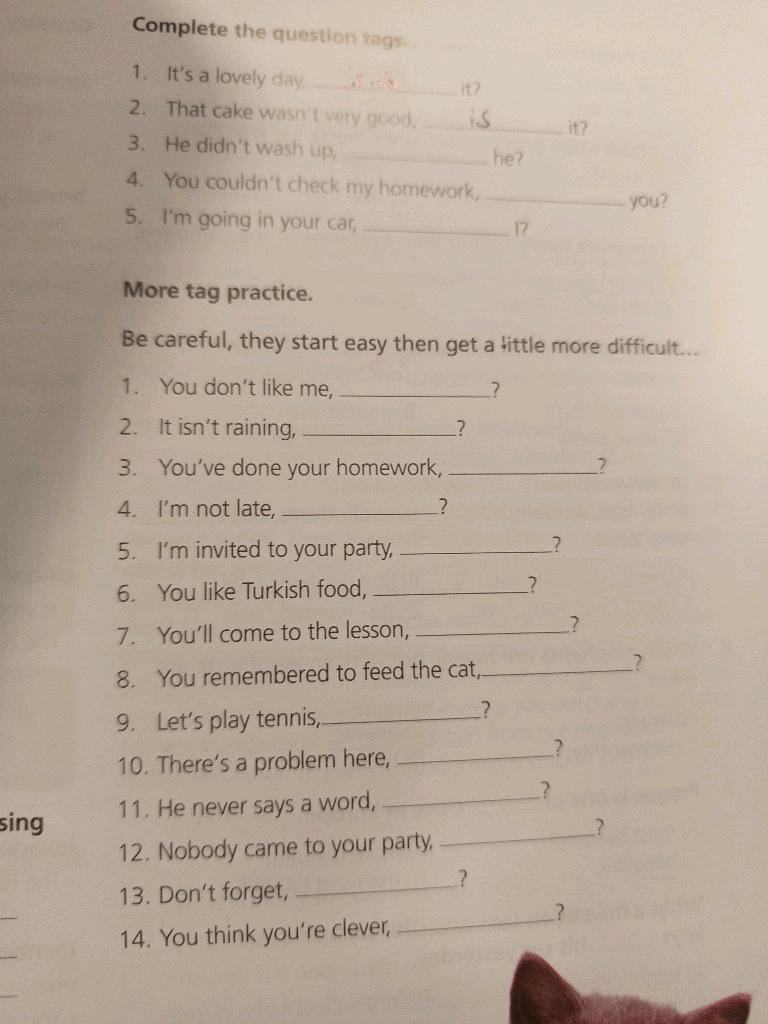
Complete the question tags.
- It’s a lovely day _________ it?
- That cake wasn’t very good, _________ it?
- He didn’t wash up, _________ he?
- You couldn’t check my homework, _________ you?
- I’m going in your car, _________ I?
More tag practice.
Be careful, they start easy then get a little more difficult…
- You don’t like me, _________?
- It isn’t raining, _________?
- You’ve done your homework, _________?
- I’m not late, _________?
- I’m invited to your party, _________?
- You like Turkish food, _________?
- You’ll come to the lesson, _________?
- You remembered to feed the cat, _________?
- Let’s play tennis, _________?
- There’s a problem here, _________?
- He never says a word, _________?
- Nobody came to your party, _________?
- Don’t forget, _________?
- You think you’re clever, _________?
English Grammar: Question Tags Rules and Practice
 KEY FORMULA / RULE: Question tags turn a statement into a question by adding an auxiliary verb and a subject pronoun to the end of the sentence. A positive statement takes a negative tag, while a negative statement takes a positive tag. Special cases include “I am” \rightarrow “aren’t I?”, “Let’s” \rightarrow “shall we?”, imperatives \rightarrow “will you?”, and words with negative meaning (never, nobody) which take a positive tag.
 SOLUTION STEPS
Part 1: Complete the Question Tags
- 1. It’s a lovely day, isn’t it? (Positive present with “is” \rightarrow negative tag)
- 2. That cake wasn’t very good, was it? (Negative past with “wasn’t” \rightarrow positive tag; note: the handwritten “is” in the image is incorrect because the sentence is in the past tense)
- 3. He didn’t wash up, did he? (Negative past with “didn’t” \rightarrow positive tag)
- 4. You couldn’t check my homework, could you? (Negative modal “couldn’t” \rightarrow positive tag)
- 5. I’m going in your car, aren’t I? (Positive “I am” \rightarrow irregular tag “aren’t I?”)
Part 2: More Tag Practice
- 1. You don’t like me, do you?
- 2. It isn’t raining, is it?
- 3. You’ve done your homework, haven’t you? (Present perfect with “have”)
- 4. I’m not late, am I? (Negative “I’m not” \rightarrow regular positive “am I?”)
- 5. I’m invited to your party, aren’t I? (Positive “I am” \rightarrow “aren’t I?”)
- 6. You like Turkish food, don’t you? (Present simple positive \rightarrow “don’t”)
- 7. You’ll come to the lesson, won’t you? (Future modal “will” \rightarrow “won’t”)
- 8. You remembered to feed the cat, didn’t you? (Past simple positive \rightarrow “didn’t”)
- 9. Let’s play tennis, shall we? (Suggestions starting with “Let’s” always take “shall we?”)
- 10. There’s a problem here, isn’t there? (Existential “there is” retains “there” as the pronoun)
- 11. He never says a word, does he? (“Never” makes the sentence negative, requiring a positive tag)
- 12. Nobody came to your party, did they? (“Nobody” is negative and refers to people, taking the plural pronoun “they” and positive auxiliary “did”)
- 13. Don’t forget, will you? (Negative imperative requests take “will you?”)
- 14. You think you’re clever, don’t you? (The tag targets the main governing clause “You think”)
 EXAM INSIGHT / PITFALL: Words like never, nobody, no one, hardly, and seldom carry negative meaning on their own. Even though the main verb looks positive, the clause is semantically negative, so the question tag must always be positive (e.g., Nobody came \rightarrow did they?).