-In
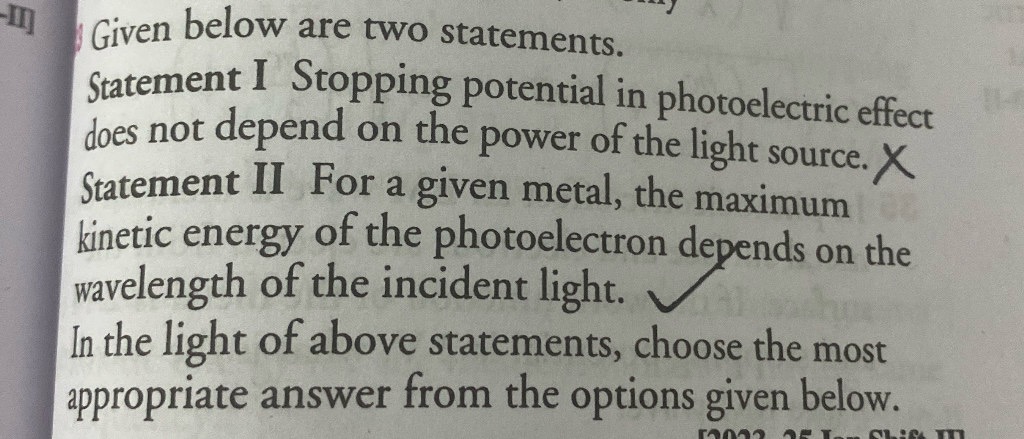
Civen below are two statements.
Sratement l Stopping potential in photoelectric efect
nes not depend on the power of the light source. X
Statement ll For a given metal, the maximum
kinetic energy of the photoelectron depends on the
wavelength of the incident light.
In the light of above statements, choose the most
appropriate answer from the options given below.
Analysis of Statements on the Photoelectric Effect
 FORMULAS & RULES USED:
K_{\max} = e V_0 = h\nu - \phi = \frac{hc}{\lambda} - \phi
Where:
- K_{\max} = Maximum kinetic energy of photoelectrons
- V_0 = Stopping potential
- e = Elementary charge
- \nu = Frequency of the incident light
- \lambda = Wavelength of the incident light
- \phi = Work function of the given metal
 STEP-BY-STEP SOLUTION & STATEMENT EVALUATION:
-
Evaluation of Statement I:
“Stopping potential in photoelectric effect does not depend on the power of the light source.”
- The power (or intensity) of a light source determines the number of photons emitted per second, not the energy of each individual photon.
- The stopping potential depends solely on the energy of the individual incident photons (h\nu) and the work function (\phi) of the metal surface:V_0 = \frac{hc}{e\lambda} - \frac{\phi}{e}
- Changing the power changes the number of ejected photoelectrons per second (photocurrent), but leaves the maximum kinetic energy and the stopping potential unchanged.
- Statement I is CORRECT (True).
-
Evaluation of Statement II:
“For a given metal, the maximum kinetic energy of the photoelectron depends on the wavelength of the incident light.”
- According to Einstein’s photoelectric equation:K_{\max} = \frac{hc}{\lambda} - \phi
- For a given metal, the work function \phi is constant. Consequently, the maximum kinetic energy K_{\max} depends inversely on the wavelength \lambda of the incident light.
- Statement II is CORRECT (True).
- According to Einstein’s photoelectric equation:
━━━━━━━━━━━━━━━━━━━━━━━━━━━
 FINAL ANSWER:
Both Statement I and Statement II are correct (true).
━━━━━━━━━━━━━━━━━━━━━━━━━━━
 KEY CONCEPTS:
- Power / Intensity vs. Frequency: Intensity or power governs the number of photoelectrons emitted per second (saturation current), whereas frequency (or wavelength) governs the energy of each individual emitted electron (stopping potential).
- Stopping Potential (V_0): The minimum retarding potential required to stop the fastest-moving photoelectrons from reaching the collector plate.
 COMMON MISTAKES:
 Incorrect Approach: Assuming that higher power delivers more total energy to each electron, thereby increasing the stopping potential.
- Correct Approach: Light interacts with electrons in discrete packets (photons) on a one-to-one basis. Higher power merely means more photons, not more energetic photons.
Would you like to solve a numerical problem calculating the threshold wavelength and stopping potential for a given metal?