2C
Circle the correct word.
NOUN
1 le ansaeres the quslians quick/quickły.
Put the worts below into the correct category by adding suffixes. Some words may not fit in some categories
Z Mandylsa pretty/prettity ar
1The cass terrible /terribly ioud today
4Max is s good/well singer
S tou can easy /easity opan this tin
a terribte/ terribly day today
ahe irps the sang good /well
a Heis = careful /caretutly drser
Hadees the car careful/carefutty:
10. The dog barks loud/ leudly
Put the ords in brackets in the appropriate form (use suffixes)
1He was acting inavery lchildl
25he led her Le (happyl
2e paed his exan He as fsuccess)
8
51touldnted any fweak)
6H
4The leam that he su0pOrtedwas abie t wn the lchampion)
He wants ts be a Imath
Imathematics)
VERR
ee Were only a thand)
and she died ate
Vou needa lcombine)
ih his theory
Theroad was t00 narro s thy hud tn lwidel
91ihink thatyou shot reconsiaeryour ldecidel
act
mernory
ADVERB
happiy
coipete
Tor the second ti
when ne gro up
at pedple at the ateh
siow
11. The bus driver was serious /seriously injured
12 Kenn sextreme /extremely clever
13 This hmburger tastes awłut /awtully
ADJECTIVE
happy
14. Be careful /caretutty with this glass of rrniik shot
15, Robin locks sad /s
ay Whats the matter with hm
16 Jack is terrible / teribly upset about los ng hs krro
17.Thus steak shelis good /wetl.
18. Our basketball team played bad /badly last Frida
19 Don’tspeak so fast / fastly i can’t understand yo
20Mura opened her present slow/stowty
tay not be the best thing to
metvaton, orgaization and hard ork to teulize your iam
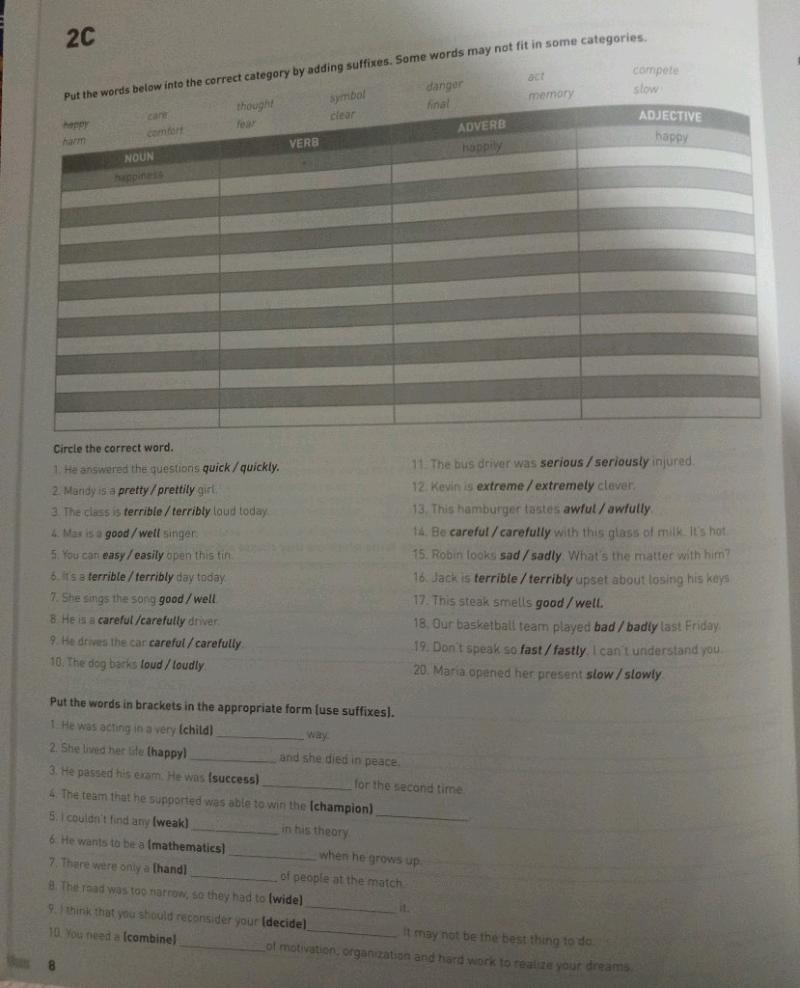
English Grammar: Word Formation & Adjectives vs. Adverbs
Part 1: Word Formation Table (Suffixes)
| Base Word | Noun | Verb | Adverb | Adjective |
|---|---|---|---|---|
| happy | happiness | — | happily | happy |
| care | care / carelessness | care | carefully / carelessly | careful / careless |
| thought | thought / thoughtfulness | think | thoughtfully / thoughtlessly | thoughtful / thoughtless |
| symbol | symbol | symbolize | symbolically | symbolic |
| danger | danger | endanger | dangerously | dangerous |
| act | action / activity / actor | act / activate | actively | active |
| compete | competition / competitor | compete | competitively | competitive |
| harm | harm | harm | harmlessly / harmfully | harmful / harmless |
| comfort | comfort | comfort | comfortably | comfortable |
| fear | fear | fear | fearfully / fearlessly | fearful / fearless |
| clear | clarity / clearness | clear / clarify | clearly | clear |
| final | final / finale / finality | finalize | finally | final |
| memory | memory | memorize | memorably | memorable |
| slow | slowness | slow | slowly | slow |
Part 2: Circle the Correct Word (Adjective vs. Adverb)
 FORMULAS & RULES USED:
- Adjectives modify nouns (
a careful driver) or follow linking/sense verbs such as look, smell, taste, sound, seem, be (tastes awful,looks sad). - Adverbs of manner modify verbs, adjectives, or other adverbs (
drives carefully,extremely clever).
- He answered the questions quickly. (Modifies the verb “answered”)
- Mandy is a pretty girl. (Modifies the noun “girl”)
- The class is terribly loud today. (Modifies the adjective “loud”)
- Max is a good singer. (Modifies the noun “singer”)
- You can easily open this tin. (Modifies the verb “open”)
- It’s a terrible day today. (Modifies the noun “day”)
- She sings the song well. (Modifies the verb “sings”)
- He is a careful driver. (Modifies the noun “driver”)
- He drives the car carefully. (Modifies the verb “drives”)
- The dog barks loudly. (Modifies the verb “barks”)
- The bus driver was seriously injured. (Modifies the participle/adjective “injured”)
- Kevin is extremely clever. (Modifies the adjective “clever”)
- This hamburger tastes awful. (Follows the sense verb “tastes”)
- Be careful with this glass of milk. It’s hot. (Follows the linking verb “be”)
- Robin looks sad. What’s the matter with him? (Follows the linking verb “looks”)
- Jack is terribly upset about losing his keys. (Modifies the adjective “upset”)
- This steak smells good. (Follows the sense verb “smells”)
- Our basketball team played badly last Friday. (Modifies the verb “played”)
- Don’t speak so fast. I can’t understand you. (“Fast” is both an adjective and an adverb; “fastly” does not exist)
- Maria opened her present slowly. (Modifies the verb “opened”)
Part 3: Word Formation with Suffixes
-
He was acting in a very childish way.
(Suffix:-ishforms an adjective describing negative, immature behavior) -
She lived her life happily and she died in peace.
(Suffix:-lyforms an adverb modifying the verb “lived”) -
He passed his exam. He was successful for the second time.
(Suffix:-fulforms an adjective following the linking verb “was”) -
The team that he supported was able to win the championship.
(Suffix:-shipforms a noun denoting a status or competition) -
I couldn’t find any weakness in his theory.
(Suffix:-nessforms an abstract noun after the determiner “any”) -
He wants to be a mathematician when he grows up.
(Suffix:-ianforms a noun referring to a specialist or profession) -
There were only a handful of people at the match.
(Suffix:-fulforms a noun meaning a small quantity) -
The road was too narrow, so they had to widen it.
(Suffix:-enforms a verb meaning “to make wider” after the infinitive “to”) -
I think that you should reconsider your decision. It may not be the best thing to do.
(Suffix:-ionforms a noun after the possessive adjective “your”) -
You need a combination of motivation, organization and hard work to realize your dreams.
(Suffix:-ationforms a noun after the indefinite article “a”)
 KEY CONCEPTS:
- Linking / Sense Verbs: Verbs like taste, smell, look, feel, sound, be are followed by adjectives, not adverbs, because they describe the subject rather than the action.
- Irregular Adverbs:
- Good \rightarrow Well
- Fast \rightarrow Fast (never “fastly”)
- Hard \rightarrow Hard (“hardly” means “scarcely”, not with great effort)
 COMMON MISTAKES:
 Incorrect Approach: “The food tastes deliciously.”
 Correct Approach: “The food tastes delicious.” (Use an adjective after sense verbs).
Would you like to practice creating more nouns, verbs, and adjectives using common prefixes and suffixes?