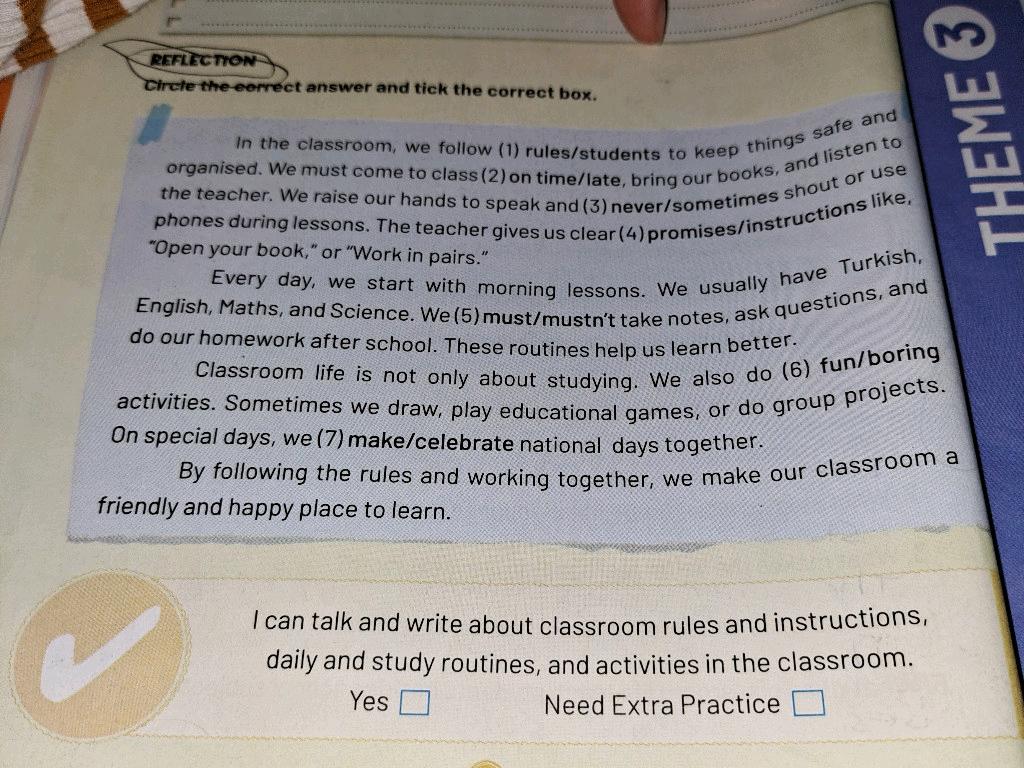
REFLECTION
Circle the correct answer and tick the correct box.
In the classroom, we follow (1) rules/students to keep things safe and organised. We must come to class (2) on time/late, bring our books, and listen to the teacher. We raise our hands to speak and (3) never/sometimes shout or use phones during lessons. The teacher gives us clear (4) promises/instructions like, “Open your book,” or "Work in pairs.
Every day, we start with morning lessons. We usually have Turkish, English, Maths, and Science. We (5) must/mustn’t take notes, ask questions, and do our homework after school. These routines help us learn better.
Classroom life is not only about studying. We also do (6) fun/boring activities. Sometimes we draw, play educational games, or do group projects. On special days, we (7) make/celebrate national days together.
By following the rules and working together, we make our classroom a friendly and happy place to learn.
I can talk and write about classroom rules and instructions, daily and study routines, and activities in the classroom.
Yes square Need Extra Practice square
Classroom Rules, Routines, and Vocabulary in Context
 KEY FORMULA / RULE: Contextual vocabulary and modal verbs determine the correct word choice based on meaning, collocations (e.g., follow rules, on time, celebrate days), and classroom etiquette rules.
 SOLUTION & OPTION ANALYSIS
- (1) rules: The verb phrase is “follow rules” to ensure order and safety in a school environment.
- (2) on time: The obligation “must” requires positive behavior; students must arrive on time, not late.
- (3) never: Shouting and phone use are disruptive behaviors prohibited during class time, so the negative frequency adverb never is correct.
- (4) instructions: Directives such as “Open your book” or “Work in pairs” are classroom instructions (directions given by a teacher), not personal promises.
- (5) must: Taking notes, asking questions, and completing homework are necessary positive study routines, requiring the modal verb of obligation must.
- (6) fun: Drawing, playing educational games, and group projects are engaging and enjoyable (fun) activities, contrasting with strict studying.
- (7) celebrate: The natural collocation used with holidays and national observances is to celebrate national days.
 FINAL ANSWER:
- rules
- on time
- never
- instructions
- must
- fun
- celebrate
- Self-Evaluation Checkbox: Tick Yes [
 ] (confirming mastery of talking and writing about classroom rules, routines, and activities).
 EXAM INSIGHT / PITFALL: Pay close attention to surrounding verbs and examples. When a sentence gives examples in quotation marks (such as “Open your book”), look at the function of those phrases—they serve as commands or directions (instructions).