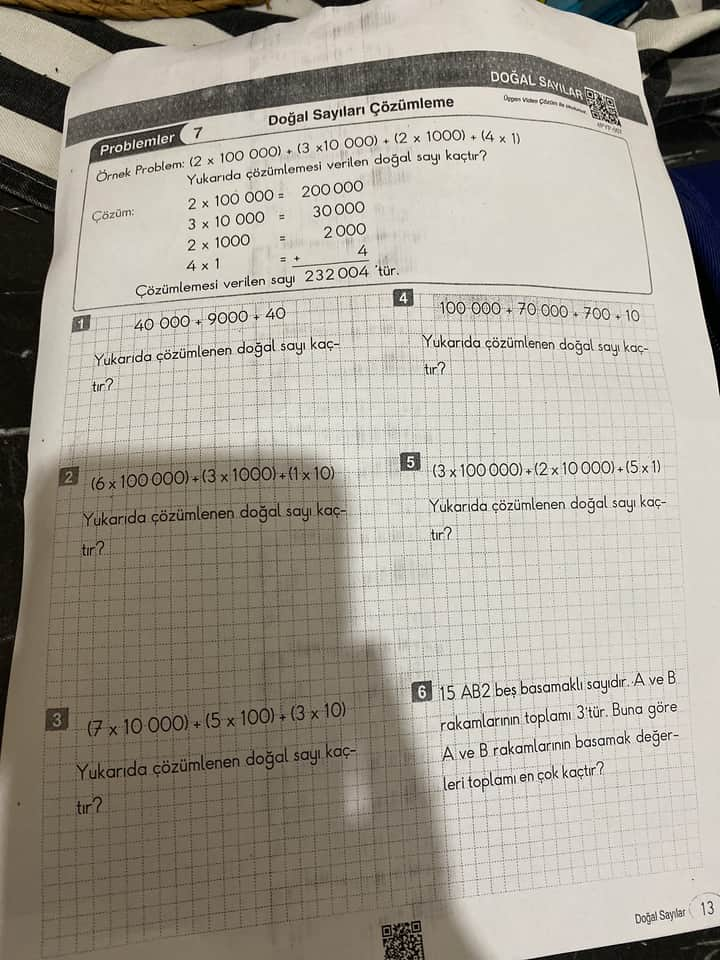
Merhaba Yonca, soruların adım adım çözümleri şöyle:
-
40 000 + 9 000 + 40
= 49 040 -
(6 × 100 000) + (3 × 1 000) + (1 × 10)
= 600 000 + 3 000 + 10
= 603 010 -
(7 × 10 000) + (5 × 100) + (3 × 10)
= 70 000 + 500 + 30
= 70 530 -
100 000 + 70 000 + 700 + 10
= 170 710 -
(3 × 100 000) + (2 × 10 000) + (5 × 1)
= 300 000 + 20 000 + 5
= 320 005 -
15 AB2 sayısında A+B = 3 ve basamak değerleri A→100’lük, B→10’luk.
A+B=3 iken A’nın büyük olması basamak değeri toplamını (A×100 + B×10) maksimize eder.
En büyük değer için A=3, B=0 ⇒ 3×100 + 0×10 = 300
Özet tablo:
• 1 → 49 040
• 2 → 603 010
• 3 → 70 530
• 4 → 170 710
• 5 → 320 005
• 6 → 300
Yonca_Kilic’s question: Solve the natural number decomposition problems shown in the image.
Answer:
Let’s analyze and solve each problem step-by-step according to the natural number decomposition method shown in the example at the top of the image.
Table of Contents
1. Example Problem Explained
The example problem decomposes the number into parts based on place values:
Each term corresponds to digit × place value. This method is used to find the original natural number that the sum equals.
2. Problem 1
Let’s add:
Answer:
The natural number is 49,040.
3. Problem 2
Calculate each term:
Sum:
Answer:
The natural number is 603,010.
4. Problem 3
Calculate:
Sum:
Answer:
The natural number is 70,530.
5. Problem 4
Sum step-by-step:
Answer:
The natural number is 170,710.
6. Problem 5
Calculate terms:
Sum:
Answer:
The natural number is 320,005.
7. Problem 6
Problem:
15AB2 is a five-digit number. The sum of the digits A and B is 3. What is the maximum possible sum of the place values of A and B digits?
Step 1: Understand the digits
The number is:
$$1 \quad 5 \quad A \quad B \quad 2$$
Where A and B are digits (0–9).
We have:
We need to find the maximum possible sum of their place values.
The place values for A and B:
- A is in the hundreds place → value contribution: A \times 100
- B is in the tens place → value contribution: B \times 10
We want to maximize:
with the constraint:
and both A, B in [0, 9].
Step 2: Calculate Maximum
Since A contributes more (100 times) than B (10 times), maximize A.
Possible values with A + B = 3:
| A | B | 100A + 10B |
|---|---|---|
| 3 | 0 | 300 |
| 2 | 1 | 210 |
| 1 | 2 | 120 |
| 0 | 3 | 30 |
Maximum is 300 when A=3 and B=0.
Answer:
The maximum sum of the place values of A and B is 300.
Summary Table
| Problem | Expression | Calculated Number | Explanation |
|---|---|---|---|
| 1 | 40,000 + 9,000 + 40 | 49,040 | Sum of terms |
| 2 | 6 \times 100,000 + 3 \times 1,000 + 1 \times 10 | 603,010 | Multiply digits by place values |
| 3 | 7 \times 10,000 + 5 \times 100 + 3 \times 10 | 70,530 | Multiply digits by place values |
| 4 | 100,000 + 70,000 + 700 + 10 | 170,710 | Sum of terms |
| 5 | 3 \times 100,000 + 2 \times 10,000 + 5 \times 1 | 320,005 | Multiply digits by place values |
| 6 | Maximize 100A + 10B with A + B =3 | 300 | A=3, B=0 gives max sum |
If you want, I can also help explain any step in more detail! @Yonca_Kilic