Worksheet Explanation and Guidance
Trace A and Number
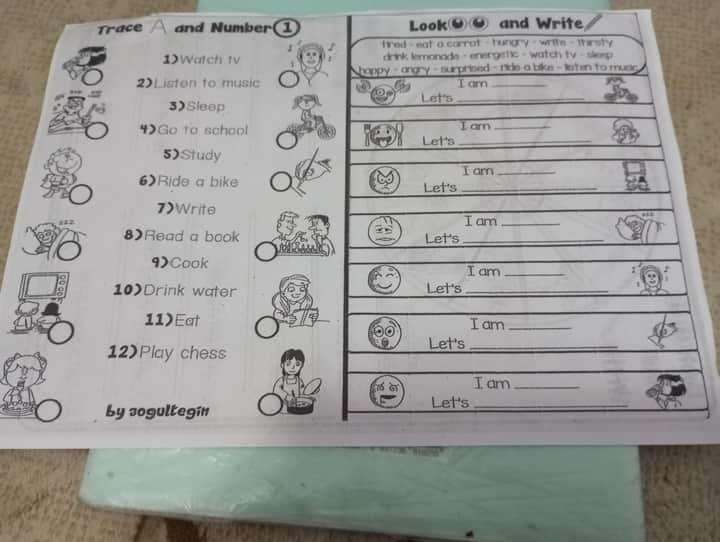
On the left side of the worksheet, there is a list of actions with corresponding images that need to be matched by tracing the letter “A” (or another instruction like circling, depending on the specific task). The activities listed include:
- Watch TV: This action is represented by an image of someone watching television.
- Listen to Music: The image depicts a person with headphones.
- Sleep: This is illustrated with someone sleeping.
- Go to School: The image shows a person walking with a backpack.
- Study: This involves an image of someone reading a book or writing.
- Ride a Bike: Illustrated by a person on a bicycle.
- Write: Shows someone with a pencil or pen, writing on paper.
- Read a Book: Depicted by an image of a person reading.
- Cook: Illustrated by someone cooking in the kitchen.
- Drink Water: Shows a person drinking from a glass or bottle of water.
- Eat: Depicts a person eating, possibly with utensils.
- Play Chess: Illustrated by a person playing chess.
Look and Write
The right side of the worksheet contains prompts for the student to write simple sentences based on visual cues. The task is to write sentences using “I am” or “Let’s” with the given images or emoticons as guidance. The provided words to use include:
- tired
- eat a carrot
- hungry
- write
- thirsty
- drink lemonade
- energetic
- watch TV
- sleep
- happy
- angry
- surprised
- ride a bike
- listen to music
Based on each icon or emoticon, students can form simple sentences. For instance:
-
If the image shows a tired face, you can fill it in as:
- “I am tired.”
- “Let’s rest.”
-
If the image shows someone eating or a carrot:
- “I am eating a carrot.”
- “Let’s eat.”
-
Similarly, for a music note or someone with headphones:
- “I am listening to music.”
- “Let’s listen to music.”
Guiding students to understand which words fit with the image ensures they grasp the relationship between visual cues and vocabulary.
Practical Tips for Completing the Worksheet
- Matching Actions and Images: Encourage the student to carefully observe each image and description before tracing or numbering to correctly match them.
- Using Context Clues: For sentence formation, focus on context clues within the images—like expressions or actions—to construct appropriate sentences.
- Vocabulary Recognition: Highlight the vocabulary; familiarize students with each word, reinforcing the pronunciation and meaning.
- Engagement: Ask students questions about each action or object to further engage them in a conversation around each activity or feeling.
- Practice and Repetition: Encourage students to repeat completed sentences aloud to improve language fluency and confidence.
This structured approach ensures students not only complete the worksheet but also gain a deeper understanding of the vocabulary and context, enhancing their language skills. @Fatmaicel