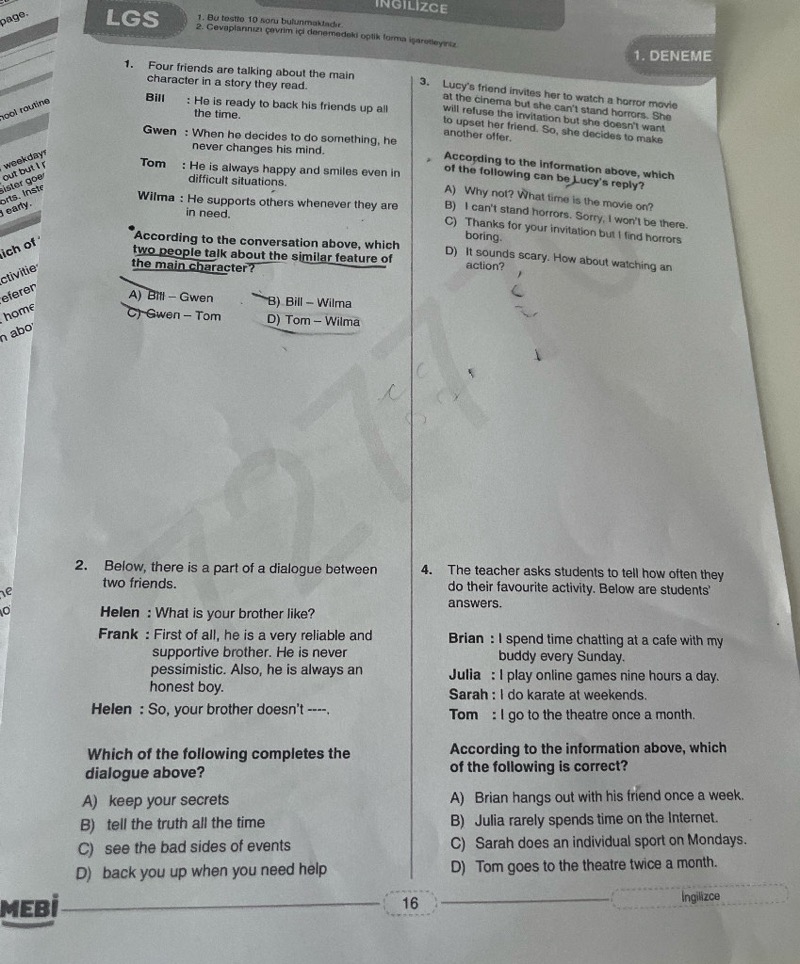
- Four friends are talking about the main character in a story they read.
Bill1 He is ready to back his friends up all the time.
Gwen1 When he decides to do something, he never changes his mind.
Tom1 He is always happy and smiles even in difficult situations.
Wilma1 He supports others whenever they are in need.
According to the conversation above, which two people talk about the similar feature of the main character?
A) Bill - Gwen
B) Bill - Wilma
C) Gwen - Tom
D) Tom - Wilma - Below, there is a part of a dialogue between two friends.
Helen1 What is your brother like?
Frank1 First of all, he is a very reliable and supportive brother. He is never pessimistic. Also, he is always an honest boy.
Which of the following completes the dialogue above?
A) keep your secrets
B) tell the truth all the time
C) see the bad sides of events
D) back you up when you need help - Lucy’s friend invites her to watch a horror movie at the cinema but she can’t stand horrors. She will refuse the invitation but she doesn’t want to upset her friend. So, she decides to make another offer.
A) Why not? What time is the movie on?
B) I can’t stand horrors. Sorry, I won’t be there.
C) Thanks for your invitation but I find horrors boring.
D) It sounds scary. How about watching an action? - The teacher asks students to tell how often they do their favourite activity. Below are students’ answers.
Brian1 I spend time chatting at a cafe with my buddy every Sunday.
Julia1 I play online games nine hours a day.
Sarah1 I do karate at weekends.
Tom1 I go to the theatre once a month.
A) Brian hangs out with his friend once a week.
B) Julia rarely spends time on the Internet.
C) Sarah does an individual sport on Mondays.
D) Tom goes to the theatre twice a month.
LGS English: Friendship and Teen Life Reading Comprehension
 KEY FORMULA / RULE: In LGS English questions, match synonymous target vocabulary (e.g., back up = support, pessimistic = seeing the bad sides of events) and identify communicative functions such as refusing an invitation while making an alternative offer, or calculating frequency equivalents (every Sunday = once a week).
 SOLUTION & OPTION ANALYSIS
Question 1
- Bill says: “He is ready to back his friends up all the time.” (Target synonym: to back up = to support).
- Gwen describes him as stubborn or determined (“never changes his mind”).
- Tom describes him as optimistic and cheerful (“always happy and smiles”).
- Wilma says: “He supports others whenever they are in need.”
- Conclusion: Both Bill and Wilma highlight that the character is supportive and helpful.
- A) Bill – Gwen: Incorrect (Supportive vs. Stubborn).
- B) Bill – Wilma: Correct (Both mention being supportive).
- C) Gwen – Tom: Incorrect (Determined vs. Cheerful).
- D) Tom – Wilma: Incorrect (Cheerful vs. Supportive).
 FINAL ANSWER: B) Bill – Wilma
Question 2
- Dialogue Context: Frank states that his brother is reliable, supportive, honest, and “never pessimistic”.
- Helen completes the negative sentence: “So, your brother doesn’t ----.”
- A) keep your secrets: Incorrect; a reliable person does keep secrets.
- B) tell the truth all the time: Incorrect; an honest person does tell the truth.
- C) see the bad sides of events: Correct; pessimistic means focusing on the negative aspects of life, so being “never pessimistic” means he does not see the bad sides.
- D) back you up when you need help: Incorrect; a supportive person does back you up.
FINAL ANSWER: C) see the bad sides of events
Question 3
- Context: Lucy must refuse the horror movie invitation without upsetting her friend and make another offer.
- A) Why not? What time is the movie on?: Incorrect; this accepts the invitation.
- B) I can’t stand horrors. Sorry, I won’t be there.: Incorrect; refuses bluntly without offering an alternative.
- C) Thanks for your invitation but I find horrors boring.: Incorrect; refuses without proposing another activity.
- D) It sounds scary. How about watching an action?: Correct; politely declines and proposes a different movie genre (“How about…?”).
FINAL ANSWER: D) It sounds scary. How about watching an action?
Question 4
- Student Statements:
- Brian: “every Sunday” \rightarrow happens once every seven days (once a week).
- Julia: “nine hours a day” \rightarrow spends an excessive amount of time, not rarely.
- Sarah: “at weekends” \rightarrow Saturday and Sunday, not Mondays.
- Tom: “once a month” \rightarrow one time per month, not twice.
- A) Brian hangs out with his friend once a week: Correct; every Sunday equals once a week.
- B) Julia rarely spends time on the Internet: Incorrect; 9 hours a day is very frequent.
- C) Sarah does an individual sport on Mondays: Incorrect; she practices on weekends.
- D) Tom goes to the theatre twice a month: Incorrect; he goes once a month.
FINAL ANSWER: A) Brian hangs out with his friend once a week.
 EXAM INSIGHT / PITFALL: Pay close attention to negative sentence frames like “doesn’t ----” in dialogues. When the prompt uses negative polarity, choose the behavior the person avoids, rather than their positive traits.