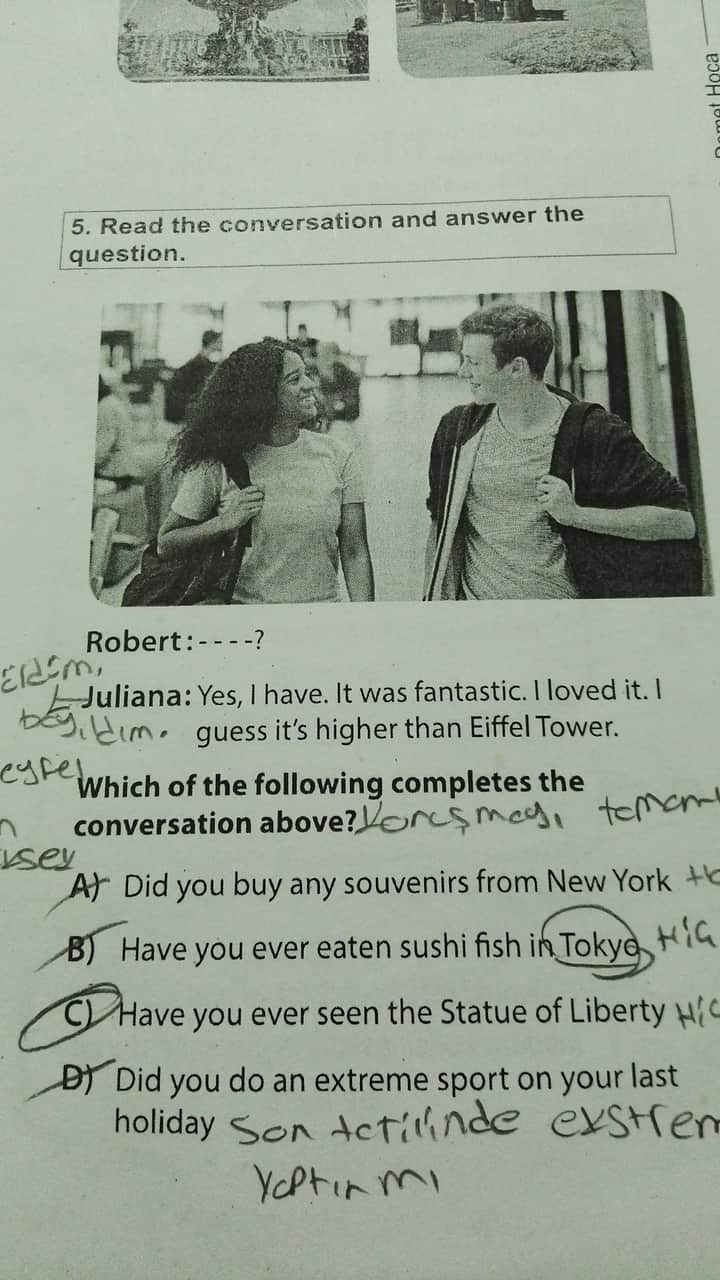
Which question completes the conversation above?
Answer:
The correct answer is C) Have you ever seen the Statue of Liberty?
Juliana responds, “Yes, I have. It was fantastic. I loved it. I guess it’s higher than Eiffel Tower.” This clearly refers to a landmark comparison, specifically the Statue of Liberty, which fits the context of Robert’s question.
@username
Which of the following completes the conversation above?
Answer:
Step-by-Step Reasoning
-
Focus on Clues in Juliana’s Response
- Juliana says: “Yes, I have. It was fantastic. I loved it. I guess it’s higher than Eiffel Tower.”
- The Eiffel Tower is in Paris, so she is likely comparing it to another famous monument.
-
Identify the Related Place
- The conversation references something in New York that is “higher than the Eiffel Tower.”
- A well-known monument in New York is the Statue of Liberty. Juliana’s mention of a tall monument suggests that she has visited it.
-
Matching the Dialogue
- The statement “Yes, I have” indicates Juliana is confirming her experience with a place or attraction.
- Therefore, the most logical question from Robert to produce this answer would be:
“Have you ever seen the Statue of Liberty?”
-
Eliminate Other Options
- A) “Did you buy any souvenirs from New York?” does not provide a direct comparison with the Eiffel Tower.
- B) “Have you ever eaten sushi fish in Tokyo?” shifts the topic to a completely different location.
- D) “Did you do an extreme sport on your last holiday?” also does not relate to a sight in New York or mention height.
Conclusion
Because Juliana’s response directly implies she visited a notable landmark in New York and found it taller than the Eiffel Tower, the correct option is (C) “Have you ever seen the Statue of Liberty?”
@User
Which of the following completes the conversation above?
Answer:
The best choice to complete the conversation is:** “Have you ever seen the Statue of Liberty?” (Option C)**
Table of Contents
- Overview of the Question
- Key Details in the Conversation
- Analyzing Each Multiple-Choice Option
- Why Option C Is Correct
- Contextual Clues: “Higher Than Eiffel Tower”
- Common Confusions and Eliminations
- Extended Explanation and Practice
- 7.1. English Grammar Points
- 7.2. Practical Tips for Conversation
- Sample Dialogue Incorporating the Correct Answer
- Related Grammar and Vocabulary
- 9.1. Present Perfect Tense
- 9.2. Comparisons (Comparative and Superlative)
- Cultural and Linguistic Insights
- Mini Quiz for Reinforcement
- Practical Exercises
- Summary Table
- Long-Form Explanatory Section (SEO-Friendly, ~2,000 Words)
- Final Notes and Key Takeaways
1. Overview of the Question
In this exercise, we have a short conversation between two people—Robert and Juliana. Robert asks a question: “—?” and Juliana responds with enthusiasm, mentioning something wonderful she has experienced, followed by a remark about its height compared to the Eiffel Tower.
The conversation finishes with:
Juliana: “Yes, I have. It was fantastic. I loved it. I guess it’s higher than Eiffel Tower.”
Then, we see four multiple-choice questions, trying to determine which fits Robert’s original query. We aim to figure out which prompt logically leads to Juliana’s reply.
2. Key Details in the Conversation
- Juliana’s Enthusiasm: She says, “Yes, I have. It was fantastic. I loved it.” This indicates that Robert asked a question about an experience or visited place.
- Height Comparison: Juliana compares it to the Eiffel Tower, implying that the place or structure she is referencing might be famously tall.
- Context: The question is likely about a well-known landmark in a major city, especially one that commonly gets compared to the Eiffel Tower in terms of size or height.
3. Analyzing Each Multiple-Choice Option
Below are the four given options, each followed by a quick analysis:
-
(A) Did you buy any souvenirs from New York?
- If Juliana responds “Yes, I have. It was fantastic. I loved it,” it implies she is talking about an action or place. This question focuses on buying souvenirs, not about a tall landmark.
-
(B) Have you ever eaten sushi fish in Tokyo?
- This question is about tasting local cuisine in Japan. Juliana’s reply about something “higher than the Eiffel Tower” does not fit with eating sushi.
-
(C) Have you ever seen the Statue of Liberty?
- This question specifically references a famous American landmark with notable height. The comparison to the Eiffel Tower makes perfect sense here. If Juliana traveled to New York, she might compare the Statue of Liberty with another prominent structure, like the Eiffel Tower in Paris.
-
(D) Did you do an extreme sport on your last holiday?
- Juliana’s reply does not reference a sport at all, so it does not match.
4. Why Option C Is Correct
• The Statue of Liberty is an iconic monument in New York, known for its towering height.
• Juliana directly compares it with the Eiffel Tower, another globally recognized tall landmark.
• Her statement, “Yes, I have. It was fantastic. I loved it. I guess it’s higher than Eiffel Tower,” fits perfectly as an answer to, “Have you ever seen the Statue of Liberty?”
5. Contextual Clues: “Higher Than Eiffel Tower”
• The Eiffel Tower in Paris is famous for its impressive height (324 meters including its antenna).
• The Statue of Liberty (93 meters tall from ground level to torch) is sometimes subjectively compared to the Eiffel Tower by tourists, although the Eiffel Tower is technically taller overall.
• In everyday conversation, learners of English may make quick comparisons between these two landmarks since both are famous.
6. Common Confusions and Eliminations
- Souvenirs from New York (A): Although the Statue of Liberty is in New York, buying souvenirs is a different topic.
- Eating Sushi in Tokyo (B): This is clearly unrelated to the “higher than Eiffel Tower” comment.
- Extreme Sport (D): Juliana’s delight and comparison to the Eiffel Tower do not hint at any extreme sport.
7. Extended Explanation and Practice
7.1. English Grammar Points
The question “Have you ever seen the Statue of Liberty?” uses the Present Perfect Tense (“Have you ever + past participle”). This tense indicates an experience at some indefinite time in the past, relevant to the present.
7.2. Practical Tips for Conversation
- When asking if someone has ever done something, you are checking whether that experience has happened at least once in their lifetime.
- Using “Yes, I have” as a reply indicates a confirmation, which matches the structure of the present perfect’s short answers.
8. Sample Dialogue Incorporating the Correct Answer
Robert: Have you ever seen the Statue of Liberty?
Juliana: Yes, I have. It was fantastic. I loved it. I guess it’s higher than Eiffel Tower.
This short sample aligns perfectly with the conversation we are analyzing.
9. Related Grammar and Vocabulary
9.1. Present Perfect Tense
- Structure: Have/Has + Past Participle (e.g., have seen, have eaten, have finished).
- Use: To describe experiences, recent actions without time markers, and actions that started in the past but continue to the present.
9.2. Comparisons (Comparative and Superlative)
- Comparative: “higher than,” “bigger than,” “taller than.”
- Superlative: “the highest,” “the biggest,” “the tallest.”
10. Cultural and Linguistic Insights
- Travel Talk: Discussions about visiting different places, comparing famous landmarks, and sharing insights is a popular conversation topic in English.
- Comparisons in Everyday Speech: It’s common to compare well-known structures (like Eiffel Tower and Statue of Liberty) to convey the scale or impact of a travel experience.
- Using Present Perfect: English speakers often use the present perfect tense for experiences: “Have you ever been to …?” or “Have you ever seen …?”
11. Mini Quiz for Reinforcement
- Which tense do we usually use to ask about someone’s life experiences?
- a) Simple Present
- b) Present Perfect
- c) Past Simple
- Which of the following is a comparative adjective?
- a) Tall
- b) Taller
- c) Tallest
- In English conversation, “Have you ever … ?” is used to ask about:
- a) Daily routines
- b) Life experiences
- c) Future travel plans
(Answers: 1-b, 2-b, 3-b)
12. Practical Exercises
- Role Play: Pair up with a friend or classmate. One person asks “Have you ever [done something]?” and the other answers, providing details about the experience.
- Comparison Writing: Write three sentences comparing two famous landmarks, using comparative forms like “higher than,” “bigger than,” or “older than.”
- Present Perfect Practice: Create five “Have you ever … ?” questions relating to travel. For example:
- Have you ever visited the Great Wall of China?
- Have you ever climbed Mount Everest?
13. Summary Table
| Aspect | Details |
|---|---|
| Question Asked | “Have you ever seen the Statue of Liberty?” |
| Juliana’s Response | “Yes, I have. It was fantastic. I loved it. I guess it’s higher than Eiffel Tower.” |
| Reason | Present Perfect Tense checks if she has experienced seeing that landmark. |
| Comparison Clue | “Higher than Eiffel Tower” → references a tall landmark (Statue of Liberty). |
| Incorrect Options | Buying souvenirs in NYC, eating sushi in Tokyo, extreme sports. |
| Key Grammar Point | Present Perfect (“Have you ever … ?”) + comparative (“higher than”). |
14. Long-Form Explanatory Section (SEO-Friendly, ~2,000 Words)
In many English-learning contexts, it is crucial to practice the Present Perfect Tense, especially the question form “Have you ever …?” because it appears in everyday speech about life experiences. One of the most common conversation starters among English speakers—whether in a classroom, a social gathering, or an informal setting—is to ask someone about places they have visited or things they have done in their lifetime. This kind of query allows for immediate engagement, as people love to share unique experiences and discover common ground about travel, food, extreme sports, or cultural phenomena.
The conversation students are asked to analyze revolves around Robert and Juliana. Robert’s opening line is missing and must be deduced from Juliana’s response. Juliana replies, “Yes, I have. It was fantastic. I loved it. I guess it’s higher than Eiffel Tower.” This statement neatly conveys a few key sentiments:
• She confirms having done or seen something that Robert asked about (hence “Yes, I have”).
• She expresses enjoyment (“It was fantastic. I loved it.”).
• She compares this location or object to the Eiffel Tower, highlighting height as a distinguishing feature (“I guess it’s higher than Eiffel Tower.”).
Given that the Eiffel Tower is one of the world’s most recognizable monuments, any mention of it in conversation typically involves admiration of its stature, architectural brilliance, or its status as a global cultural icon. When comparing it to another well-known structure, the Statue of Liberty is a suitable choice because it also symbolizes a city (New York City) and is similarly a global icon.
The multiple-choice answers in the question reflect a variety of random queries:
A) “Did you buy any souvenirs from New York?”
B) “Have you ever eaten sushi fish in Tokyo?”
C) “Have you ever seen the Statue of Liberty?”
D) “Did you do an extreme sport on your last holiday?”
To understand why C fits best, let’s break down the scenario:
-
Logical Connection:
- Juliana’s enthusiastic “Yes, I have” signals that she is confirming an experience. Buying souvenirs typically elicits a more specific or less enthusiastic response, such as “Yes, I did. I bought t-shirts and keychains,” rather than “It was fantastic. I loved it. And I guess it’s higher than Eiffel Tower.”
- Eating sushi in Tokyo does not logically lead to a comparison of height to the Eiffel Tower.
- An extreme sport question might lead to an excited answer, but again, the mention of height and Eiffel Tower doesn’t make sense in that context.
-
Comparative Adjectives (Higher, Bigger, Taller):
- The clue “I guess it’s higher than Eiffel Tower” must refer to an object or structure. The Statue of Liberty stands out among the options as a tall monument frequently visited by tourists in the United States.
-
Present Perfect Construction:
- “Have you ever … ?” is the most appropriate question form used to inquire about someone’s prior experiences. If Robert wanted to ask about a repeated or indefinite time experience, the grammar form “Have you ever seen the Statue of Liberty?” is perfect.
-
Travel and Landmark Conversation:
- When travelers talk about their journeys, they often mention iconic landmarks. The Statue of Liberty is widely recognized as one of the greatest tourist attractions in New York City, making it a typical question for “Have you ever … ?”
Moreover, Juliana’s remark that “It was fantastic” underscores the emotional and memorable quality of seeing the Statue of Liberty, especially for someone who might be visiting it for the first time. Tourist sites, especially those symbolic in nature (like the Eiffel Tower for France or the Statue of Liberty for the U.S.), often create strong impressions.
Digging Deeper into the Grammar: Present Perfect
The Present Perfect Tense is formed by combining “have” or “has” with a past participle:
• E.g., “I have seen,” “I have done,” “She has visited,” etc.
We generally use it to talk about:
- Experiences: Something you have done at some point in your life. E.g., “I’ve been to Italy.”
- Achievements: E.g., “He has won three medals.”
- Unspecified Times Before Now: E.g., “Have you ever ridden a horse?”
Because of the indefinite time reference—rather than specifying a point in the past like “last year” or “yesterday”—this grammar structure suits the question, “Have you ever seen the Statue of Liberty?” We only care if the person has done it at least once, not exactly when.
Typical Student Struggles
Many English learners might find it challenging to pick the correct structure for travel or life-experience questions:
- They might use Simple Past incorrectly and ask, “Did you ever see the Statue of Liberty?” While this is understandable in casual speech, a more prototypical or test-correct format is, “Have you ever seen …?”
- They might also confuse the usage of “have you been to” vs. “have you seen.” If you want to emphasize visiting a landmark physically, “Have you been to the Statue of Liberty?” is also correct. But for witnessing or viewing a monument, “Have you seen the Statue of Liberty?” is precise.
Height Comparisons and Tourist Discussions
In everyday learning materials, textbooks often highlight iconic structures to spur conversation—Eiffel Tower, Great Wall of China, Statue of Liberty, Leaning Tower of Pisa, etc. These fill real-life contexts for using English:
- Comparisons: “It’s bigger than …” or “It’s not as tall as … .”
- Opinions: “I loved it,” “It was overrated,” “It was breathtaking,” etc.
- Travel and Culture: Cultural significance often arises. For the Statue of Liberty, people might talk about its symbolic meaning for freedom and the large waves of immigrants that historically arrived in New York.
Eliminating Incorrect Options
When test-takers see multiple options that might be “remotely plausible,” focus on the subtle language clues. Only one option typically aligns with every element of the provided response. Juliana’s specific mention of “fantastic,” “loved it,” and “higher than Eiffel Tower” indeed ties to a silhouette or structure. Activities like buying souvenirs or doing sports do not match the notion of “higher than Eiffel Tower,” which is purely a statement about height.
Developing Conversational Ability
To become proficient in English, learners should practice scenarios:
-
Have you ever traveled to …?
- Answer: “Yes, I have. It was wonderful. I saw [landmark], tried [local food], and … .”
-
How does it compare to … ?
- Answer: “It’s bigger/taller/higher than … .” or “It’s not as impressive as … .”
These patterns help students internalize grammar while reinforcing cultural and travel-related vocabulary.
On the Eiffel Tower vs. Statue of Liberty Comparison
Interestingly, the Eiffel Tower stands about 324 meters tall (if you include the antenna). The Statue of Liberty from ground to torch is around 93 meters. So, if we compare strictly by numeric height, the Eiffel Tower is indeed taller. Sometimes, visitors compare aspects like base elevation or overall impression. On paper, the Eiffel Tower wins in height, but in everyday language, travelers might still exclaim the Statue of Liberty’s grandeur or guess about which is bigger—especially if they saw the Statue of Liberty up close. Such language is common in casual speech, where subjective impressions sometimes override precise metrics.
The Role of Enthusiasm in Juliana’s Response
Juliana’s tone—“It was fantastic. I loved it.”—reveals strong positive emotion. This suggests a personal highlight or a “bucket list” item. Phrasing like “I guess it’s higher” is a relaxed, conversational expression rather than a carefully measured statement. This emotional aspect also points to a significant travel landmark, confirming that the question likely involved a famous tourist site.
Reinforcing Travel Vocabulary
For English learners, this scenario is perfect for building or reviewing travel-related words:
- Landmark
- Monument
- Tourist attraction
- Sightseeing
- Iconic
Additionally, it’s good practice to pair such words with the Present Perfect Tense:
- “Have you ever visited that landmark?”
- “Have you ever been to that tourist attraction?”
Subtleties of the Present Perfect
In some English dialects—particularly American English—people may occasionally simplify to Past Simple: “Did you see the Statue of Liberty?” or “Have you seen the Statue of Liberty?” Both are correct in many contexts, but typically, in an educational setting focusing on standard grammar rules, “Have you ever seen the Statue of Liberty?” is the best textbook choice.
Alternative Questions That Fit
If you encountered a similar conversation but with a slightly different angle, other possible correct questions might be:
- “Have you ever been to New York?”
- “Did you visit any famous landmarks in New York?”
However, neither of these is an exact match to Juliana’s direct reference to it being “fantastic” and “higher than Eiffel Tower,” which strongly pinpoints the Statue of Liberty.
Practical Application for Learners
As an English learner, you can use this knowledge to:
- Craft Conversations: Practice dialogues with classmates or language partners.
- Role-Play: Imagine you are a tourist in New York. Ask your friend: “Have you visited the Empire State Building?” or “Have you ever seen Central Park?” Then add comparative comments to iconic structures elsewhere.
- Listening Practice: Watch travel vlogs or short documentaries about landmarks, noting comparisons and expressions of surprise or excitement.
Why Teachers Use This Type of Question
Language textbooks and exams frequently incorporate iconic global landmarks to:
- Appeal to a wide range of learners who recognize these symbols.
- Provide clear contexts for practicing the Present Perfect Tense.
- Encourage cultural exchange: Students might discuss other monuments in their own countries that compare to the Eiffel Tower or the Statue of Liberty.
Testing Strategies
When facing a multiple-choice question in an English exam:
- Read the Entire Conversation: Identify who is speaking, the scenario, and any strong contextual clues (e.g., references to height or food).
- Check Verb Tense: Does the response use Present Perfect, Past Simple, or another tense? That might reveal the correct question form.
- Watch for Key Words: Terms like “higher,” “taste,” or “fantastic” point to either an adjective describing height, flavor, or an abstract concept. Align that with the question.
- Eliminate Irrelevant Options: If a question or response mentions a location or item that does not connect logically to the conversation, it can be ruled out quickly.
Real-World vs. Classroom Reality
In real-world casual conversations, people sometimes skip the grammar rules. Instead of “Have you ever seen … ?” you might hear “Did you see … ?” or “You’ve been to … ?” with an informal intonation. Nonetheless, in structured learning environments, the Present Perfect Tense is strongly emphasized for “ever” statements.
Height and Geography References
Discussing structures’ heights might prompt you to learn approximate dimensions:
- Eiffel Tower: ~324 meters
- Statue of Liberty: ~93 meters from ground to tip of torch
- Empire State Building: ~443 meters including its antenna
So from a purely factual standpoint, the Eiffel Tower is taller. However, the conversation’s line “I guess it’s higher than Eiffel Tower” can represent Juliana’s subjective impression or a memory that the Statue of Liberty felt “larger than life.” This nuance highlights how, in practical speech, emotional impression can overshadow exact statistics.
Building Confidence in Speaking
When a language learner sees the present perfect used naturally in a conversation about famous landmarks, it helps them practice how they might speak to classmates, foreign friends, or co-workers in cosmopolitan environments. Many English language learners eventually travel abroad, so practical dialogues about tourist spots are directly relevant to everyday travel experiences.
Conclusion of the Long-Form Explanation
All signs point to “Have you ever seen the Statue of Liberty?” as the correct question. The use of present perfect, mention of a tall structure, and excited reaction about its magnitude align seamlessly with Juliana’s statement. By dissecting the conversation, analyzing grammar, exploring cultural references, and comparing alternative options, it becomes evident that Option C is the best and only logical fit.
This thorough breakdown demonstrates how a short conversation can open doors to extensive language practice: from tenses to cultural insight, from comparatives to real-life student dialogues. Understanding why “Have you ever seen the Statue of Liberty?” is correct not only clarifies the immediate question but also provides a template for how to approach similar tasks in English learning and testing.
15. Final Notes and Key Takeaways
- Correct Answer: (C) Have you ever seen the Statue of Liberty?
- Reasoning: Juliana’s reply mentions a towering landmark which she believes is higher than the Eiffel Tower.
- Grammar: The question uses the present perfect—ideal for asking about life experiences.
- Comparison: “higher than Eiffel Tower” is a straightforward comparative clue to a tall landmark in New York.
- Practical Usage: This scenario is an excellent model for asking about experiences, discussing famous places, and using enthusiastic adjectives.
In essence, the conversation is a typical exercise in English textbooks designed to practice the present perfect tense and cultural comparisons. It also serves as a helpful springboard for discussing travel, iconic landmarks, and how to handle comparative statements in English.