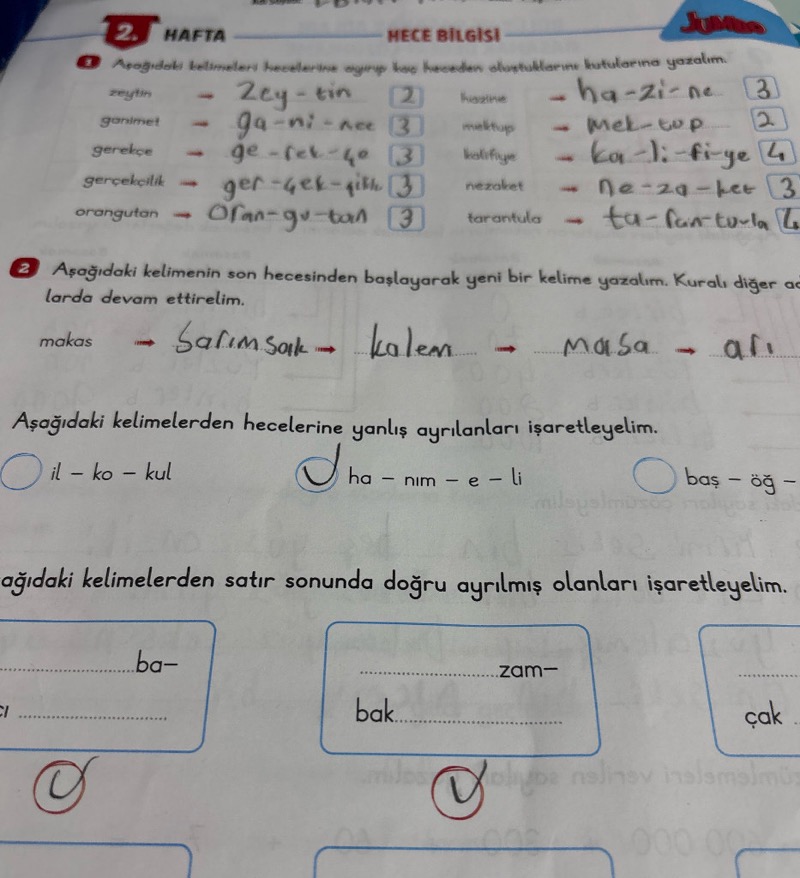
The worksheet focuses on syllable division in Turkish words. Analyzing the first exercise, it appears the student needs to divide words into syllables and indicate the number of syllables. Initial observation shows that “zeytin” is correctly divided as “Zey - tin” with 2 syllables, and the next word is “hazine.”
Analyzing syllable counts for several words, identifying an error in “gerçekçilik” where the student incorrectly combined syllables. Verifying the syllable division for “orangutan,” confirming the correct division as “o - ran - gu - tan.” The second exercise requires the new word to begin with the last syllable of the previous word; the student’s response will be checked against this rule starting with ‘makas’ as ‘kas’ and then ‘Sarımsak’.
The previous word chain error is identified; ‘Sarımsak’ doesn’t start with ‘kas’, and the student’s chain is incorrect. Clarification is needed, and a correct sequence will be provided.
Considering the third exercise, the syllabification of “ilkokul” requires verification. Checking the Turkish Language Association rules for compound words confirms that “il-ko-kul” is the correct division.
Exercise 3 requires identifying incorrectly syllabified words. “Başöğretmen” is incorrectly divided as “baş - öğ - ret - men” and needs marking; “hanımeli” is incorrectly divided as “ha - nım - e - li” and needs marking. “İlkokul” is correctly divided as “il - ko - kul” and should not be marked.
Analyzing Exercise 4, the objective is to find words correctly divided at the end of a line. In the first box, the word seems to be “balıkçı,” divided as “ba-” and “cı,” so it needs closer inspection, as a partial word is shown and needs to be verified.
Examining the first box, the partial word appears to be “ba-cı,” which follows Turkish syllable division rules because the syllable “cı” is two letters and can be separated at the end of a line. The second box confirms the correct division of “zambak” as “zam- / bak.” Analyzing Box 3, the partial word requires further clarification based on the preceding lines, possibly to identify line division errors.
Considering Turkish syllable division rules, single vowels cannot be left at the end of a line. The example “u- / çak” is incorrect, which means single-letter syllable divisions at the end of a line are wrong. The student’s markings in the first exercise box need careful analysis. It appears the division might be “ba-cı,” which is valid because “cı” consists of two letters.
Analyzing the user’s input, it’s clear they’re submitting an elementary school worksheet for evaluation and assistance. This worksheet involves four distinct activities related to Turkish syllable division and word construction.
The initial task is to divide words into syllables and determine the number of syllables, followed by forming a word chain based on the last syllable of the previous word. The third task focuses on identifying incorrectly syllabified compound words, while the final task requires identifying correctly divided words at the end of lines.
Each exercise will need individual evaluation, and then the overall response can be provided by combining the four section answers and adding an engagement loop.
Analyzing Activity 1 word-by-word, checking vowel counts to determine correct syllable divisions and numbers. Comparing each student answer against the derived results to identify and explain any errors, correcting the syllable counts and divisions. Proceeding to evaluate “orangutan” next, continuing with this detailed approach for the remaining words.
Analyzing each word in the first activity, comparing student responses to the correct syllable divisions based on vowel count. Identified an error in “orangutan,” explaining the correct division and syllable count considering Turkish rules. Subsequent words have been verified and confirmed as correct, following the principle that syllable count equals vowel count. The analysis highlights a fundamental rule for Turkish syllable division: a word’s syllables match its vowel count.
Analyzing the word chain rule, the student incorrectly starts the chain. The rule mandates that the next word begins with the last syllable of the previous word, not the last sound or letter. The student’s chain errors at each step; the “kas” from “makas” does not transition to “Sarımsak,” “sak” does not go to “kalem,” and so on. A correct example chain is demonstrated. Further searching the syllable for the word starting with “kas”.
Exploring word chains based on syllable division, initially focusing on words starting with “kas”. Considering “makas” to initiate the chain, then evaluating “kasket,” “kasko,” and “kasvet” for their initial “kas” syllable. Evaluating “makas” to “kasket” to construct a syllable chain, observing syllable division and chain continuity. Identifying potential difficulties with a syllable chain for children and searching for simpler word choices. Formulating a test chain starting with “makas”, and trying several options to build a list. Checking if simple words “kasa” like “ka - sa” are acceptable. The current chain leads to undesirable “ra” syllable from ‘razı’ after ‘çapraz’, so the simpler chain is sought again. Finding simpler word options, creating the chain “makas”, “kasket”, “ketçap”, “çapkın”.
Analyzing syllable-based word chains, determined that student likely misinterprets the rule, constructing a chain based on the last letter instead of the last syllable. Recognizing this common error, an alternative explanation is needed to make the rule clearer to elementary students. Constructing the following chain to demonstrate the correct syllable: “makas,” “kasket,” “ketçap,” and “çapkın.”
The agent identified the student’s error in the word chain activity; the student constructed the chain using the final letter instead of the final syllable. A demonstration of a correctly formed syllable-based chain was made.
Analyzing the third exercise, the rules for syllabification of compound Turkish words were examined according to the guidelines of the Turkish Language Association. It was determined that “hanımeli” and “başöğretmen” were incorrectly divided, and “ilkokul” was correctly divided. The student correctly marked the incorrect syllabifications.
Examined the fourth exercise, focusing on correct syllable division at line breaks. Identified the key rule: single letters cannot be left at the end or beginning of a line. Analyzed the first example; the division of “ba-cı” is correct because the syllable “cı” is two letters and is separated as such, but the student missed an important item.
The second example, “zam-bak”, follows the rules correctly as well.
Identified a need to mark this, because the student seems to have missed one.
Examining the line break activity, identified that the student correctly recognized the single-letter rule violation in the example. Further analysis confirmed that the student correctly identified and did not mark the error.
İlkokul Hece Bilgisi Çalışma Sayfası Çözüm ve Kontrol Rehberi
Bu çalışma sayfasında yer alan 4 temel etkinlik; kelimeleri hecelerine ayırma, hece sayısı bulma, kelime zinciri oluşturma, birleşik kelimelerin hecelenmesi ve satır sonuna sığmayan kelimelerin yazımı kurallarını içermektedir.
İçindekiler
- Etkinlik 1: Kelimeleri Hecelerine Ayırma ve Hece Sayıları
- Etkinlik 2: Son Heceden Yeni Kelime Türetme (Kelime Zinciri)
- Etkinlik 3: Yanlış Hecelenen Birleşik Kelimeler
- Etkinlik 4: Satır Sonunda Doğru Ayrılan Kelimeler
- Özet Kontrol Tablosu
1. Etkinlik: Kelimeleri Hecelerine Ayırma ve Hece Sayıları
 Altın Kural: Türkçede bir kelimedeki hece sayısı, o kelimedeki ünlü (sesli) harf sayısına eşittir. Ünlü harfler: **a
 ÇÖZÜM ADIMLARI:
 YANLIŞ. Birleşik kelimeler hecelenirken ulama yapılır: Doğrusu
 )
 CEVAP ÖZETİ:
 TEMEL KAVRAMLAR:
 SIK YAPILAN HATALAR: