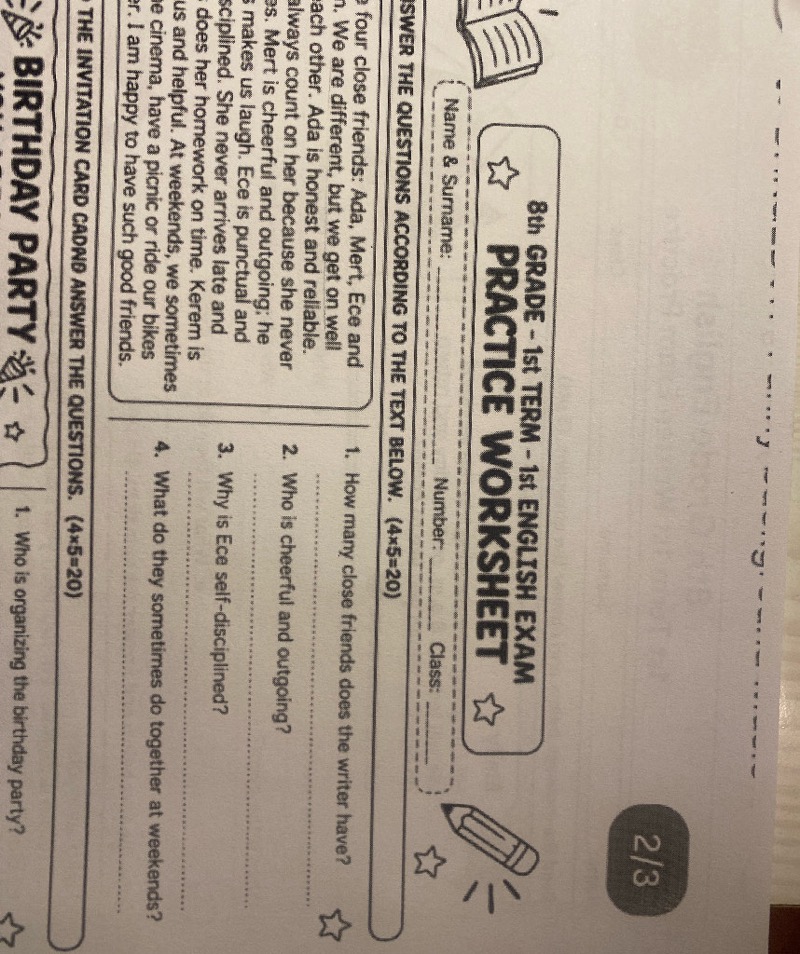
ANSWER THE QUESTIONS ACCORDING TO THE TEXT BELOW. (4x5=20)
We are four close friends: Ada, Mert, Ece and Kerem. We are different, but we get on well with each other. Ada is honest and reliable. We can always count on her because she never tells lies. Mert is cheerful and outgoing; he always makes us laugh. Ece is punctual and self-disciplined. She never arrives late and always does her homework on time. Kerem is generous and helpful. At weekends, we sometimes go to the cinema, have a picnic or ride our bikes together. I am happy to have such good friends.
KEY FORMULA / RULE: To answer reading comprehension questions accurately, locate the specific keywords (e.g., how many, who, why, what) in the text and restate the information in complete, grammatically correct sentences matching the verb tense of the question.
SOLUTION STEPS
1. How many close friends does the writer have?
Text Reference:“I have four close friends: Ada, Mert, Ece and Kerem.”
Answer: The writer has 4 (four) close friends. (Full sentence: The writer has four close friends.)
2. Who is cheerful and outgoing?
Text Reference:“Mert is cheerful and outgoing; he always makes us laugh.”
Answer:Mert is cheerful and outgoing.
3. Why is Ece self-disciplined?
Text Reference:“Ece is punctual and self-disciplined. She never arrives late and always does her homework on time.”
Answer: Because she always does her homework on time (and she never arrives late).
4. What do they sometimes do together at weekends?
Text Reference:“At weekends, we sometimes go to the cinema, have a picnic or ride our bikes together.”
Answer: They sometimes go to the cinema, have a picnic, or ride their bikes together.
FINAL ANSWER:
The writer has 4 close friends.
Mert is cheerful and outgoing.
Because she always does her homework on time (and never arrives late).
They sometimes go to the cinema, have a picnic, or ride their bikes together.
EXAM INSIGHT / PITFALL: When answering “Why” questions, always begin your answer with “Because…” and change the subject pronoun from the text’s “I / we” to the appropriate third-person pronoun (“she / they”).
 KEY FORMULA / RULE: To answer reading comprehension questions accurately, locate the specific keywords (e.g., how many, who, why, what) in the text and restate the information in complete, grammatically correct sentences matching the verb tense of the question.
 SOLUTION STEPS
 FINAL ANSWER:
 EXAM INSIGHT / PITFALL: When answering “Why” questions, always begin your answer with “Because…” and change the subject pronoun from the text’s “I / we” to the appropriate third-person pronoun (“she / they”).