14 Project
anning a softw
how long it will t-
and
a
is
Methodology flexible adaptVe dPp
adaptin and quickly
software
ile
oproach to sotware development, aea.
the
3.1.2 Aqile Methodology
merging codé Changes Into a cental
methods include practices such as:
changes as the project progresses. The main idea is to Work in short cycle
iterations or sprints, which help teams delive pars or
tne sorWare
rapidly and oat
cUses on delivering smal, functional
B.Agle
ltte
• Continuous Integration: Regularly
repository to detect and fix issues early
feedbackeaty as shown in Figure 1.31 Test-Driven Developrment: Writing tests betore writing the
code to ensure be
software works as expected.
parts o
14.1 Comp
Comprehensive
before you star
howit will be do1Pair Programming: Two developerS work
together at one workstation, with 0na
writing code and the other
reviewing it in real-time.
KNOW?
DO YO
Devtapamt
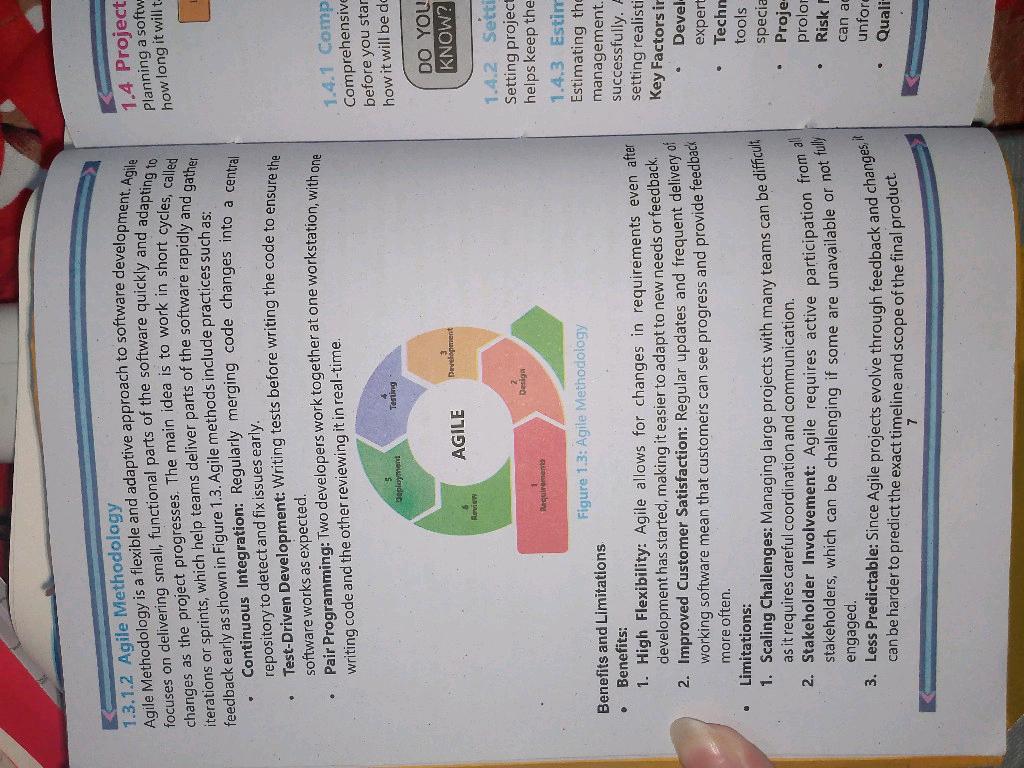
AGILE
Sett
Corting projec
alns keep the
helps keept
14.3 Estir
eimans
Estimating the
management.
Figure 1.3: Aqle Metnodology
settine rele:
Key Factors ie
Devel-
expert
Benefits and
Limitatlons
Benefits:
lechn
newt
needs
or
feedback
High Flexibility: Agile allows for changes in requirements even ar
working sottware mean that customers can see progress and provide feedbeck
Improved Customer Satisfaction: Regular updates and
frequent deivey
development has started, making iteaslerto adaptte
tools
spéci
Proje-
prolor
tul
can which lers,
are some if challenging be
unavailable stakeholders. or nat
- Scaling Challenges: Managing large projects with many teams carn be olm
3 Sabdinaton and communication.
Risk
ivovemen: Agile requires active participation fron
Can a
untor=
engaged.
Qualr
- Less Predictable: Since Agile projects evolve through feedback and eia
can be harder to predict the exact timeline and scope of the final proaut
Understanding Agile Methodology in Software Development
Agile Methodology is a flexible and adaptive approach to software development that focuses on delivering small, functional pieces of a project in short cycles known as sprints or iterations. Instead of waiting until the end to deliver a final product, it allows teams to adapt to changes quickly and gather frequent feedback.
Core Agile Practices:
- Continuous Integration: Developers regularly merge their code changes into a central repository, which helps detect and fix issues early in the process.
- Test-Driven Development (TDD): Writing automated tests before writing the actual code to ensure the software works exactly as expected from the start.
- Pair Programming: Two developers collaborate at a single workstation; one actively writes the code while the other reviews it in real-time.
Table of Contents
- The Agile Development Cycle
- Benefits and Limitations
- Summary Table
The Agile Development Cycle
The Agile process operates in a continuous, iterative loop. As shown in your textbook’s diagram, a single iteration generally follows these continuous phases:
- Requirements: Identifying what features need to be built.
- Design: Planning the architecture and user experience.
- Development: The actual coding and creation of the software.
- Testing: Checking the software for bugs and verifying it meets the initial requirements.
- Deployment: Releasing the functional software to users or a live environment.
- Review: Gathering feedback and evaluating the sprint to improve the next cycle.
 Pro Tip: The main advantage of working in these short cycles is that if a market requirement changes, the development team can pivot quickly in the next cycle rather than having to rewrite months of completed work.
Benefits and Limitations
While Agile is a highly popular standard in the tech industry, it comes with specific trade-offs that project managers must consider.
Benefits:
- High Flexibility: Agile easily accommodates changes in project requirements even after development has already started.
- Improved Customer Satisfaction: Because working software is delivered frequently, customers can see tangible progress early and provide immediate feedback.
Limitations:
- Scaling Challenges: It can be difficult to coordinate communication and manage Agile practices across very large projects with multiple distinct teams.
- Stakeholder Involvement: Agile requires the active, ongoing participation of stakeholders. This can cause bottlenecks if clients or managers are unengaged or unavailable.
- Less Predictable: Because the final product constantly evolves based on feedback, it is much harder to predict the exact final scope, budget, and timeline at the very beginning of the project.
Summary Table
| Key Point |
Details |
| Definition |
An iterative, flexible approach to software development focusing on the rapid delivery of small, functional parts. |
| Key Methods |
Continuous Integration, Test-Driven Development (TDD), and Pair Programming. |
| Main Advantage |
High flexibility to changing needs and improved customer satisfaction through regular updates. |
| Main Drawback |
Timelines and final scopes are less predictable; requires high stakeholder availability. |
Shall I explain how this Agile approach compares to traditional, step-by-step software development models like the Waterfall method?