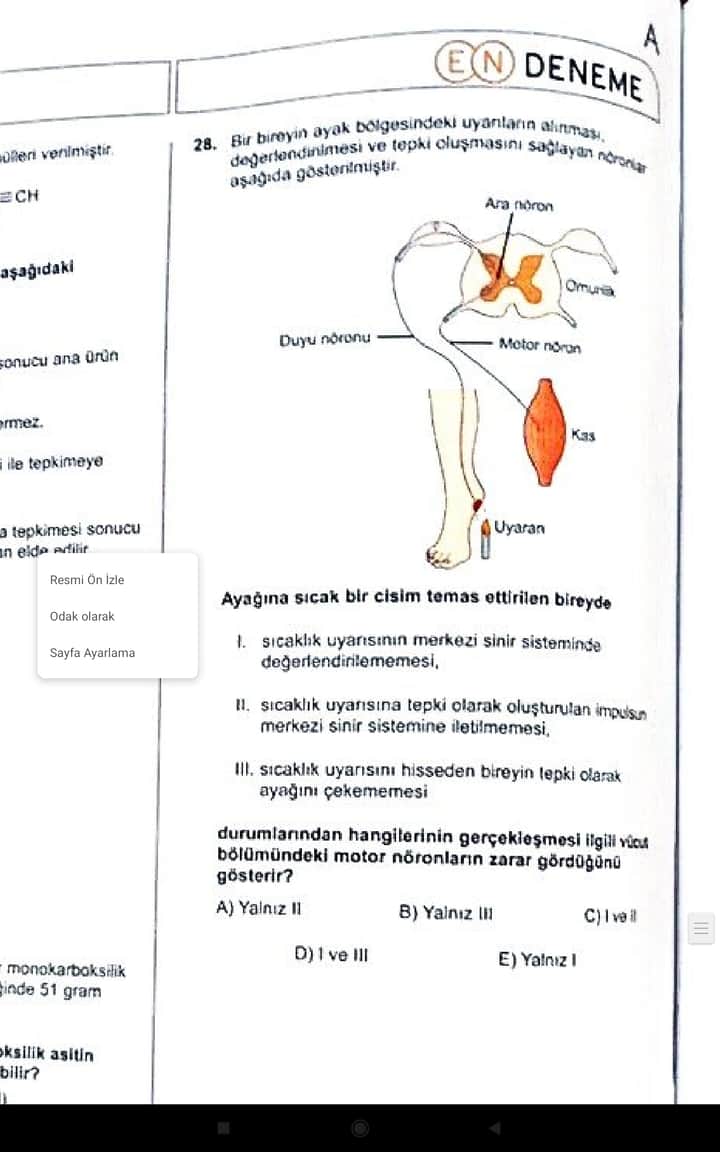
Question:
Esma Cengiz has shared a biology question regarding the reflex arc system:
The question provides a diagram of a reflex action pathway and asks:
“Which situations indicate that the motor neurons in the related body region have been damaged?”
It lists the following three conditions:
- The thermal stimulus cannot be evaluated by the central nervous system.
- The impulse generated as a response to the thermal stimulus cannot be transmitted to the central nervous system.
- The individual who senses the thermal stimulus cannot react by moving their foot away.
The answer choices are:
- A) Only II
- B) Only III
- C) I and II
- D) I and III
- E) Only I
Answer:
This question evaluates how damage to motor neurons affects reflex activities. To solve it, let’s break it down step by step:
Understanding the Nervous System Pathway in Reflex Actions
Reflex actions involve the following components:
- Sensory Neurons: These detect the stimulus (e.g., heat) and transmit the signal to the spinal cord or central nervous system (CNS).
- Interneurons: Located in the spinal cord, these process the signal from sensory neurons and send instructions to motor neurons.
- Motor Neurons: These transmit instructions from the CNS to effectors (e.g., muscles). The muscle then performs the reaction (e.g., withdrawing the foot).
Damage to Motor Neurons:
- If the motor neurons are damaged, the muscles cannot receive instructions, even if sensory neurons and interneurons are functioning properly.
Analyzing the Given Conditions
-
Condition I:
- “The thermal stimulus cannot be evaluated by the central nervous system.”
- This indicates a problem with sensory neurons or interneurons, not motor neurons.
- Therefore, this condition does not indicate motor neuron damage.
-
Condition II:
- “The impulse generated as a response to the thermal stimulus cannot be transmitted to the central nervous system.”
- This also suggests an issue with sensory neurons, as the motor neurons only act after the CNS processes the stimulus.
- Hence, this condition does not indicate motor neuron damage.
-
Condition III:
- “The individual who senses the thermal stimulus cannot react by moving their foot away.”
- If the individual senses the stimulus but cannot move their foot, it means the motor neurons or the muscles are not functioning.
- Therefore, this condition indicates damage to motor neurons.
Correct Answer
The correct answer is:
B) Only III
This is because only Condition III reflects damage to the motor neurons.
If you’d like further clarification, let me know! 
Bu soruda sorulan temel şey, “Hangi durumda oradaki motor nöronların (yani kası uyaran çıkış sinirlerinin) zarar gördüğü anlaşılır?” sorusudur.
• Seçenek I (sıcaklık uyarısının merkezî sinir sisteminde değerlendirilmemesi) ve Seçenek II (tepki olarak üretilen impulsun merkezî sinir sistemine iletilmemesi) daha çok duyusal (afferent) yol veya merkezî sinir sistemindeki değerlendirme kısmı ile ilgilidir. Yani I ve II duyusal iletim veya beyin/omurilikteki “yorumlama” basamaklarının bozulmasına işaret eder, motor nöronlardaki bir hasarı doğrudan göstermez.
• Seçenek III (sıcaklığı hissedebilen bireyin ayağını çekememesi) ise duyusal kısım sağlam kaldığını (“sıcaklığı hissedebiliyor”) ama kası uyaran motor sinyallerin iletilmesinde sorun olduğunu gösterir. Bu da bizzat motor nöronların (ya da kas ile motor nöron arasındaki bağlantının) hasarına işaret eder.
Dolayısıyla yalnızca III numaralı durumda motor nöronların zarar gördüğü anlaşılır. Bu nedenle doğru yanıt “Yalnız III”tür.
Ayağına sıcak bir cisim temas ettirilen bireyde motor nöronlar zarar görürse hangi belirtiler ortaya çıkar?
Answer:
Bu soruda, refleks yayında yer alan üç durumun (I, II ve III) hangi durumda “ilgili vücut bölümündeki motor nöronların” (yani kaslara emir götüren sinir hücrelerinin) hasar aldığını gösterdiği sorgulanıyor.
Aşağıdaki açıklamaları adım adım inceleyelim:
-
“Sıcaklık uyarısının merkezi sinir sisteminde değerlendirilmemesi”
• Bu ifade, ayağa dokunan sıcaklık uyartısının (duyu) beyne veya omuriliğe ulaşamadığı veya orada işlenemediği anlamına gelir.
• Duyu siniri ya da beyin/omurilikteki ara nöronlarla ilgili bir problem olabilir.
• Dolayısıyla bu durum motor nöron arızasını değil, daha çok duyu veya değerlendirme (merkezî) kısmındaki bozukluğu gösterir. -
“Sıcaklık uyarısına tepki olarak oluşturulan impulsun merkezi sinir sistemine iletilmemesi”
• Bu ifade kulağa ilk bakışta “tepkisel sinyalin beyine/omuriliğe gidememesi” gibi görünür, ancak tipik refleks yayında tepki sinyali (motor uyarı) merkezi sinir sisteminden kasa doğru gider.
• “Merkezi sinir sistemine iletilmemesi” genellikle duyu nöronlarının bozukluğuna işaret eder (çünkü merkeze iletimi yapan duyu nöronudur).
• Motor nöronun görevi, omurilik veya beyin sapından çıkan komutu kasa götürmektir. Bu ifade, motor nöron değil duyu (afferent) yolu sorunu gibi durmaktadır. -
“Sıcaklık uyarısını hisseden bireyin tepki olarak ayağını çekememesi”
• Kişi sıcaklığı ‘hissedebildiğine’ göre duyuda ve değerlendirmede (merkezde) sorun yoktur.
• Fakat tepki hareketini gerçekleştirememesi, kaslara giden motor sinirin ya da kasın kendisinin hasarlı olduğunu gösterir.
• Dolayısıyla bu madde doğrudan “motor nöron” hasarına işaret eder.
Bu açıklamalardan yola çıkarak, yalnızca 3. durum (III), ilgili bölgedeki motor nöronların zarar gördüğünü net biçimde gösterir.
Dolayısıyla doğru cevap genellikle B) Yalnız III şeklindedir.
Özetle:
- Bir duyunun beyne/omuriliğe iletilememesi duyu nöronu veya merkezî sinir sistemi problemidir.
- Duyu alınabiliyor ancak tepki hareketi yapılamıyorsa bu, motor nörondaki veya kaslardaki bozukluğa işaret eder.