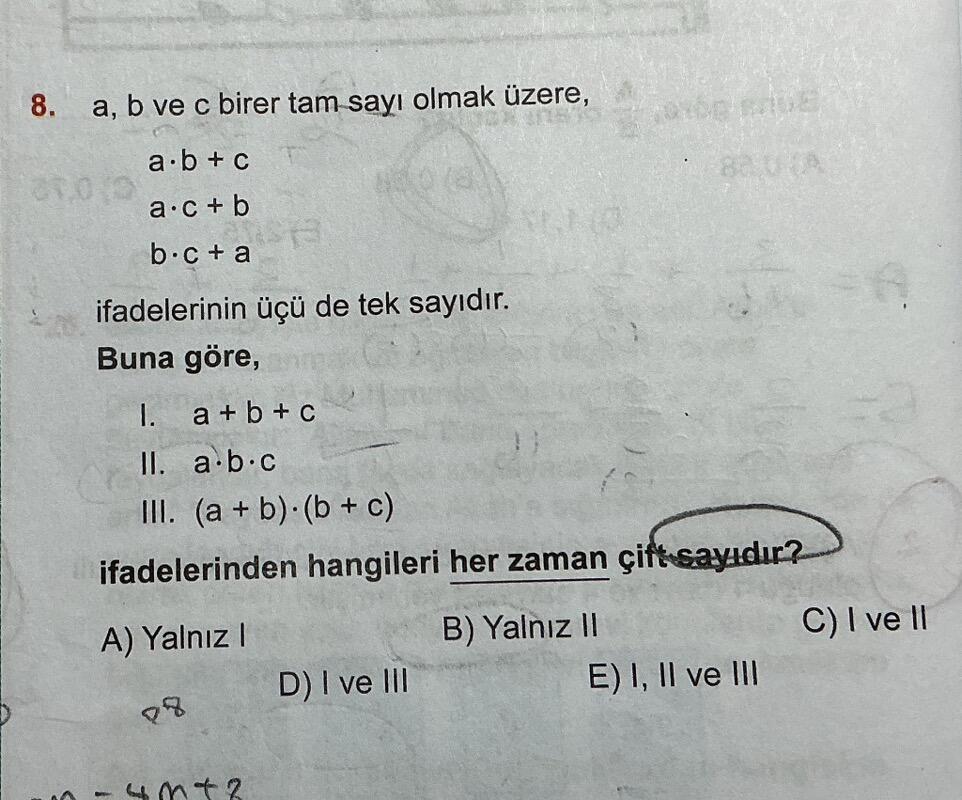
a, b ve c birer tam sayı olmak üzere,
a dot b + c
a dot c + b
b dot c + a
ifadelerinin üçü de tek sayıdır.
Buna göre,
I. a + b + c
II. a dot b dot c
III. (a + b) dot (b + c)
ifadelerinden hangileri her zaman çift sayıdır?
A) Yalnız I
B) Yalnız II
C) I ve II
D) I ve III
E) I, II ve III
a, b, c Tam Sayıları İçin Teklik-Çiftlik İncelemesi
 KULLANILAN KURAL:
- Çarpma: \text{Tek} \cdot \text{Tek} = \text{Tek}, \text{Çift} \cdot \text{Herhangi Bir Tam Sayı} = \text{Çift}
- Toplama: \text{Tek} + \text{Tek} = \text{Çift}, \text{Çift} + \text{Çift} = \text{Çift}, \text{Tek} + \text{Çift} = \text{Tek}
 ÇÖZÜM ADIMLARI:
Adım 1 — Verilen İfadelerin Parite (Teklik/Çiftlik) Durumunu İnceleme
Soruda verilen üç ifadenin de tek sayı olduğu belirtilmiştir:
- a \cdot b + c = \text{Tek}
- a \cdot c + b = \text{Tek}
- b \cdot c + a = \text{Tek}
a, b, c sayılarının alabileceği tüm teklik-çiftlik durumlarını inceleyelim:
-
Durum 1: Üçü de tek sayı olsun (a = \text{Tek}, b = \text{Tek}, c = \text{Tek})
a \cdot b + c = \text{Tek} \cdot \text{Tek} + \text{Tek} = \text{Tek} + \text{Tek} = \text{Çift} \quad (\text{Şartı sağlamaz}) -
Durum 2: Üçü de çift sayı olsun (a = \text{Çift}, b = \text{Çift}, c = \text{Çift})
a \cdot b + c = \text{Çift} \cdot \text{Çift} + \text{Çift} = \text{Çift} + \text{Çift} = \text{Çift} \quad (\text{Şartı sağlamaz}) -
Durum 3: İkisi çift, biri tek sayı olsun (Örn: a = \text{Tek}, b = \text{Çift}, c = \text{Çift})
a \cdot b + c = \text{Tek} \cdot \text{Çift} + \text{Çift} = \text{Çift} + \text{Çift} = \text{Çift} \quad (\text{Şartı sağlamaz}) -
Durum 4: Biri çift, ikisi tek sayı olsun (Örn: a = \text{Çift}, b = \text{Tek}, c = \text{Tek})
- a \cdot b + c = \text{Çift} \cdot \text{Tek} + \text{Tek} = \text{Çift} + \text{Tek} = \text{Tek}

- a \cdot c + b = \text{Çift} \cdot \text{Tek} + \text{Tek} = \text{Çift} + \text{Tek} = \text{Tek}
- b \cdot c + a = \text{Tek} \cdot \text{Tek} + \text{Çift} = \text{Tek} + \text{Çift} = \text{Tek}
- a \cdot b + c = \text{Çift} \cdot \text{Tek} + \text{Tek} = \text{Çift} + \text{Tek} = \text{Tek}
Bu sonuca göre a, b, c sayılarından kesinlikle 1 tanesi çift, 2 tanesi tek sayıdır.
Adım 2 — Öncüllerin Değerlendirilmesi
-
I. a + b + c İfadesi:
Sayıların 2 tanesi tek, 1 tanesi çifttir:a + b + c = \text{Tek} + \text{Tek} + \text{Çift} = \text{Çift} + \text{Çift} = \text{Çift}(Her zaman çifttir. Doğru)
-
II. a \cdot b \cdot c İfadesi:
Çarpanlardan en az biri çift sayı olduğuna göre çarpımın sonucu her zaman çift sayıdır:a \cdot b \cdot c = \text{Çift} \cdot \text{Tek} \cdot \text{Tek} = \text{Çift}(Her zaman çifttir. Doğru)
-
III. (a + b) \cdot (b + c) İfadesi:
Hangi sayının çift olduğu kesin değildir:- Eğer b = \text{Çift}, a = \text{Tek}, c = \text{Tek} seçilirse:(a + b) \cdot (b + c) = (\text{Tek} + \text{Çift}) \cdot (\text{Çift} + \text{Tek}) = \text{Tek} \cdot \text{Tek} = \text{Tek}
Sonuç tek sayı çıkabildiği için her zaman çift sayı değildir. (Yanlış)
- Eğer b = \text{Çift}, a = \text{Tek}, c = \text{Tek} seçilirse:
━━━━━━━━━━━━━━━━━━━━━━━━━━━
CEVAP: C) I ve II
━━━━━━━━━━━━━━━━━━━━━━━━━━━
 TEMEL KAVRAMLAR:
1. Tek ve Çift Sayılarda Toplama & Çarpma
- Tanım: Çarpma işleminde tek bir çift çarpanın bulunması sonucu çift yapar; toplamada ise çift sayıda tek sayının toplamı çift sayı verir.
- Bu problemde: a, b, c sayılarının simetrik yapısından faydalanılarak 1 çift ve 2 tek sayı içerdiği belirlenmiştir.
 SIK YAPILAN HATALAR:
 III. Öncülde a’yı Sabit Çift Kabul Etmek
- Yanlış: Sadece a = \text{Çift} durumunu deneyip (a+b)(b+c) = (\text{Çift}+\text{Tek})(\text{Tek}+\text{Tek}) = \text{Tek} \cdot \text{Çift} = \text{Çift} bularak ifadeye her zaman doğrudur demek.
- Doğru: Çift olan sayının b olma ihtimalini de göz önüne almak (b = \text{Çift} olduğunda sonuç tek çıkar).
- Neden yanlış: “Her zaman” sorularında tüm değişkenlerin yer değiştirme olasılıkları kontrol edilmelidir.
Teklik-çiftlik kavramını daha iyi pekiştirmek için benzer bir TYT tarzı soru çözmemi ister misin?