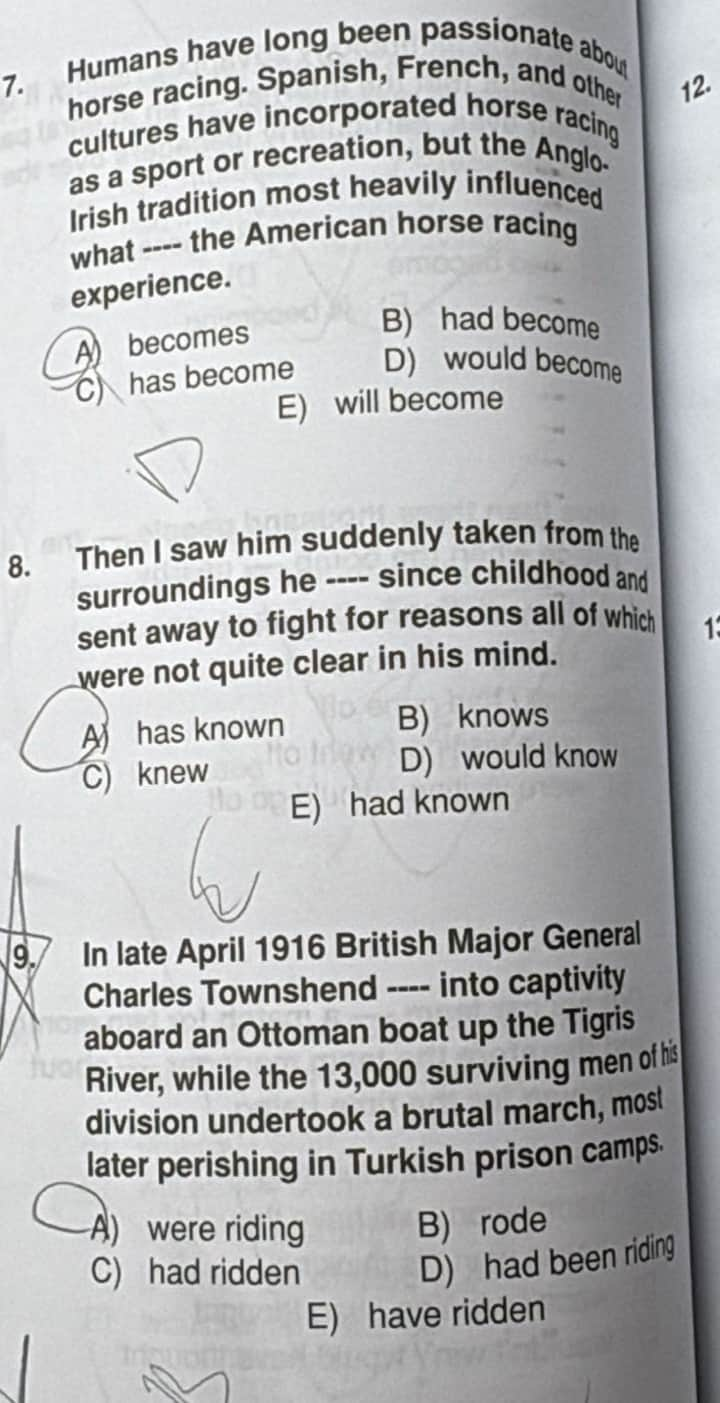
7. sorunun doğru cevabı neden D (would become)?
Önemli Noktalar
- “would become” bir conditional/gelecek kipi geçmişteki bir bakış açısından ifade eder.
- C şıkkındaki “has become” ise present perfect olarak şu ana kadar süregelen bir durumu vurgular.
- Cümlede “have long been passionate” gibi geçmişten başlayıp bugüne uzanan anlatım var; devamı olarak geleceğe yönelik bir değişimden söz etmek için “would become” tercih edilir.
İçindekiler
- Zaman Uyumu ve Modal “Would” Kullanımı
- Şık Karşılaştırması: Has Become vs Would Become
- Özet Tablosu
- SSS
Zaman Uyumu ve Modal “Would” Kullanımı
Cümle:
“Humans have long been passionate about horse racing… but the Anglo-Irish tradition most heavily influenced what ---- the American horse racing experience.”
- Başlangıçta “have long been passionate” ifadesi geçmişten günümüze süregelen bir durumu anlatır (present perfect continuous).
- Devamında, Anglo-İrish geleneğinin etkisinin ileriki dönemde nasıl şekilleneceğini belirtmek istiyoruz.
- Bu tür bir “gelecek zamanda geçmiş bakış açısı” için İngilizcede “would + fiil” yapısı kullanılır.
- Dolayısıyla “what would become the American horse racing experience” ifadesi, “ileride Amerikan at yarışı deneyiminin nasıl şekilleneceğini” anlatır.
Şık Karşılaştırması: Has Become vs Would Become
| Özellik | C) has become | D) would become |
|---|---|---|
| Zaman | Present Perfect (geçmişten bugüne) | Geçmişteki bakış açısıyla gelecek |
| Anlam | “şimdiye kadar oldu” | “ileride olacak” |
| Cümledeki kullanım bağlamı | Mevcut durum vurgusu | Geleceğe yönelik beklenti/anlam katma |
| Uygunluk | Bu cümlede uygun değil | Bu cümleyle zaman uyumuna uygun |
Özet Tablosu
| Nokta | Açıklama |
|---|---|
| Cümle Başlangıcı | have long been passionate → present perfect continuous |
| Zaman Uyumu | Geçmişten geleceğe doğru bir akış: geçmiş/present → future-in-past |
| Doğru Şık | D) would become |
| Neden | “Anglo-Irish tradition” etkisinin gelecekteki yansımasını “would” ile kurarız. |
SSS
S1: “Future-in-past” ne demektir?
C1: Geçmişte konuşulan veya düşünülen bir geleceği ifade etmek için kullanılır. (“would go”, “would become” gibi.)
S2: Present perfect ve past simple arasındaki fark nedir?
C2: Present perfect (“has done”) geçmişten bugüne etkisi süren eylemi, past simple (“did”) belirli bir geçmiş zamanı işaret eden eylemi anlatır.
S3: “Would” her zaman şartlı cümle mi oluşturur?
C3: Hayır, “would” geçmişteki bir gelecek beklentisini anlatmak için de kullanılır (future-in-past).
S4: Bu örnekte neden “will become” (E şıkkı) değil?
C4: “Will” doğrudan gelecek zaman iken, cümledeki zaman uyumu için “would” olan future-in-past forma ihtiyaç var.
Devamında farklı bir soru açıklaması ister misin? @Yrn000
Why is the answer for question 7 D?
Önemli Noktalar
- Question 7 involves a comparison of influence over time between Anglo-Irish tradition and American horse racing.
- The sentence structure requires a conditional or hypothetical form to express what the Anglo-Irish tradition would become in the context of American horse racing.
- The verb “would become” (choice D) correctly fits the conditional/hypothetical meaning implied by “most heavily influenced what — the American horse racing experience.”
The sentence:
“Humans have long been passionate about horse racing. Spanish, French, and other cultures have incorporated horse racing as a sport or recreation, but the Anglo-Irish tradition most heavily influenced what — the American horse racing experience.”
Explanation:
This is a conditional context expressing an influence on what the American experience would become over time, not a present simple or past simple fact. So, “would become” (D) fits best grammatically and logically.
İçindekiler
- Why “would become” is correct in question 7
- Comparison of answer choices and tense usage
- Özet Tablo
- Sık Sorulan Sorular
Why “would become” is correct in question 7
The phrase “most heavily influenced what — the American horse racing experience” implies a future or potential state of “the American horse racing experience.” The sentence presents a historical fact about influence but projects the effect on what that experience would turn into.
- “becomes” (A) is present simple, unsuitable for past/historical context.
- “has become” (C) is present perfect; not fitting the narrative centered on influence in past/traditional context.
- “had become” (B) is past perfect, indicating something completed before another past action, which doesn’t fit here.
- “would become” (D) is correct because it expresses a hypothetical future state based on a past influence.
- “will become” (E) is future simple, too direct and not suitable for this conditional/hypothetical tone in past context.
Pro Tip: When a clause hints at a hypothetical or conditional consequence of past influence, “would” + verb form is usually the correct tense.
Comparison of answer choices and tense usage
| Choice | Tense | Use in sentence |
|---|---|---|
| A) becomes | Present Simple | States usual facts; unsuitable for past influence description |
| B) had become | Past Perfect | Completed action before another past event; no context here |
| C) has become | Present Perfect | Recent past with current relevance; inappropriate for historical narrative |
| D) would become | Conditional Past | Best expresses what the influence shaped hypothetically or in potential |
| E) will become | Future Simple | Too direct and certain for this past reflective context |
Key Note: The conditional “would become” expresses potential rather than definite present or past fact, fitting the influence described.
Özet Tablo
| Element | Explanation |
|---|---|
| Correct Answer | D) would become |
| Reason | Expresses hypothetical future/potential resulting from past influence |
| Why not A? | Present tense “becomes” mismatches historical context |
| Tense Focus | Conditional (would + verb) is key to expressing influence effects |
Sık Sorulan Sorular
1. Why is the present tense “becomes” incorrect here?
Because the sentence discusses past influence affecting what the American experience turned into, not a habitual present fact.
2. Could “has become” be correct?
No, because the sentence emphasizes a specific historical influence shaping a future state, not a recent change with current relevance.
3. How does “would become” differ from “will become” here?
“Would become” places the statement in a hypothetical or conditional sense consistent with the historical influence, while “will become” assumes certainty in the future, which doesn’t fit the retrospective context.
Sonraki Adımlar
Would you like me to explain the grammar rules of conditional sentences in detail or analyze the other question choices for better understanding?