- Let’s play together. ( 've got two ears. Ahat have what have you got? you got? I’ve got a mouth. E a week ja head a rubber hair I’ve got a nose. Speaking-Expression HOW many eyes have ) Listen and repeat together. O ALPHABET you got? Speaking & Pronunciation five big I’ve got two eyes. a pencil glue tour)agiraffe Eight elephants eat eleven eggs. Listening Trgck 3i a jacket (45
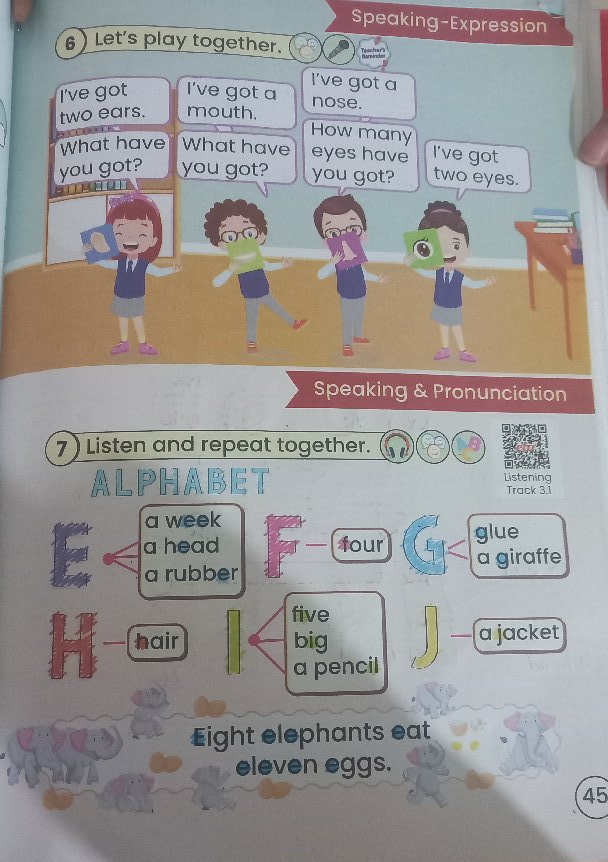
6) Let’s play together. ( I’ve got two ears, What have you got? I’ve got a mouth, What have you got? I’ve got a nose, How many eyes have you got? I’ve got two eyes. )
BU sayfadaki konuşma alıştırması ve telaffuz çalışması şunları içeriyor:
- Kısa cümlelerle vücut parçalarını ifade etme (I’ve got two ears, I’ve got a mouth, I’ve got a nose, I’ve got two eyes).
- Karşılıklı soru-cevap kalıpları (What have you got? How many eyes have you got?).
- Alfabe harflerine ait bazı kelimeler ve telaffuzları (örneğin: E - a week, a head, a rubber; F - four; G - glue, a giraffe; H - hair; I - five, big, a pencil; J - a jacket).
- Basit cümlelerle kelime tekrarları ve işitsel kelime çalışması (“Eight elephants eat eleven eggs”).
Bu alıştırma ilkokul seviyesinde İngilizce öğrenen çocukların temel kelime ve kalıpları sesli olarak tekrar etmelerini, çift yönlü soru-cevap yapmalarını ve alfabe ile bazı temel kelimeleri öğrenmelerini hedefler.
Başka soruların olursa sormaktan çekinme! 
How to complete the “Let’s play together” and “Alphabet (Listen and repeat)” exercises?
ANSWER:
- For the “Let’s play together” speech bubbles, read and answer using I’ve got (informal) = I have. Example dialogue:
- “I’ve got two ears.” — “What have you got?” — “I’ve got a mouth.”
- “I’ve got a nose.” — “How many eyes have you got?” — “I’ve got two eyes.”
- For the “Alphabet / Listen and repeat” part, say each letter and its example words clearly, then repeat the tongue-twister: “Eight elephants eat eleven eggs.”
EXPLANATION:
- Use I’ve got to say possessions (meaning I have). Questions in the book use British form “What have you got?” and “How many eyes have you got?” (American English: “What do you have?”, “How many eyes do you have?”).
- Alphabet practice: say the letter name, then the example words slowly, paying attention to the initial sound of each example:
- E — practice words (say each once): “a week”, “a head”, “a rubber” (focus on the short /e/ or schwa in connected speech).
- F — “four” (sound: /f/)
- G — “glue”, “a giraffe” (sound: /g/ in glue, /dʒ/ in giraffe)
- H — “hair” (sound: /h/)
- I — “five”, “big”, “a pencil” (watch vowel sounds: /aɪ/ in five, /ɪ/ in big)
- J — “a jacket” (sound: /dʒ/)
- Say the sentence “Eight elephants eat eleven eggs.” slowly several times, then faster, focusing on the /e/ vowel and linking between words.
KEY CONCEPTS:
- have / I’ve got
- Definition: used to show possession.
- In this exercise: answer questions like “What have you got?” with “I’ve got a …”.
- Alphabet pronunciation
- Definition: say the letter name and the initial sound in example words.
- In this exercise: repeat each letter + example word(s) to practice letter sounds and intonation.
PRACTICE TIPS:
- Repeat each bubble and answer aloud on your own.
- For the alphabet, first listen (if you have the audio), then imitate the pronunciation.
- Practice the tongue-twister slowly, then increase speed for fluency.
Feel free to ask if you have more questions!
Would you like another example or a pronunciation recording for any of these lines?