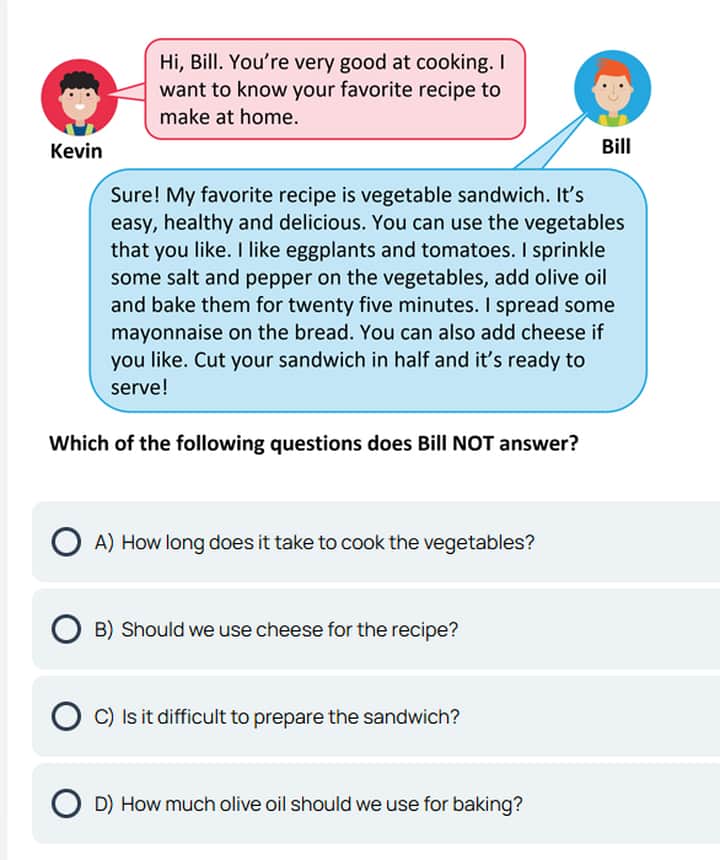
Which of the following questions does Bill NOT answer in the dialogue?
Step-by-Step Analysis:
-
Option A - How long does it take to cook the vegetables?
- Bill says, “bake them for twenty five minutes.”
- This information answers Option A, so it is NOT the correct choice.
-
Option B - Should we use cheese for the recipe?
- Bill mentions, “You can also add cheese if you like.”
- This information answers Option B, so it is NOT the correct choice.
-
Option C - Is it difficult to prepare the sandwich?
- Bill does not say anything related to the difficulty of preparing the sandwich.
- This question is NOT answered by Bill, making Option C the correct choice.
-
Option D - How much olive oil should we use for baking?
- Bill mentions, “Add olive oil,” but he does not specify the quantity.
- This question is partially unanswered, but Option C takes priority as completely unanswered.
Final Answer:
C) Is it difficult to prepare the sandwich?
Which of the following questions does Bill NOT answer?
Answer:
Bill mentions how long to cook the vegetables (25 minutes), explains that adding cheese is optional, and describes that making the sandwich is easy. However, he never specifies how much olive oil to use. Therefore, the question he does not answer is:
• D) How much olive oil should we use for baking?
Which of the following questions does Bill NOT answer?
A) How long does it take to cook the vegetables?
B) Should we use cheese for the recipe?
C) Is it difficult to prepare the sandwich?
D) How much olive oil should we use for baking?
Answer: D) How much olive oil should we use for baking?
Table of Contents
- Overview of the Reading Passage
- Key Vocabulary in the Dialogue
- Step-by-Step Reasoning
- Contextual Clues from Bill’s Reply
- In-Depth Explanation of the Unanswered Question
- Sample Table: Question vs. Answered Status
- Additional Reading Comprehension Tips
- Why Reading Comprehension Is Important
- Possible Variations in Test Questions
- Extended Analysis: How to Infer Missing Information
- References
- Summary
1. Overview of the Reading Passage
In the provided conversation, Kevin asks Bill about his favorite recipe to make at home. Bill responds in detail about a vegetable sandwich. He discusses how he likes to use vegetables such as eggplants and tomatoes, how he seasons them with salt and pepper, and how he adds mayonnaise and (optionally) cheese to the sandwich. He also explains the cooking time and the process to bake or roast the vegetables.
A multiple-choice question follows, asking: “Which of the following questions does Bill NOT answer?” Four possible questions (A, B, C, D) are listed. We must identify which question remains unanswered by Bill’s explanation.
2. Key Vocabulary in the Dialogue
- Recipe: A set of instructions for preparing a particular dish.
- Vegetables: Edible plants or their parts; Bill’s example includes eggplants and tomatoes.
- Mayonnaise: A thick, creamy sauce often used in sandwiches.
- Cheese: A dairy product Bill suggests adding if desired.
- Bake: To cook in an oven, usually referring to uncovered cooking.
- Easy, healthy, delicious: Descriptors Bill uses to characterize his favorite sandwich.
This vocabulary helps structure the core information Bill shares and reveals which details he provides (and which details he leaves out).
3. Step-by-Step Reasoning
To pinpoint which question Bill does not address, we must analyze his statements and compare them to each question choice.
3.1. Identifying Time to Cook Vegetables
Bill states:
“… and bake them for twenty five minutes.”
This segment indicates how long the vegetables should be cooked. Therefore, Question A (“How long does it take to cook the vegetables?”) is indeed answered.
3.2. Clarifying the Cheese Option
He says:
“You can also add cheese if you like.”
This directly addresses the question about using cheese in the recipe. Hence, Bill does answer Question B (“Should we use cheese for the recipe?”) by indicating it is optional.
3.3. Difficulty Level of the Recipe
Early in his reply, Bill says:
“It’s easy, healthy, and delicious.”
From this, we know Bill believes the recipe is simple, implying that the sandwich is not difficult to prepare. Therefore, we can treat it as an answer to Question C (“Is it difficult to prepare the sandwich?”). He explicitly says it is “easy,” so that covers the difficulty question.
3.4. Olive Oil Quantity
Although Bill mentions:
“I sprinkle some salt and pepper on the vegetables, add olive oil and bake them…”
He never quantifies exactly how much olive oil should be used. He simply instructs to “add olive oil.” Thus, he never specifies the amount, leaving that detail ambiguous.
4. Contextual Clues from Bill’s Reply
- Bill’s Approach: His focus is on the simplicity and tastiness of the recipe rather than exact measurements.
- Time Mentioned: 25 minutes for baking clarifies a crucial cooking detail.
- Optional Cheese: He acknowledges that cheese may or may not be part of the recipe.
- Ease of Preparation: He explicitly endorses the recipe as “easy,” directly tying the sandwich’s preparation method to a minimal difficulty level.
Nowhere, however, does he specify how many teaspoons (or tablespoons, or milliliters) of olive oil is needed. This directly corresponds to answer choice (D).
5. In-Depth Explanation of the Unanswered Question
- (D) How much olive oil should we use for baking?
Bill only says “add olive oil.” This is a common instruction in informal recipes, especially among experienced cooks who rely on personal preference or intuition to judge the quantity. However, from the perspective of someone reading the instructions in detail, the question is entirely open-ended. Without specifying “a tablespoon” or “two tablespoons,” Bill effectively does not answer how much olive oil is necessary.
This gap is what tests your reading comprehension: you must notice that all other possible questions have explicit information (baking time, optional cheese, difficulty level), while the exact amount of olive oil is never stated.
6. Sample Table: Question vs. Answered Status
| Option | Question | Does Bill Answer It? | Evidence |
|---|---|---|---|
| A | How long does it take to cook the vegetables? | Yes | “Bake them for twenty five minutes.” |
| B | Should we use cheese for the recipe? | Yes | “…You can also add cheese if you like.” |
| C | Is it difficult to prepare the sandwich? | Yes | “It’s easy, healthy and delicious.” |
| D | How much olive oil should we use for baking? | No | No textual detail or specific measurement is provided. |
As you can see in the table, the only question that remains unanswered is D.
7. Additional Reading Comprehension Tips
- Identify Keywords: Locate specific words like “time,” “quantity,” and “difficulty” to spot the information quickly.
- Compare Each Question: Directly match question prompts with the text to determine coverage.
- Look for Exact or Approximate Answers: Not every question may require a definitive numeric answer (e.g., “a teaspoon,” “a pinch,” or “some”); however, the presence or absence of any indication is crucial for question D.
- Distractors: Tests often include distractors that seem unanswered at first glance but are actually addressed indirectly (like difficulty, implied by the word “easy”).
8. Why Reading Comprehension Is Important
Reading comprehension involves analyzing text thoroughly and extracting precise information. When test makers present a scenario with multiple questions, they aim to see if you can:
- Detect relevant data.
- Infer meaning from context.
- Recognize gaps where no information is provided.
Such skills are highly valuable not only for academic purposes but also for everyday tasks like following instructions, evaluating product descriptions, or verifying facts in news articles.
9. Possible Variations in Test Questions
In many standardized reading comprehension tests, a similar scenario might ask:
- “Which question is completely answered in the text?”
- “Which question is partially answered but needs more details?”
- “Which question cannot be answered based on Bill’s explanation?”
Expect test designers to vary the phrasing. The logic for finding the correct response remains the same: thoroughly check each provided statement for matching or missing information.
10. Extended Analysis: How to Infer Missing Information
Sometimes, a careful reader can make reasonable assumptions about minor details, like drizzle amounts or “a pinch” of salt. For high-stakes or more formal cooking instructions, however, an exact measurement is valuable. The question about the measure of olive oil stands out because:
- Bill references time (25 minutes) and mayonnaise as well as cheese by name (though cheese is optional).
- Bill clarifies the method (sprinkle, bake, cut).
- No numerical or approximate measure is given for olive oil.
Hence, the skill tested here is noticing that everything else has a reference or value except for the olive oil amount.
11. References
- Cambridge Assessment English. (2021). Tips for Reading Comprehension Tests.
- Common Core State Standards Initiative. (2020). Reading Standards for Informational Text.
- OpenStax College. (2022). Active Reading Techniques: Strategies for Academic Texts.
12. Summary
In Bill’s detailed reply about his favorite sandwich recipe, he provides clear information about:
- How long to bake the vegetables (25 minutes).
- The possibility of adding cheese.
- The ease and healthiness of the sandwich, implying it is not difficult to make.
However, the quantity of olive oil—whether it should be measured in teaspoons, tablespoons, or “just a drizzle”—is never stated. Therefore, the question “How much olive oil should we use for baking?” remains unanswered.
By cross-referencing each question (A, B, C, D) with Bill’s statements, we confirm that the only missing piece of information is the specific amount of olive oil. Consequently, the correct choice—the question Bill does NOT answer—is:
D) How much olive oil should we use for baking?
@anonymous13