\lim_{x \to -ınfty} \frac{2x + os 2x}{x^2 + 1}
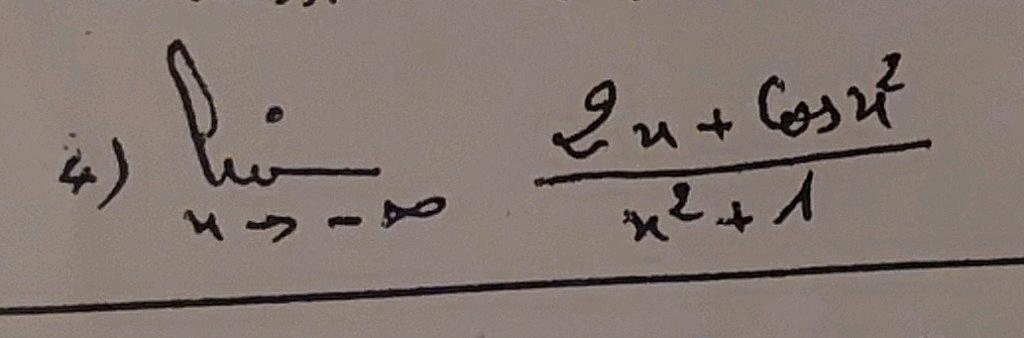
Evaluation of the Limit as x \to -\infty for \frac{2x + \cos(x^2)}{x^2 + 1}
 RULE / FORMULA USED:
- Sum Rule for Limits: \lim_{x \to a} [f(x) + g(x)] = \lim_{x \to a} f(x) + \lim_{x \to a} g(x) (if both limits exist).
- Squeeze Theorem (Sandwich Theorem): If g(x) \le f(x) \le h(x) and \lim_{x \to -\infty} g(x) = \lim_{x \to -\infty} h(x) = L, then \lim_{x \to -\infty} f(x) = L.
- Boundedness of Cosine: For any real argument \theta, -1 \le \cos(\theta) \le 1.
 SOLUTION STEPS:
Step 1 — Split the Expression into Two Rational Terms
Rewrite the original fraction as the sum of two separate terms:
\lim_{x \to -\infty} \frac{2x + \cos(x^2)}{x^2 + 1} = \lim_{x \to -\infty} \left( \frac{2x}{x^2 + 1} + \frac{\cos(x^2)}{x^2 + 1} \right)
Step 2 — Evaluate the First Term
Divide numerator and denominator by the highest power of x, which is x^2:
\lim_{x \to -\infty} \frac{2x}{x^2 + 1} = \lim_{x \to -\infty} \frac{\frac{2}{x}}{1 + \frac{1}{x^2}} = \frac{0}{1 + 0} = 0
Step 3 — Evaluate the Second Term Using the Squeeze Theorem
Since the cosine function is bounded between -1 and 1 for all real numbers:
-1 \le \cos(x^2) \le 1
Since x^2 + 1 > 0 for all real x, divide the entire inequality by x^2 + 1:
-\frac{1}{x^2 + 1} \le \frac{\cos(x^2)}{x^2 + 1} \le \frac{1}{x^2 + 1}
Taking the limit as x \to -\infty:
\lim_{x \to -\infty} \left(-\frac{1}{x^2 + 1}\right) = 0
\lim_{x \to -\infty} \left(\frac{1}{x^2 + 1}\right) = 0
By the Squeeze Theorem:
\lim_{x \to -\infty} \frac{\cos(x^2)}{x^2 + 1} = 0
Step 4 — Combine the Limits
Add the limits of both individual terms:
\lim_{x \to -\infty} \frac{2x + \cos(x^2)}{x^2 + 1} = 0 + 0 = 0
━━━━━━━━━━━━━━━━━━━━━━━━━━━
 ANSWER: 0
━━━━━━━━━━━━━━━━━━━━━━━━━━━
 KEY CONCEPTS:
1. Squeeze Theorem with Trigonometric Functions at Infinity
- Definition: A method to determine the limit of an oscillating bounded function divided by an expression tending to infinity.
- In this problem: \cos(x^2) oscillates indefinitely between -1 and 1, but dividing by x^2 + 1 \to \infty forces the value to 0.
 COMMON MISTAKES:
 Applying L’Hôpital’s Rule Directly
- Wrong: Differentiating \cos(x^2) to get -2x\sin(x^2) and trying to evaluate the limit.
- Right: Use bounding and the Squeeze Theorem instead.
- Why it’s wrong: Differentiating \cos(x^2) yields -2x\sin(x^2), which continues to oscillate and does not simplify the limit. L’Hôpital’s Rule fails when derivatives oscillate without approaching a limit.
Would you like me to solve another limit involving trigonometric terms and the Squeeze Theorem to practice this method?