\lim_{x \to 2} \frac{\sqrt{x+7} - \sqrt{3x-2} - 1}{x-2}
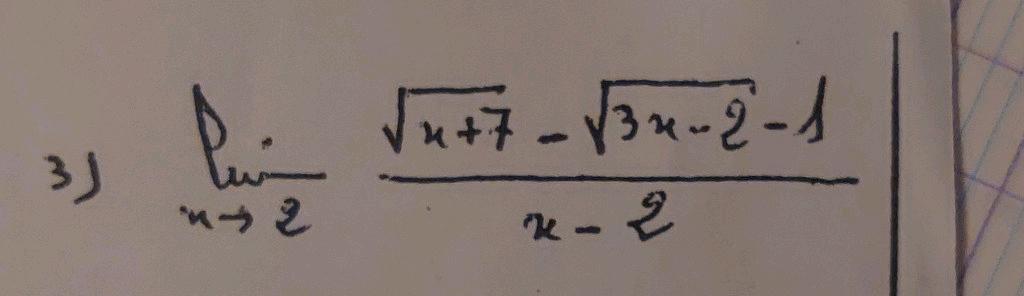
Evaluating the Limit of \frac{\sqrt{x+7} - \sqrt{3x-2} - 1}{x-2} as x \to 2
 RULE / FORMULA USED:
- Indeterminate Form \left[\frac{0}{0}\right] Resolution via Conjugates:\frac{\sqrt{A} - B}{x-a} = \frac{(\sqrt{A} - B)(\sqrt{A} + B)}{(x-a)(\sqrt{A} + B)} = \frac{A - B^2}{(x-a)(\sqrt{A} + B)}
- Alternative (L’Hôpital’s Rule): If \lim_{x \to a} \frac{f(x)}{g(x)} = \frac{0}{0}, then \lim_{x \to a} \frac{f(x)}{g(x)} = \lim_{x \to a} \frac{f'(x)}{g'(x)}
 SOLUTION STEPS:
Step 1 — Direct Substitution to Identify the Indeterminate Form
Substitute x = 2 into the expression:
\text{Numerator: } \sqrt{2+7} - \sqrt{3(2)-2} - 1 = \sqrt{9} - \sqrt{4} - 1 = 3 - 2 - 1 = 0
\text{Denominator: } 2 - 2 = 0
Since this results in the indeterminate form \left[\frac{0}{0}\right], algebraic simplification is required.
Step 2 — Splitting the Expression into Two Standard Limit Forms
Rewrite the numerator by grouping terms with constants 3 and -2 (since \sqrt{9}=3 and \sqrt{4}=2):
\sqrt{x+7} - \sqrt{3x-2} - 1 = (\sqrt{x+7} - 3) - (\sqrt{3x-2} - 2)
Now, split the overall fraction into two separate fractions:
\lim_{x \to 2} \left[ \frac{\sqrt{x+7} - 3}{x - 2} - \frac{\sqrt{3x-2} - 2}{x - 2} \right]
Step 3 — Evaluating the First Part Using Conjugate Multiplication
Multiply the numerator and denominator by (\sqrt{x+7} + 3):
\lim_{x \to 2} \frac{(\sqrt{x+7} - 3)(\sqrt{x+7} + 3)}{(x - 2)(\sqrt{x+7} + 3)} = \lim_{x \to 2} \frac{(x + 7) - 9}{(x - 2)(\sqrt{x+7} + 3)}
\lim_{x \to 2} \frac{x - 2}{(x - 2)(\sqrt{x+7} + 3)} = \lim_{x \to 2} \frac{1}{\sqrt{x+7} + 3}
Substituting x = 2:
\frac{1}{\sqrt{2+7} + 3} = \frac{1}{3 + 3} = \frac{1}{6}
Step 4 — Evaluating the Second Part Using Conjugate Multiplication
Multiply the numerator and denominator by (\sqrt{3x-2} + 2):
\lim_{x \to 2} \frac{(\sqrt{3x-2} - 2)(\sqrt{3x-2} + 2)}{(x - 2)(\sqrt{3x-2} + 2)} = \lim_{x \to 2} \frac{(3x - 2) - 4}{(x - 2)(\sqrt{3x-2} + 2)}
\lim_{x \to 2} \frac{3x - 6}{(x - 2)(\sqrt{3x-2} + 2)} = \lim_{x \to 2} \frac{3(x - 2)}{(x - 2)(\sqrt{3x-2} + 2)} = \lim_{x \to 2} \frac{3}{\sqrt{3x-2} + 2}
Substituting x = 2:
\frac{3}{\sqrt{3(2)-2} + 2} = \frac{3}{2 + 2} = \frac{3}{4}
Step 5 — Combining the Evaluated Limits
Subtract the second limit from the first limit:
\lim_{x \to 2} \frac{\sqrt{x+7} - \sqrt{3x-2} - 1}{x-2} = \frac{1}{6} - \frac{3}{4}
Find a common denominator (12):
\frac{2}{12} - \frac{9}{12} = -\frac{7}{12}
━━━━━━━━━━━━━━━━━━━━━━━━━━━
 ANSWER: -\frac{7}{12}
━━━━━━━━━━━━━━━━━━━━━━━━━━━
 KEY CONCEPTS:
1. Conjugate Expansion for Radicals
- Definition: Multiplying by the conjugate (\sqrt{A} + B) utilizes the difference of squares identity (a-b)(a+b) = a^2 - b^2 to eliminate radical expressions in limits.
- In this problem: It helped eliminate the factor (x - 2) that was creating the \frac{0}{0} zero-division.
2. Linearity of Limits
- Definition: If limits exist individually, \lim [f(x) - g(x)] = \lim f(x) - \lim g(x).
- In this problem: Decomposing the three-term numerator into two manageable terms made evaluating conjugates straightforward.
 COMMON MISTAKES:
 Distributing the Negative Sign Incorrectly
- Wrong: Writing - (\sqrt{3x-2} - 2) as -\sqrt{3x-2} - 2, which alters the constant balance (-3 - 2 = -5 \neq -1).
- Right: Keeping track of parentheses: -3 - (-2) = -3 + 2 = -1.
- Why it’s wrong: Sign errors in the constant terms change the value of the function, invalidating the factorization.
Multiplying Entire Tri-nomial Numerator by a Single Conjugate
- Wrong: Trying to treat (\sqrt{x+7} - \sqrt{3x-2} - 1) as a single binomial and multiplying by (\sqrt{x+7} + \sqrt{3x-2} + 1).
- Right: Splitting the expression into two pairs of binomials before applying conjugates.
- Why it’s wrong: A three-term conjugate expansion introduces mixed cross-terms like 2\sqrt{x+7}\sqrt{3x-2}, which complicates rather than simplifies the calculation.
Would you like me to demonstrate how to solve this same problem directly using L’Hôpital’s Rule to double-check the derivative method?
Explain this answer to me clearly, step by step
Step-by-Step Explanation of \lim_{x \to 2} \frac{\sqrt{x+7} - \sqrt{3x-2} - 1}{x-2}
RULE / FORMULA USED:
- Conjugate Identity (Difference of Squares):(a - b)(a + b) = a^2 - b^2
- Limit Splitting Property:\lim_{x \to c} [f(x) - g(x)] = \lim_{x \to c} f(x) - \lim_{x \to c} g(x)
SOLUTION STEPS:
Step 1 — Understand Why Direct Substitution Fails
When you plug x = 2 directly into the expression:
- Numerator: \sqrt{2+7} - \sqrt{3(2)-2} - 1 = \sqrt{9} - \sqrt{4} - 1 = 3 - 2 - 1 = 0
- Denominator: 2 - 2 = 0
This yields the indeterminate form \left[\frac{0}{0}\right]. The term causing the problem is (x - 2) in the denominator. The goal is to eliminate (x - 2) by canceling it out.
Step 2 — Cleverly Group the Terms in the Numerator
Notice the individual values when x = 2:
- \sqrt{x+7} becomes 3
- \sqrt{3x-2} becomes 2
The constant -1 can be rewritten as -3 + 2. This allows grouping the numerator into two separate pairs:
\sqrt{x+7} - \sqrt{3x-2} - 1 = (\sqrt{x+7} - 3) - (\sqrt{3x-2} - 2)
Now rewrite the entire limit as two simpler limits:
\lim_{x \to 2} \frac{\sqrt{x+7} - 3}{x - 2} - \lim_{x \to 2} \frac{\sqrt{3x-2} - 2}{x - 2}
Step 3 — Solve the First Limit Using the Conjugate
Multiply the numerator and denominator by the conjugate (\sqrt{x+7} + 3):
\frac{(\sqrt{x+7} - 3)(\sqrt{x+7} + 3)}{(x - 2)(\sqrt{x+7} + 3)} = \frac{(\sqrt{x+7})^2 - (3)^2}{(x - 2)(\sqrt{x+7} + 3)}
\frac{(x + 7) - 9}{(x - 2)(\sqrt{x+7} + 3)} = \frac{x - 2}{(x - 2)(\sqrt{x+7} + 3)}
Cancel the common factor (x - 2):
\frac{1}{\sqrt{x+7} + 3}
Substitute x = 2:
\frac{1}{\sqrt{2+7} + 3} = \frac{1}{3 + 3} = \frac{1}{6}
Step 4 — Solve the Second Limit Using the Conjugate
Multiply the numerator and denominator by the conjugate (\sqrt{3x-2} + 2):
\frac{(\sqrt{3x-2} - 2)(\sqrt{3x-2} + 2)}{(x - 2)(\sqrt{3x-2} + 2)} = \frac{(\sqrt{3x-2})^2 - (2)^2}{(x - 2)(\sqrt{3x-2} + 2)}
\frac{(3x - 2) - 4}{(x - 2)(\sqrt{3x-2} + 2)} = \frac{3x - 6}{(x - 2)(\sqrt{3x-2} + 2)}
Factor out 3 from the numerator:
\frac{3(x - 2)}{(x - 2)(\sqrt{3x-2} + 2)}
Cancel the common factor (x - 2):
\frac{3}{\sqrt{3x-2} + 2}
Substitute x = 2:
\frac{3}{\sqrt{3(2)-2} + 2} = \frac{3}{2 + 2} = \frac{3}{4}
Step 5 — Subtract the Two Limit Values
Combine the two results:
\text{Limit} = \frac{1}{6} - \frac{3}{4}
Find a common denominator (12):
\frac{1 \times 2}{6 \times 2} - \frac{3 \times 3}{4 \times 3} = \frac{2}{12} - \frac{9}{12} = -\frac{7}{12}
━━━━━━━━━━━━━━━━━━━━━━━━━━━
ANSWER: -\frac{7}{12}
━━━━━━━━━━━━━━━━━━━━━━━━━━━
KEY CONCEPTS:
1. Splitting the Constant
- Definition: Decomposing a constant term into parts that pair naturally with separate square roots.
- In this problem: Breaking -1 into -3 + 2 allowed pairing \sqrt{x+7} with -3 and -\sqrt{3x-2} with +2.
2. Radical Rationalization
- Definition: Using (A - B)(A + B) = A^2 - B^2 to remove radicals from a fraction.
- In this problem: Rationalization exposed the hidden (x - 2) factor in the numerator, eliminating the division by zero.
COMMON MISTAKES:
Forgetting to Distribute the Minus Sign
- Wrong: Splitting as (\sqrt{x+7} - 3) - (\sqrt{3x-2} + 2).
- Right: Splitting as (\sqrt{x+7} - 3) - (\sqrt{3x-2} - 2).
- Why it’s wrong: -(-2) = +2, which balances -3 + 2 = -1. Using +2 inside the parentheses would result in -3 - 2 = -5.
Would you like to see how to solve this in just two lines using L’Hôpital’s Rule (derivatives) as a quick verification method?