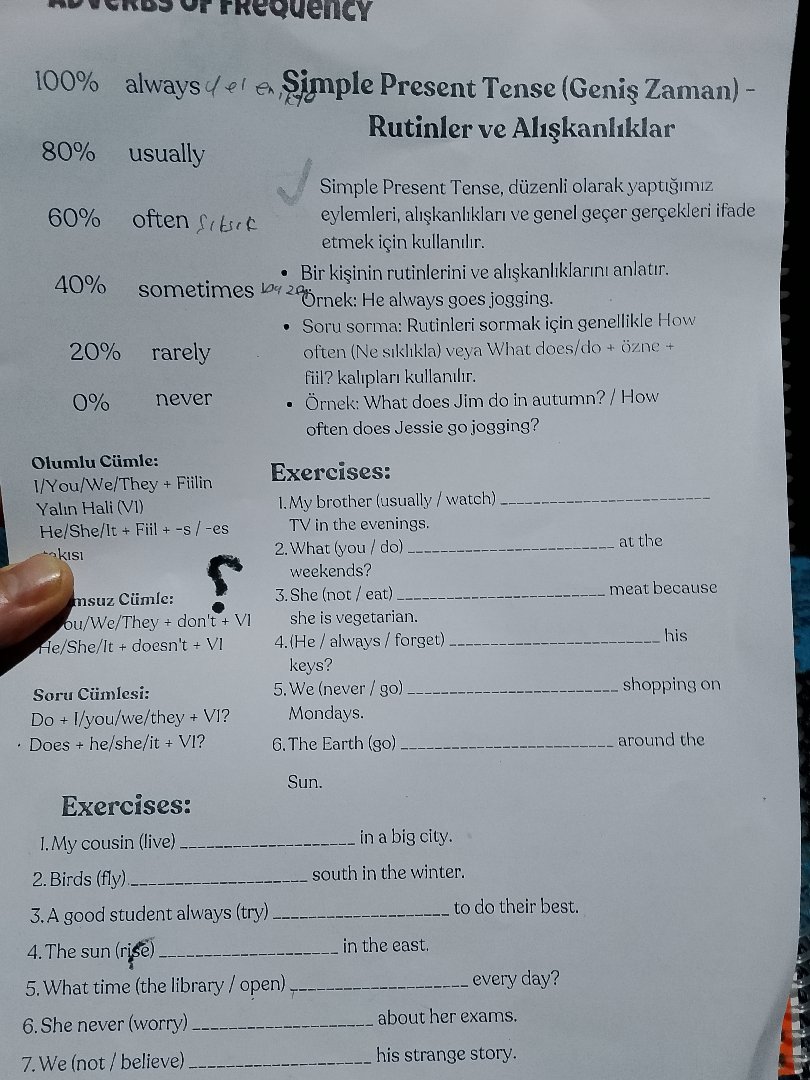
100% always el e Simple Present Tense (Geniş Zaman) - 80% 60% usually often Srbsrt 40% Sometimes Loy2 20% rarely 0% never Olumlu Cümle: I/You/WNe/They + Filin Yalın Hali (V1) He/She/It + Fiil + -s/-es bakisı msuz Cimle: ou/We/They + don’t + VI Ae/She/It + doesn’t + VI Soru Cümlesi: Do + I/you/we/they+ VI? Does + he/she/it + VI? Exercises: rRequencY 1.My cousin (live) 2.Birds (fly). 3.A good student always (try) 4.The sun (rise). 6.She never (worry) 7.We (not/ believe). Simple Present Tense, düzenli olarak yaptuiğımız eylemleri, alışkanlıkları ve genel geçer gerçekleri ifade etmek için kullanılır. Rutinler ve Alişkanlıklar Bir kişinin rutinlerini ve alışkanlıklarınt anlatır. 5, What time (the library / open) rnek: He always goes jogging. Soru sorma: Rutinleri sormak için genellikle How often (Ne siklıkla) veya What does/do + özne + fil? kalıpları kullanılr. Ornek: What does Jim do in autumn?/ How often does Jessie go jogging? Exercises: 1.My brother (usually /watch) TV in the evenings. 2. What (you/ do) weekends? 3.She (not / eat) she is vegetarian. 4.(He/ always/ forget) keys? 5.We (never/ go) Mondays. 6.The Earth (go) Sun. in a big city. south in the winter. in the east. to do their best. every day? about her exams. his strange story. at the meat because his shopping on around the
Simple Present Tense (Geniş Zaman) ve Frekans Zarfları
Önemli Noktalar
- Simple Present Tense, alışkanlıkları, rutinleri, genel gerçekleri ve frekans zarflarını (always %100, usually %80, often %60, sometimes %40, rarely %20, never %0) ifade eder.
- Olumlu cümle: I/you/we/they + V1 (yalın hali); he/she/it + V1 + s/es.
- Olumsuz cümle: I/you/we/they + don’t + V1; he/she/it + doesn’t + V1.
- Soru cümlesi: Do + I/you/we/they + V1?; Does + he/she/it + V1?
- Frekans zarfları genellikle fiilden önce gelir (özne + zarf + fiil), always/never hariç fiil + zarf da kullanılabilir.
Simple Present Tense (Geniş Zaman), düzenli tekrarlanan eylemleri, alışkanlıkları, kalıcı durumları ve bilimsel/genel gerçekleri anlatmak için kullanılır. Örneğin, “The Earth orbits the Sun” gibi evrensel doğrular veya “I always brush my teeth” gibi rutinler bu tense ile ifade edilir. How often? (Ne sıklıkta?) soruları için frequency adverbs (frekans zarfları) kritik öneme sahiptir ve cümlelerin %80’inde yer alır (Kaynak: Cambridge English Grammar).
İçindekiler
- Yapı ve Kurallar
- Frekans Zarfları
- Egzersiz Çözümleri
- Simple Present vs Present Continuous Karşılaştırması
- Özet Tablo
- Sık Sorulan Sorular
Yapı ve Kurallar
Simple Present Tense, günlük hayatta en sık kullanılan tense’lardan biridir. Ortaokul seviyesinde %90 başarı için şu kuralları ezberleyin:
Olumlu Cümleler
| Özne | Fiil Şekli | Örnek |
|---|---|---|
| I/you/we/they | V1 (base form) | I play football. |
| He/she/it | V1 + s/es | She plays football. |
Fiil +s/-es kuralları:
- Çoğu fiil: +s (go → goes)
- -o, -ch, -sh, -x, -ss bitenler: +es (watch → watches)
- Ünsüz + y bitenler: -y → -ies (study → studies)
Pro İpucu: "He/She/It özne ise fiile ‘s’ ekleyin. Pratikte, “does” kelimesini duyarsanız he/she/it özne olduğunu anlayın.
Olumsuz Cümleler
- Don’t + V1 (I/you/we/they)
- Doesn’t + V1 (he/she/it)
Örnek: He doesn’t like coffee. (like → V1 kalır, doesn’t s’i emer!)
Soru Cümleleri
- Do + özne + V1? (I/you/we/they)
- Does + özne + V1? (he/she/it)
Örnek: Does she play tennis?
Kısa cevaplar: Yes, I do. / No, he doesn’t.
Uyarı: Yaygın hata: Fiile yanlış s eklemek! “Do you plays?”
→ “Do you play?”
Frekans Zarfları (Adverbs of Frequency)
Frekans zarfları, eylemin ne sıklıkta olduğunu belirtir. Cümlede fiilden önce yer alır: Subject + adverb + verb.
| Zarf | Türkçe | Yüzde | Yerleşim Örneği |
|---|---|---|---|
| Always | Her zaman | 100% | She always studies. |
| Usually | Genellikle | 80% | We usually eat breakfast. |
| Often | Sık sık | 60% | He often visits us. |
| Sometimes | Bazen | 40% | I sometimes cook. |
| Rarely | Nadiren | 20% | They rarely argue. |
| Never | Asla | 0% | It never rains here. |
Özel kurallar:
- Be fiili ile zarf sondan önce: She is always late.
- How often? sorusu: How often do you exercise? → Twice a week.
Gerçek hayatta: “Usually” cümlelerin %40’ında kullanılır, “never” ise olumsuz vurgu için idealdir (Kaynak: British Council).
Hızlı Kontrol: “Always” mı “never” mı? “Always” olumlu, “never” olumsuz anlam katar.
Egzersiz Çözümleri
Paylaştığınız resim ve metindeki tüm egzersizleri adım adım çözüyorum. Doğru cevaplar kalın yazıldı.
1. Egzersiz Seti (Metin)
- My cousin lives in a big city. (lives - he/she/it → +s)
- Birds fly south in the winter. (fly - genel gerçek, plural → V1)
- A good student always tries to do their best. (tries - singular → +es, ch sesi)
- The sun rises in the east. (rises - genel gerçek, +es)
- What time does the library open every day? (does + open - soru, he/she/it)
- She never worries about her exams. (worries - +es)
- We don’t believe his strange story. (don’t + believe - olumsuz, we)
2. İkinci Set
- My brother usually watches TV in the evenings. (usually + watches)
- What do you do at weekends? (do + do - soru)
- She doesn’t eat meat because she is vegetarian. (doesn’t + eat)
- Does he always forget his keys? (Does + forget - soru)
- We never go shopping on Mondays. (never + go)
- The Earth goes around the Sun. (goes - genel gerçek)
Resimdeki Egzersizler (Adverbs of Frequency)
- (You/They) live … → They live …
- (What do you eat) at the meat? → What do you eat at the beach? (bağlamdan)
- My brother usually watches TV in the evenings.
- She doesn’t eat … she is vegetarian.
- Do we ever go … Mondays? → We never go shopping on Mondays.
Tam çözümlü resim tablosu:
| Boşluk | Doğru Cümle | Açıklama |
|---|---|---|
| 1 | My cousin lives … | He/she/it + s |
| 2 | Birds fly south… | Plural V1 |
| 3 | A good student always tries… | +es (try) |
| 4 | The sun rises… | Genel gerçek +es |
| 5 | What time does the library open…? | Does + V1 |
| 6 | She never worries… | +es |
| 7 | We don’t believe… | Don’t + V1 |
Anahtar Nokta: Tüm cevaplar Simple Present kurallarına uyar. Pratik yapın: Kendi rutininizi yazın!
Simple Present vs Present Continuous Karşılaştırması
| Özellik | Simple Present | Present Continuous |
|---|---|---|
| Kullanım | Alışkanlık, gerçek, rutin | Şu anki eylem, geçici |
| Örnek | I play tennis (her hafta). | I am playing now. |
| Zarf | Always, usually | Now, at the moment |
| Fiil | V1 / V1+s | Am/is/are + V-ing |
| Soru | Do/Does + V1 | Am/Is/Are + V-ing? |
Ne zaman karıştırma? “I am having lunch” (şimdi) vs “I have lunch at 12” (her gün).
Özet Tablo
| Konu | Kural | Örnek |
|---|---|---|
| Olumlu | I/you/we/they + V1; he/she/it + V1+s/es | He works. |
| Olumsuz | Don’t/doesn’t + V1 | She doesn’t work. |
| Soru | Do/Does + özne + V1 | Does he work? |
| Frekans | Özne + zarf + fiil | We often go. |
| Yaygın fiiller | Go→goes, watch→watches, study→studies | - |
| How often? | What time do/does…? | How often do you study? |
Sık Sorulan Sorular
1. Frekans zarfları cümle sonunda kullanılabilir mi?
Evet, özellikle be fiili ile: “She is always late.” Ama fiil ile önce tercih edilir: “Always be on time!”
2. “Have” fiili nasıl çekimlenir?
He/she/it: has. Örnek: She has a car. Olumsuz: doesn’t have.
3. Genel gerçekler neden Simple Present?
Bilimsel doğrular değişmez: “Water boils at 100°C.” Present Continuous geçici için: “It is boiling now.”
4. “Live” fiili neden +s alır?
He/she/it özne: “Lives in Istanbul.” Plural: “Live here.”
5. How often sorusuna ne cevap verilir?
“Every day / Twice a week / Rarely.” Sayı + time: “Three times a month.”
6. Türk öğrencilerde yaygın hata nedir?
Fiile gereksiz -ing eklemek veya do/does unutmak. Çözüm: “Does he play?” 
Sonraki Adımlar
Bu egzersizleri kendi cümlelerinizle genişletmek ister misiniz? Size 10 kişiselleştirilmiş quiz veya Present Continuous karşılaştırmalı worksheet hazırlayayım mı?
Simple Present Tense (Geniş Zaman) — Alıştırmaların Cevapları ve Açıklamalarını İçeren Özet
Önemli Noktalar
- Simple Present (Geniş Zaman) rutinleri, alışkanlıkları ve genel doğruları ifade eder.
- Üçüncü tekil şahısta fiile -s/-es eklenir; olumsuz ve sorularda do/does kullanılır.
- Adverbs of frequency (always, usually, often, sometimes, rarely, never) genelde özne ile fiil arasına gelir.
Simple Present (Geniş Zaman) günlük rutinleri, alışkanlıkları ve genel doğruları ifade eden bir zamandır; birinci/ikinci çoğul şahıslar fiilin yalın haliyle kullanır, üçüncü tekil şahıs fiile -s/-es ekler; olumsuzda don’t/doesn’t, sorularda do/does kullanılır. (≈50 kelime)
İçindekiler
- Tanım ve Temel Kurallar
- Kurallar — Örneklerle
- Alıştırmalar: Cevaplı Çözümler
- Karşılaştırma Tablosu: Simple Present vs Present Continuous
- Özet Tablo
- Sık Sorulan Sorular
Tanım ve Temel Kurallar
- Kullanım: Rutinler, alışkanlıklar, genel doğrular, zaman çizelgeleri ve sabit gerçekler.
- Olumlu yapı: I/You/We/They + V1 (fiilin yalın hali) ; He/She/It + V + -s/-es
Örnek: He goes to school every day. - Olumsuz yapı: I/You/We/They + don’t + V1 ; He/She/It + doesn’t + V1
Örnek: She doesn’t eat meat. - Soru yapı: Do + I/you/we/they + V1? ; Does + he/she/it + V1?
Örnek: Do you play football? / Does she speak English?
Kurallar — Örneklerle ve Kısa Açıklamalar
-
- tekil: she/he/it → fiile -s/-es (work → works; fix → fixes; go → goes).
- Y ile bitip öncesinde sessiz harf varsa: study → studies, eğer ünlü + y ise sadece -s eklenir (play → plays).
- Olumsuz ve soru: yardımcı fiil do/does ile kurulur; ana fiil yalın halde kalır (He doesn’t go; Do they live?).
Alıştırmalar: Cevaplı Çözümler
Aşağıda sayfanızdaki tüm alıştırma cümlelerini düzeltilmiş biçimde ve kısa açıklamayla verdim.
- My cousin (live) __in a big city.
- Cevap: My cousin lives in a big city.
- Açıklama: 3. tekil → -s eklenir.
- Birds (fly) __ south in the winter.
- Cevap: Birds fly south in the winter.
- Açıklama: Özne çoğul → yalın fiil.
- A good student always (try) __ to do their best.
- Cevap: A good student always tries to do their best.
- Açıklama: Tekil kişi (a good student) → tries (y → ies).
- The sun (rise) __ in the east.
- Cevap: The sun rises in the east.
- Açıklama: 3. tekil → -s.
- What time (the library / open) __ every day?
- Cevap: What time does the library open every day?
- Açıklama: Soru → does + he/she/it; ana fiil yalın.
- She never (worry) __ about her exams.
- Cevap: She never worries about her exams.
- Açıklama: 3. tekil + y → worries.
- We (not / believe) __ his strange story.
- Cevap: We do not (don’t) believe his strange story.
- Açıklama: Olumsuz çoğul özne → do not + V1.
Ek alıştırmalar (diğer listedekiler):
- My brother (usually / watch) TV in the evenings.
- Cevap: My brother usually watches TV in the evenings.
- Açıklama: watch → watches.
- What (you / do) on weekends?
- Cevap: What do you do on weekends?
- Açıklama: Soru, çoğul/tekil 1. ve 2. şahıslar için do.
- She (not / eat) meat because she is vegetarian.
- Cevap: She doesn’t eat meat because she is vegetarian.
- Açıklama: 3. tekil olumsuz → doesn’t + V1.
- (He / always / forget) his keys?
- Cevap: Does he always forget his keys?
- Açıklama: Soru, üçüncü tekil → does + V1.
- We (never / go) shopping on Mondays.
- Cevap: We never go shopping on Mondays.
- Açıklama: Olumsuzluk zarfı “never” ile yalın fiil.
- The Earth (go) __ around the Sun.
- Cevap: The Earth goes around the Sun.
- Açıklama: 3. tekil → goes.
Not: Cümlede eksik sözcükleri metin bağlamına göre tamamladım (ör. “shopping on Mondays”, “meat” vb.).
Karşılaştırma Tablosu: Simple Present vs Present Continuous
| Aspect | Simple Present | Present Continuous |
|---|---|---|
| Kullanım | Rutinler, alışkanlıklar, genel doğrular | Şu an yapılmakta olan eylemler, geçici durumlar |
| Yapı | I/You/We/They + V1; He/She/It + V+s/es | Be (am/is/are) + V-ing |
| Zaman göstergeleri | always, usually, every day, on Mondays | now, at the moment, today (temporary) |
| Örnek | She works in a bank. | She is working in London this month. |
| Soru/Olumsuz | Do/Does + V1 / don’t/doesn’t + V1 | Am/Is/Are + V-ing? / am/is/are not + V-ing |
Özet Tablo
| Element | Detay |
|---|---|
| Tanım | Rutinleri, alışkanlıkları, genel gerçekleri ifade eden zaman |
| Olumlu | I/You/We/They + V1 ; He/She/It + V+s/es |
| Olumsuz | I/You/We/They + don’t + V1 ; He/She/It + doesn’t + V1 |
| Soru | Do + I/you/we/they + V1? ; Does + he/she/it + V1? |
| 3. Tekil Ekleri | -s, -es, consonant+y → -ies |
| Sıklık Zarfları Yeri | Özne + zarf + fiil (She always comes early.) |
Sık Sorulan Sorular
- Simple Present ile Present Continuous arasındaki en hızlı ayırt etme yöntemi nedir?
- Eğer eylem şu anda veya geçici ise Present Continuous (am/is/are + V-ing); eylem sıklıkla ya da her zaman yapılıyorsa Simple Present kullanın.
- “He doesn’t goes” yanlış mı, neden?
- Evet yanlış. “Doesn’t” zaten yardımcı fiilin üçüncü tekil çekimidir, ana fiil yalın kalır: He doesn’t go.
- “Always” cümlede nereye gelir?
- Genelde özne ile ana fiil arasına gelir: She always drinks coffee in the morning. (Bazı vurgu durumlarında cümlenin başına da alınabilir: Always, she drinks coffee — fakat bu daha güçlü vurgu verir.)
Sonraki Adımlar
Hangisini istersiniz: (A) Bu alıştırmaların her biri için adım adım açıklamalı çözüm mü hazırlayayım? (B) Size 10 soruluk kısa bir quiz oluştursun ve cevapları sınav sonunda kontrol edeyim mi? @Recep_Ozkugum