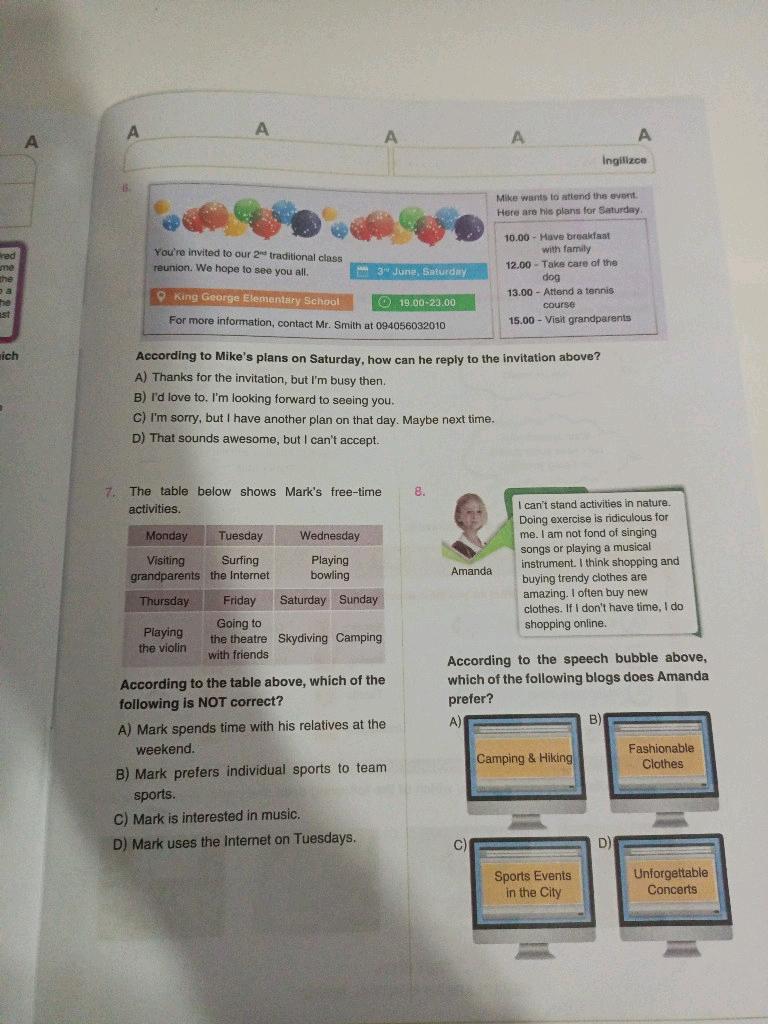
- Mike wants to attend the event. Here are his plans for Saturday.
10.00 - Have breakfast with family
12.00 - Take care of the dog
13.00 - Attend a tennis course
15.00 - Visit grandparents
According to Mike’s plans on Saturday, how can he reply to the invitation above?
A) Thanks for the invitation, but I’m busy then.
B) I’d love to. I’m looking forward to seeing you.
C) I’m sorry, but I have another plan on that day. Maybe next time.
D) That sounds awesome, but I can’t accept. - The table below shows Mark’s free-time activities.
Monday: Visiting grandparents
Tuesday: Surfing the Internet
Wednesday: Playing bowling
Thursday: Playing the violin
Friday: Going to the theatre with friends
Saturday: Skydiving
Sunday: Camping
According to the table above, which of the following is NOT correct?
A) Mark spends time with his relatives at the weekend.
B) Mark prefers individual sports to team sports.
C) Mark is interested in music.
D) Mark uses the Internet on Tuesdays. - Amanda: I can’t stand activities in nature. Doing exercise is ridiculous for me. I am not fond of singing songs or playing a musical instrument. I think shopping and buying trendy clothes are amazing. I often buy new clothes. If I don’t have time, I do shopping online.
A) Camping & Hiking
B) Fashionable Clothes
C) Sports Events in the City
D) Unforgettable Concerts
Reading Comprehension & Information Analysis: Making Invitations, Daily Routines, and Preferences
 KEY FORMULA / RULE: In English reading comprehension tasks, identify key details such as time slots, weekend vs. weekday activities, and stated likes/dislikes (e.g., can’t stand, be fond of, prefer).
 SOLUTION & OPTION ANALYSIS
Question 6: Class Reunion Invitation & Mike’s Schedule
- Event Details: Saturday, June 3rd, from 19.00 to 23.00.
- Mike’s Schedule: Mike’s planned activities end with visiting his grandparents at 15.00. He has no conflicting plans between 19.00 and 23.00, and the prompt states that he wants to attend.
- A) Incorrect: States he is busy, but he is completely free in the evening.
- B) Correct: An accepting response (“I’d love to. I’m looking forward to seeing you.”) matches his desire to attend and his free evening.
- C) Incorrect: Declines by claiming he has another plan, which contradicts his schedule.
- D) Incorrect: Refuses the invitation (“I can’t accept”).
 FINAL ANSWER (Question 6): B) I’d love to. I’m looking forward to seeing you.
Question 7: Mark’s Weekly Activity Schedule
- A) Incorrect statement (Correct answer): Mark visits his grandparents (his relatives) on Monday, which is a weekday, not at the weekend (Saturday: skydiving, Sunday: camping).
- B) True: He engages in individual activities like skydiving and camping.
- C) True: He plays the violin on Thursday, demonstrating an interest in music.
- D) True: The chart explicitly lists “Surfing the Internet” under Tuesday.
FINAL ANSWER (Question 7): A) Mark spends time with his relatives at the weekend.
Question 8: Amanda’s Personal Interests & Blog Choice
- Amanda’s Statements:
- Dislikes nature: “I can’t stand activities in nature.” \rightarrow Rules out A (Camping & Hiking).
- Dislikes exercise: “Doing exercise is ridiculous for me.” \rightarrow Rules out C (Sports Events in the City).
- Dislikes music: “I am not fond of singing songs…” \rightarrow Rules out D (Unforgettable Concerts).
- Stated interest: “I think shopping and buying trendy clothes are amazing.” \rightarrow Directly points to fashion.
- B) Correct: Fashionable Clothes aligns directly with her passion for buying trendy outfits.
FINAL ANSWER (Question 8): B) Fashionable Clothes
 EXAM INSIGHT / PITFALL: Always double-check time intervals (morning/afternoon vs. evening) and distinguish clearly between weekdays (Monday–Friday) and weekends (Saturday–Sunday) in table-based questions.