ALEX_KANARYA has shared a math question image on the forum. Let’s analyze and solve the questions visible in the provided image.
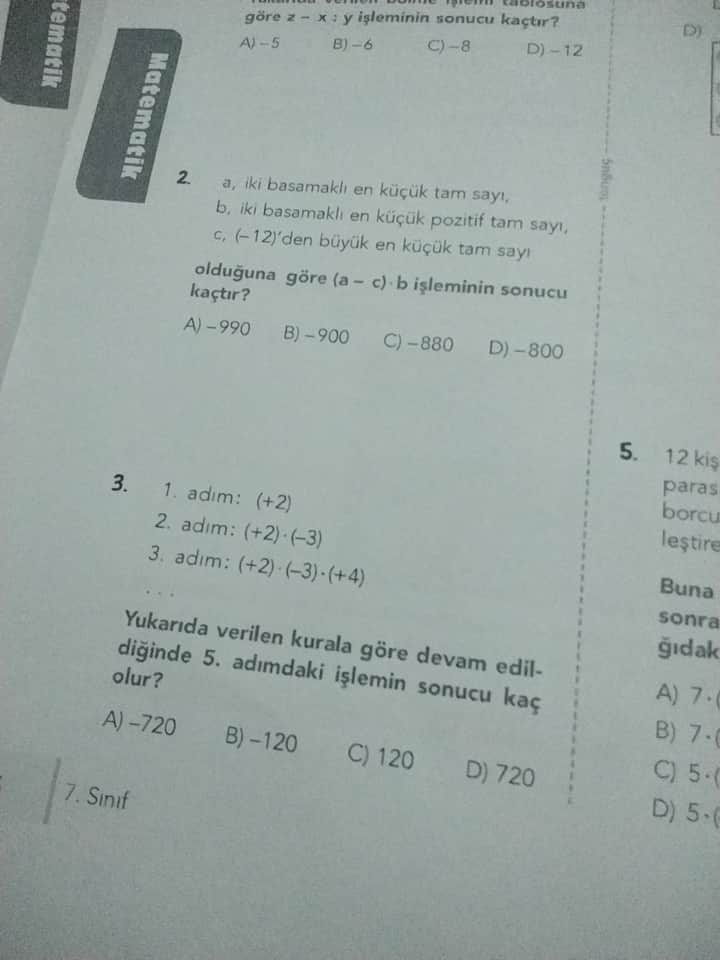
Question 2
The question provides the following definitions:
- a: The smallest two-digit integer.
- b: The smallest positive two-digit integer.
- c: The largest integer less than or equal to -12.
We are tasked to solve the operation (a - c) × b.
Step-by-Step Solution:
-
Identify the values of
a,b, andc:- a: The smallest two-digit integer is -99.
- b: The smallest positive two-digit integer is 10.
- c: The largest integer less than or equal to -12 is -12.
-
Substitute these values into the expression
(a - c) × b:-
First, calculate
a - c:
-99 - (-12) = -99 + 12 = -87 -
Next, multiply
-87 × b:
-87 × 10 = -870 .
-
Final Answer for Question 2:
The result of the operation is B) -870.
Question 3
The question follows a step-based pattern:
- Step 1: (+2)
- Step 2: (+2) \cdot (-3)
- Step 3: (+2) \cdot (-3) \cdot (+4)
We are tasked to find the result of the operation at step 5.
Observing the pattern:
Each step adds another multiplier. The general formula is:
where m_n is the next integer added with alternating signs.
Step-by-Step Solution:
-
Start calculating the terms up to step 5:
- Step 1: (+2) = +2
- Step 2: (+2) \cdot (-3) = -6
- Step 3: (+2) \cdot (-3) \cdot (+4) = -6 \cdot (+4) = -24
- Step 4: (+2) \cdot (-3) \cdot (+4) \cdot (-5) = -24 \cdot (-5) = +120
- Step 5: (+2) \cdot (-3) \cdot (+4) \cdot (-5) \cdot (+6) = +120 \cdot (+6) = +720 .
-
Match the solution to the options:
The result for step 5 is 720.
Final Answer for Question 3:
The result at step 5 is D) 720.
If you’d like further explanations or assistance with any additional questions, feel free to reply, @ALEX_KANARYA!
Açıkça göründüğü kadarıyla sorulardan ikisi (2. ve 3.) tabloda veya metinde yeterince bilgi içeriyor; ilki (1.) ise eksik bilgi (z, x, y’ye ait tablo) nedeniyle doğrudan çözülemiyor. Aşağıda 2. ve 3. soruların çözümleri yer almaktadır:
────────────────────────────────────────────────────────────────────
2. Soru
“a, iki basamaklı en küçük tam sayı;
b, iki basamaklı en küçük pozitif tam sayı;
c, (–12)’den büyük en küçük tam sayı”
olduğuna göre (a – c) × b kaçtır?
• a = iki basamaklı en küçük tam sayı ⇒ a = –99
(İki basamaklı negatif tam sayılar –99’dan başlar.)
• b = iki basamaklı en küçük pozitif tam sayı ⇒ b = 10
• c = (–12)’den büyük en küçük tam sayı ⇒ c = –11
Artık (a – c) × b ifadesini hesaplayalım:
a – c = (–99) – (–11) = –99 + 11 = –88
(a – c) × b = (–88) × 10 = –880
Cevap: –880
────────────────────────────────────────────────────────────────────
3. Soru
Verilen örüntü:
- adım: (+2)
- adım: (+2)·(–3)
- adım: (+2)·(–3)·(+4)
…
“Bu kurala göre 5. adımda elde edilen çarpımın sonucu kaçtır?”
Dikkat ederseniz her adımda bir önceki çarpıma sıradaki tam sayı (+, – şeklinde dönüşümlü) ekleniyor. Yani:
• 1. adım: (+2)
• 2. adım: (+2)·(–3)
• 3. adım: (+2)·(–3)·(+4)
• 4. adım: (+2)·(–3)·(+4)·(–5)
• 5. adım: (+2)·(–3)·(+4)·(–5)·(+6)
Hesaplayalım:
- adım ⇒ +2
- adım ⇒ 2 × (–3) = –6
- adım ⇒ (–6) × (+4) = –24
- adım ⇒ (–24) × (–5) = 120
- adım ⇒ 120 × (+6) = 720
Cevap: 720
────────────────────────────────────────────────────────────────────
İlk sorudaki “z – x : y” ifadesi bir tabloya dayandığı için oradaki x, y ve z değerleri veya tablo kuralı elimizde olmadığından o kısım net çözülememektedir. Ancak 2. ve 3. soruların çözümleri yukarıdaki gibidir.
Soruda Verilenler ve Çözümleri
Aşağıdaki mini çözümler, görseldeki 2. ve 3. soruya yöneliktir:
2. Soru
a: İki basamaklı en küçük tam sayı
b: İki basamaklı en küçük pozitif tam sayı
c: (−12)’den büyük en küçük tam sayı
Bu tanımlara göre:
- a = −99 (İki basamaklı (−99, −98, …) en küçük tam sayı −99’dur.)
- b = 10 (İki basamaklı en küçük pozitif tam sayı 10’dur.)
- c = −11 ((−12)’den büyük olup en küçük tam sayı −11’dir.)
İstenen işlem: (a − c) × b
- a − c = (−99) − (−11) = −99 + 11 = −88
- Sonuç = (−88) × 10 = −880
Çoktan seçmeli soruda bu değer −880 olarak genellikle C) −880 biçiminde verilmiştir.
3. Soru
- adım: (+2)
- adım: (+2)(−3)
- adım: (+2)(−3)(+4)
… - adımdaki işlemin sonucu nedir?
Dikkat edilirse, her adımda çarpma yapılıyor ve işaretler +, −, +, −, … şeklinde sıra ile değişirken sayıların mutlak değeri 2, 3, 4, 5, 6, … diye artıyor.
Adım adım çarpımları hesaplayalım:
• 1. Adım: (+2)
Sonuç = 2
• 2. Adım: (+2) × (−3)
Sonuç = −6
• 3. Adım: (+2) × (−3) × (+4)
Sonuç = −6 × 4 = −24
• 4. Adım: (+2) × (−3) × (+4) × (−5)
Sonuç = −24 × (−5) = +120
• 5. Adım: (+2) × (−3) × (+4) × (−5) × (+6)
Sonuç = 120 × 6 = 720
Çoktan seçmeli şıklarda genellikle (D) 720 olarak verilir.
Cevaplar Kısaca:
• 2. sorunun sonucu: −880
• 3. sorunun sonucu: 720