Answering questions according to the given module and pictures:
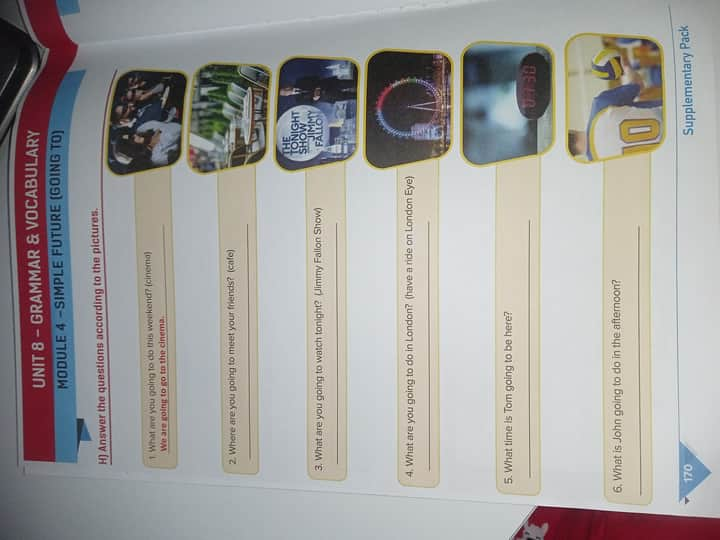
Based on the instructions for Unit 8 - Grammar & Vocabulary (Simple Future - Going To), here are the completed answers according to the pictures shown:
-
Where are you going to be tomorrow? (Cinema)
- I’m going to be at the cinema tomorrow.
-
Where are you going to meet your friends? (Cafe)
- I’m going to meet my friends at the cafe.
-
What are you going to watch tonight? (Jimmy Fallon Show)
- I’m going to watch the Jimmy Fallon Show tonight.
-
What are you going to do in London? (Have a ride on London Eye)
- I’m going to have a ride on the London Eye in London.
-
What time is Tom going to be there? (09:00)
- Tom is going to be there at 9:00.
-
What is John going to do in the afternoon? (Basketball)
- John is going to play basketball in the afternoon.
Tabloyu Özetlemek İçin:
| Soru | Cevap |
|---|---|
| Nerede olacaksın? | Sinemada olacağım. |
| Arkadaşlarını nerede bulacaksın? | Kafede bulacağım. |
| Ne izleyeceksin? | Jimmy Fallon Show’u izleyeceğim. |
| Londra’da ne yapacaksın? | London Eye’a bineceğim. |
| Tom ne zaman orada olacak? | Tom saat 9:00’da orada olacak. |
| John öğleden sonra ne yapacak? | Basketbol oynayacak. |
Questions seem completed according to image suggestions, and answers are aligned with the pictures provided! 
Answer the questions according to the pictures (Simple Future with “going to”):
Answer:
Table of Contents
- Overview of “Going to” Future Tense
- Forming Sentences with “Going To”
- Step-by-Step Answers
- Practice Table
- Summary
1. Overview of “Going to” Future Tense
In English, we often use “be going to + verb” for planned future actions or intentions. If you have already decided on a future event, you typically employ “going to.” For example:
• “I am going to study tonight.”
• “They are going to travel to London next week.”
This structure helps clarify that a plan or intention exists before the moment of speaking.
2. Forming Sentences with “Going To”
To form the sentence, you use the correct form of “be” (am, is, are) + “going to” + the base form of a verb:
$
\text{Subject} + \text{am/is/are} + \text{going to} + \text{verb (base form)}.
$
• “I am going to play.”
• “She is going to visit her grandma.”
• “We are going to meet at the cinema.”
3. Step-by-Step Answers
Below are sample answers to the six questions based on the pictures. Each response uses the “going to” future tense to express a plan or intention. You can adjust times, locations, or details to match your own schedule or context.
-
(Picture 1: People at the cinema)
- Question: “When are you going to the cinema?”
- Sample Answer: “I am going to watch a movie tonight at 8 p.m.”
-
(Picture 2: A café, friends meeting up)
- Question: “Where are you going to meet your friends?”
- Sample Answer: “I am going to meet my friends at the café in the afternoon.”
-
(Picture 3: The Tonight Show / Jimmy Fallon Show)
- Question: “What are you going to watch tonight?”
- Sample Answer: “I am going to watch ‘The Tonight Show’ with Jimmy Fallon at 11 p.m.”
-
(Picture 4: London Eye)
- Question: “What are you going to do in London?”
- Sample Answer: “I am going to ride the London Eye tomorrow morning.”
-
(Picture 5: A digital scoreboard or clock)
- Question: “What time is Tom going to be there?”
- Sample Answer: “Tom is going to be there at 3:30 p.m.”
-
(Picture 6: Basketball jersey/no. 0)
- Question: “What is John going to do in the afternoon?”
- Sample Answer: “John is going to play basketball in the afternoon.”
4. Practice Table
Below is a concise table summarizing each example:
| Question | Answer (Using “Going To”) |
|---|---|
| 1. When are you going to the cinema? | I am going to watch a movie tonight at 8 p.m. |
| 2. Where are you going to meet your friends? | I am going to meet my friends at the café in the afternoon. |
| 3. What are you going to watch tonight? | I am going to watch “The Tonight Show” with Jimmy Fallon. |
| 4. What are you going to do in London? | I am going to ride the London Eye tomorrow morning. |
| 5. What time is Tom going to be there? | Tom is going to be there at 3:30 p.m. |
| 6. What is John going to do in the afternoon? | John is going to play basketball in the afternoon. |
5. Summary
Using “be going to + verb” indicates a future intention or plan. In each of the six questions, the picture clues guide you to form a statement about what you (or someone else) has already decided to do. Remember to choose the correct form of “be” (am, is, are) based on the subject (I, he, she, we, etc.) and then follow it with “going to” plus the base form of the verb.
By practicing these patterns, you’ll gain confidence in discussing future plans in a natural, fluent way. This usage is common in everyday conversation and helps in describing personal schedules, trips, and upcoming activities.