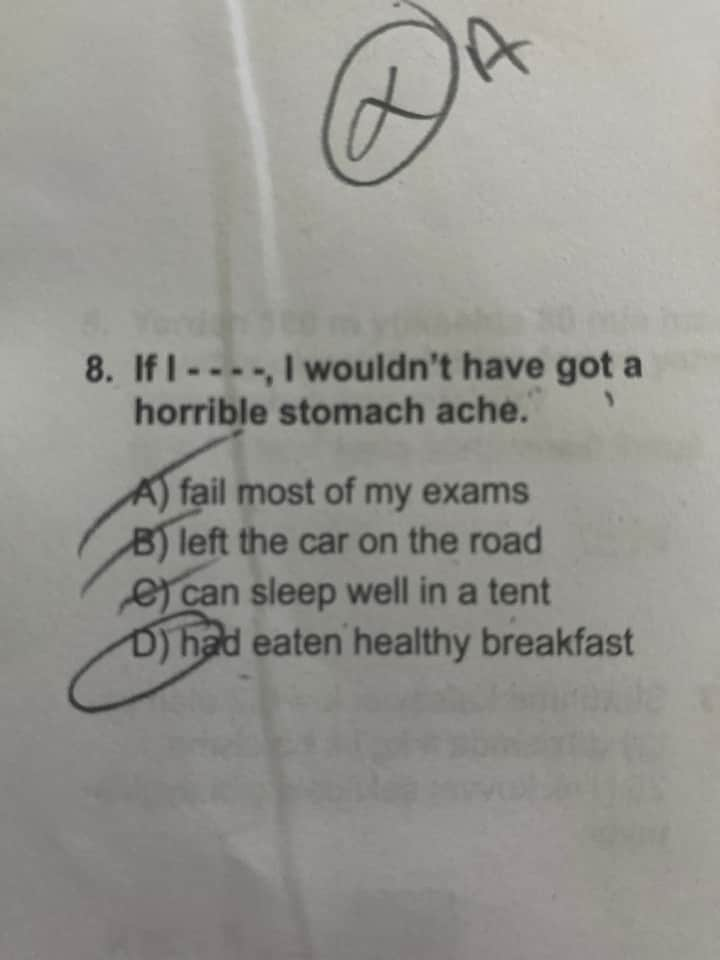
If I ----, I wouldn’t have got a horrible stomach ache.
Answer:
The sentence is a third conditional sentence because it talks about a past hypothetical situation and its result (which did not actually happen). The structure of the third conditional is:
- If + past perfect, … would have + past participle
The sentence given is:
- “If I ----, I wouldn’t have got a horrible stomach ache.”
The key is to find the correct option that fits the past perfect tense in the if-clause and matches logically with the second part.
Analyze the options:
- A) fail most of my exams
- This is simple present or past tense, but does not follow past perfect form needed for third conditional.
- B) left the car on the road
- “left” is past tense, but it would be correct as “had left” for past perfect.
- C) can sleep well in a tent
- Present tense, not matching conditional type here.
- D) had eaten healthy breakfast
- This is past perfect tense and grammatically correct for third conditional.
Logical meaning:
- “If I had eaten healthy breakfast, I wouldn’t have got a horrible stomach ache.”
Makes perfect sense logically and grammatically: in the past, you didn’t eat healthy breakfast, and as a result, you got stomach ache.
Conclusion:
The correct answer is D) had eaten healthy breakfast.
Summary Table
| Option | Verb Tense/Grammar | Logical Meaning | Correct for Sentence? |
|---|---|---|---|
| A | Simple present or past | Failing exams doesn’t relate to stomach ache here | No |
| B | Past tense (not perfect) | Needs “had left” for conditionals | No |
| C | Present tense | Doesn’t fit third conditional | No |
| D | Past perfect (had eaten) | Fits third conditional structure & logical meaning | Yes |
Final summary: For a third conditional sentence expressing regret about a past event, the correct structure is “If I had eaten healthy breakfast, I wouldn’t have got a horrible stomach ache.” So, option D is the right choice.